

Exhibition at Philadelphia’s Mütter Museum May Leave One Thinking Twice During the Next Pharmacy Visit

‘Marketing Medicine’ is a jewelbox array of period literature, vintage advertising, arrant chicanery, and brown bottles filled with mysterious liquids.
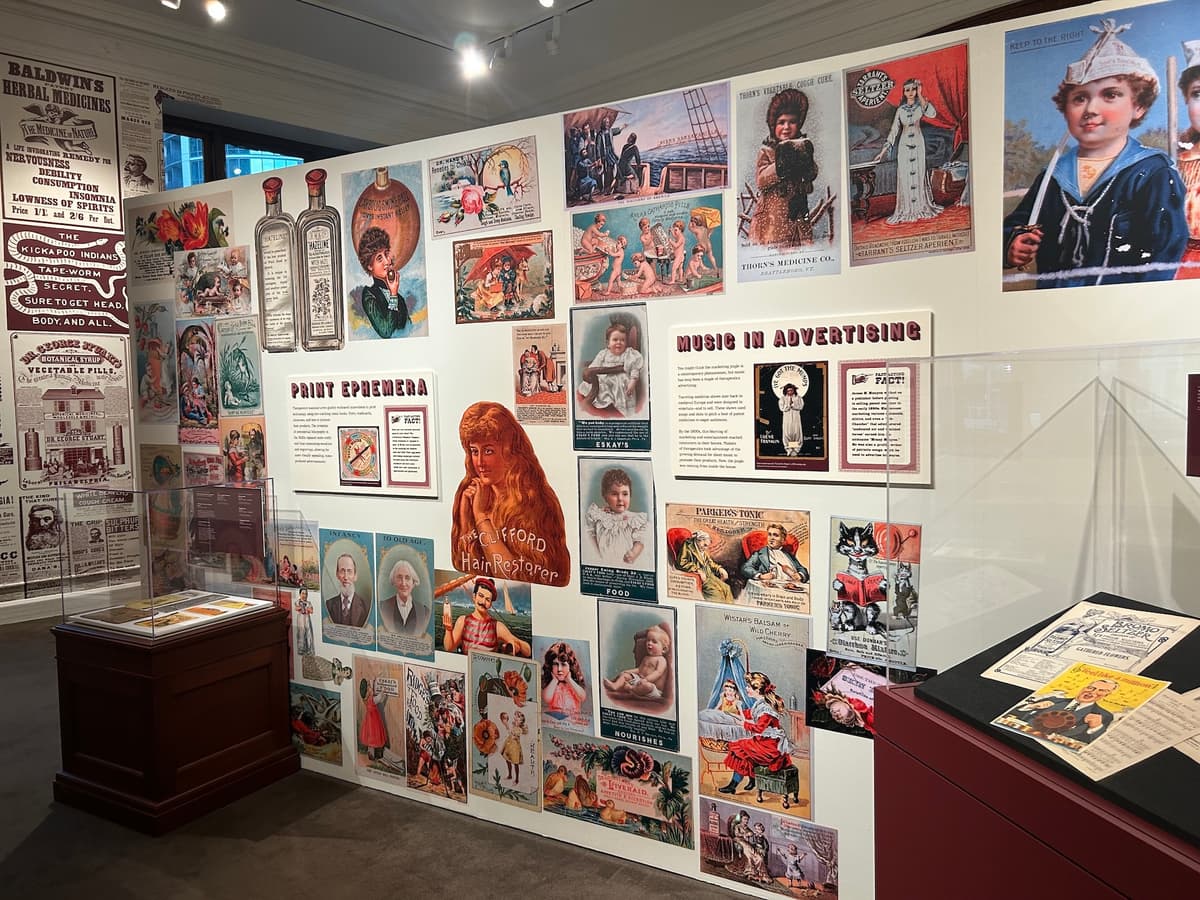
Via Mütter Museum of the College of Physicians of Philadelphia
Installation view of 'Marketing Medicine.' Via Mütter Museum of the College of Physicians of Philadelphia

W.C. Fields and Gwyneth Paltrow have, I would guess, rarely shared the same imaginative space before the mounting of an exhibition at the Mütter Museum of the College of Physicians of Philadelphia, “Marketing Medicine.” Admittedly, Fields isn’t featured in the show, but an American archetype he codified is: the purveyor of patent medicine. That is to say, snake oil salesmen. 

A wall text explains “patent medicine” as a nostrum that meets a standard presumably established by the monarchy in 17th-century Britain. American medical manufacturers in the 1800s, working without imperial or governmental oversight, sought to give their elixirs legitimacy by adapting the notion of “a patent of royal favor.” The Mütter describes these purveyors as “quacks.” A contemporaneous illustration of such a personage is reproduced nearby and could have served as a promotional illustration for Edward Sutherland’s Fields vehicle, “Poppy” (1936).

Fast-forward to 2008, when Ms. Paltrow launched a newsletter, magazine, and business whose editorial, philosophical, and commercial ambition was to “Nourish the Inner Aspect,” Goop. Over the course of almost two decades, the company has proffered a rapturous blend of New Age spirituality for a clientele who doesn’t think twice about putting down good money for a personal body massager that looks as if it were designed by the Dadaist sculptor Jean Arp. 

Qualms about the “wellness goods” marketed by Goop have been either settled out of court or, as the Harvard Journal of Law & Gender tells it, fobbed off as yet another example of male perfidy. But Ms. Paltrow isn’t the only celebrity featured in “Marketing Medicine”: Displayed alongside the Fall 2024 Goop catalogue there is a January 2022 edition of Dr. Oz/The Good Life, a magazine centered on the television personality Mehmet Oz. 

Are we to take the Mütter’s word that Professor Eustace P. McGargle, Viola de Lesseps, and the current administrator for the Centers of Medicare and Medicaid Services are birds of a feather? “Marketing Medicine” is nowhere near as declarative as all that, being a sidebar to the institution’s permanent and, in recent times, controversial display of medical anomalies. Yet this jewelbox array of period literature, vintage advertising, arrant chicanery, and brown bottles filled with mysterious liquids is diverting enough to give one pause when next entering the local pharmacy.

Via Mütter Museum of the College of Physicians of Philadelphia

Take Mrs. Winslow’s Soothing Syrup. A period advertisement features an auburn-haired mother reclining amongst the plumpest of pillows with two cherubic children in tow. A clear beaker of liquid is within reach on a nightstand. The woman holds a news supplement featuring a full-page ad extolling the medication’s ability to ease the pain of children who are teething. Invented in 1845 by Charlotte Winslow of Bangor, Maine, the concoction did well on the marketplace. 

So well that the English composer Edward Elgar subtitled an adagio “Mrs. Winslow’s Soothing Syrup,” and Woody Guthrie sang of how a dying Grandpa Joad was fed “short ribs and coffee and soothing syrup” in “Tom Joad, Part 2.” Not only could this product quell a child’s pain, but it was touted as a curative for constipation and halitosis. The American Medical Association didn’t take kindly to Mrs. Winslow’s ministrations, citing her mixture of sodium carbonate, ammonia, and morphine as a “baby killer.” The product was taken off the market in 1931, some 20 years after the AMA’s initial warning.

Not all of these cures have gone the way of Mrs. Winslow: Lydia E. Pinkham is no longer “one of the most recognizable faces in the world,” but she can still be seen on herbal supplements bearing her name. For the most part, “Marketing Medicine” highlights days gone by and why in the here-and-now we still might want to cast a skeptical eye on panaceas that are too good to be true. 

Or would you prefer a steady diet of “snails’ eggs with bilge water sauce, bee stingers rolled in sawdust and other epicurean delicacies”?


The New York Sun

© 2025 The New York Sun Company, LLC. All rights reserved.

Use of this site constitutes acceptance of our Terms of Use and Privacy Policy. The material on this site is protected by copyright law and may not be reproduced, distributed, transmitted, cached or otherwise used.

The New York Sun

Sign in or  create a free account

or
By continuing you agree to our Privacy Policy and Terms of Use