
Fani Willis’s Case Against Trump, Frozen Because of Her Disqualification for Secret Romance, Has a Two-Week Deadline to Oblivion

A Georgia judge wants the fate of the prosecution decided within two weeks.
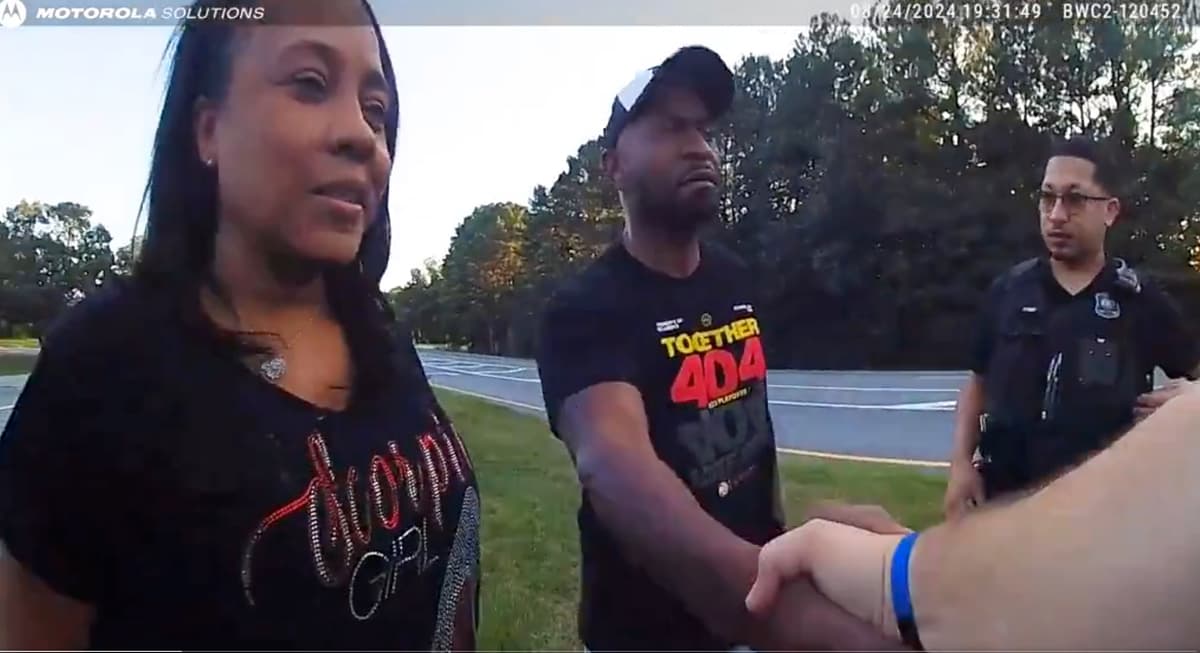
Tyrone Police Department
The Fulton County district attorney, Fani Willis, and her former special prosecutor, Nathan Wade, speak to Tyrone, Georgia police officers after the arrest of her pregnant daughter, Kaniya. Tyrone Police Department

Call it a prosecution in search of a prosecutor — post haste. That is the state of affairs for the state criminal racketeering case brought by the district attorney of Georgia’s Fulton County, Fani Willis, against President Trump and 18 others for alleged election interference.

The presiding judge in the case, Scott McAfee, has ruled that a new prosecutor for the case must be found by October 17 or he will dismiss all charges. Ms. Willis was permanently barred from the case after the Georgia supreme court declined to hear her appeal of her disqualification for her affair with her handpicked special prosecutor, Nathan Wade. 

That disqualification, which came from the Georgia court of appeals, overruled Judge McAfee. He ruled that Ms. Willis could stay on the case if Mr. Wade, who her office paid some $700,000, resigned. Judge McAfee found, though, that the behavior of Mr. Wade and Ms. Willis emitted an “odor of mendacity” and was “legally improper.” Mr. Wade has still never prosecuted a felony.

The Georgia supreme court found this to be the “rare case in which disqualification is mandated and no other remedy will suffice to restore public confidence in the integrity of these proceedings.” The appellate court, though, declined to dismiss the charges secured by Ms. Willis. It reckoned that such a decision would be “extreme.” Georgia law mandates that in a case of prosecutorial disqualification, an independent agency is tasked with replacement.

In Georgia that body is called the Prosecuting Attorneys’ Council. Its executive director, Pete Skandalakis, is the man charged with finding a stand-in for Ms. Willis, who won re-election as district attorney in a rout in November. If a new prosecutor is chosen, he will be empowered to push forward with the case, drop it altogether, or seek a new indictment along different lines.

Mr. Skandalakis, a Republican, is familiar with this scenario. Last year, he declined to bring charges against Georgia’s lieutenant governor, Burt Jones, after Ms. Willis was disqualified from prosecuting him for a conflict of interest. One former prosecutor for the council, Danny Porter — also a Republican — tells the Atlanta Journal-Constitution, “I don’t think any sane person would take” the case built by Ms. Willis.

Mr. Sandalakis took some two years to decide to drop the case against Mr. Jones, who is a Republican candidate for governor in 2026. Ms. Willis had accused Mr. Jones of being a so-called alternate elector for Mr. Trump in the wake of the 2020 election in Georgia, which the 47th president narrowly lost to President Biden. Ms. Willis’s racketeering case, which is now in jeopardy, alleged a criminal conspiracy to reverse the results of that vote.

A lawyer, Harvey Silverglate, for one of the defendants in the case, John Eastman, speculates to the Sun that Ms. Willis could have decided on a complicated racketeering prosecution in order to funnel more work to Mr. Wade. Ms. Willis, though, has declared herself a devotee of racketeering prosecutions, which she used against public school teachers and the record label Young Stoner Life, which she accused of functioning as a gang.

Any prosecution of Mr. Trump while he is in office is likely to encounter significant constitutional hurdles. The Department of Justice has concluded that sitting presidents enjoy “categorical” immunity from  prosecution. While that does not apply to state charges, the logic — that a criminal case would unconstitutionally interfere with the mandate to “take care that the laws be faithfully executed” — would appear to apply equally. 

Mr. Trump is also likely to challenge any prosecution by citing the Supreme Court’s ruling in Trump v. United States that official presidential acts are presumptively immune while unofficial ones lack that protection. It would be incumbent upon whoever prosecutes the case to show that the evidence is entirely built from unofficial acts.             

Mr. Skandalakis will have to move fast if the case is to survive. Judge McAfee writes, “Should an appointed prosecuting attorney … fail to file an entry of appearance or request a particularized extension within 14 days from entry of this Notice, the Court will issue a dismissal without prejudice for want of prosecution.”


The New York Sun

© 2025 The New York Sun Company, LLC. All rights reserved.

Use of this site constitutes acceptance of our Terms of Use and Privacy Policy. The material on this site is protected by copyright law and may not be reproduced, distributed, transmitted, cached or otherwise used.

The New York Sun

Sign in or  create a free account

or
By continuing you agree to our Privacy Policy and Terms of Use