Ugandans Express Fear Over Zohran Mamdani’s Family Privilege, Connections

The self-described ‘man of the people’ deftly evades scrutiny over his parents’ financial and political ties abroad.
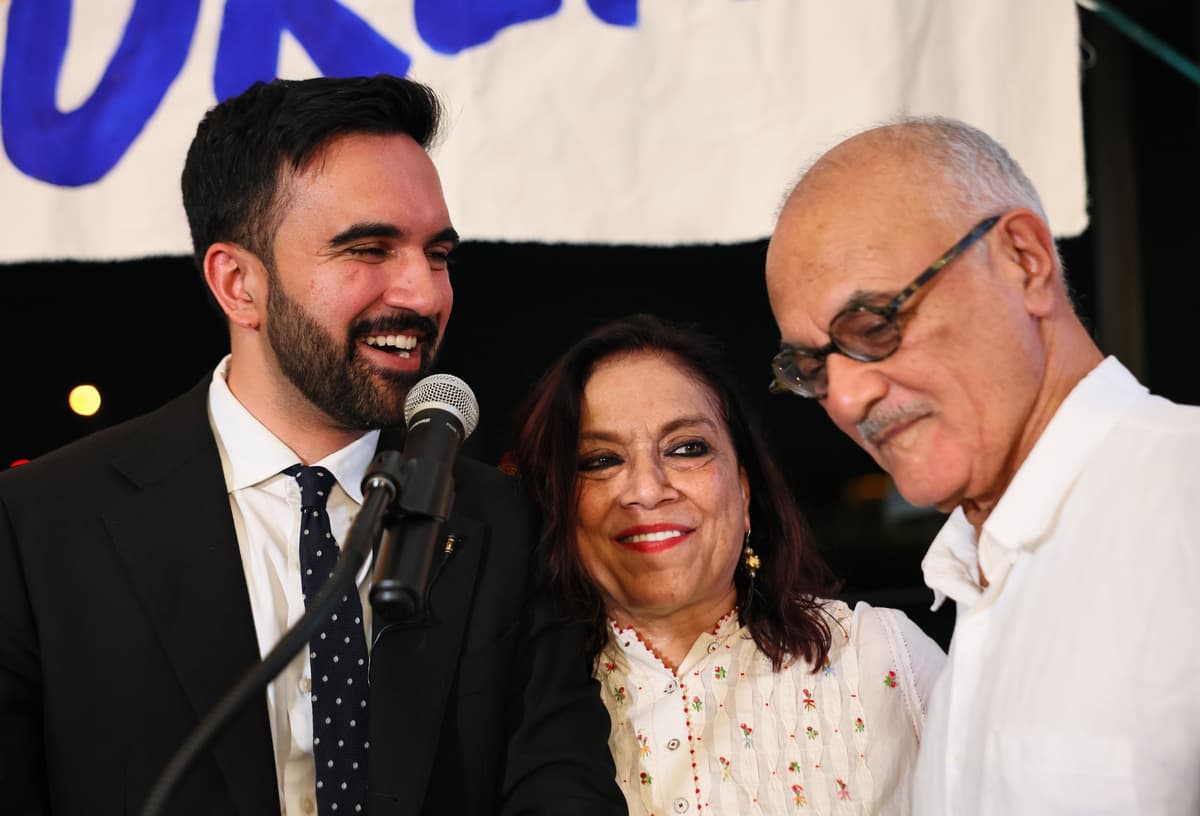

Michael M. Santiago/Getty Images
Zohran Mamdani with his mother Mira Nair, and father Mahmood Mamdani, celebrating at an election night gathering on June 24, 2025 in Queens. Michael M. Santiago/Getty Images

KAMPALA, Uganda — On a hilltop overlooking the sprawl of Uganda’s capital sits the compound of one of the country’s most talked-about families. High gates guard the suburban Buziga residence, where views stretch across Lake Victoria and armed soldiers patrol the grounds during family gatherings. 

Across the Ugandan capital, residents know of the family’s most visible son, the New York assemblyman and progressive politician, Zohran Mamdani, now the favorite to become the Big Apple’s next mayor. The self-described socialist has built his career denouncing landlords and championing working-class solidarity at New York City while deftly evading scrutiny over his family’s financial and political ties abroad. 

At Kampala, however, the Mamdani name, with its ties to the ruling elite of a country ensnared by a president for life, inspires caution. The Mamdani story is cast in whispers, not slogans.

With watchful eyes, few are willing to explain why the family name carries the weight it does. Locals describe a family that appears both privileged and untouchable, wrapped in connections to the country’s entrenched power structures.

“If you see Mamdani, it’s like you’re with (President) Museveni or his son,” one Kampala resident tells the New York Sun, lowering his voice. “That alone makes him a very dangerous person.”

Yoweri Museveni has been the president of Uganda since 1986, and his son, General Muhoozi Kainerugaba, is a senior military officer widely seen as his heir apparent. The Mamdanis are, according to many Ugandans interviewed for this article, almost as mysterious and feared as affluent power players cast against desperation and poverty can be. 

Poverty at the Doorstep of Power

Uganda is one of the poorest countries in the world. More than 40 percent of Ugandans live on less than $2 a day, and over 55 percent experience multidimensional poverty that extends beyond income to encompass education, healthcare, and access to clean water. 

Daily survival for many depends on informal trading, motorbike taxis, or subsistence farming. Families crowd into single-room homes while unemployment is far worse than official statistics suggest.

Against that backdrop, the Mamdani estate looms as a symbol of elite distance, a castle above the squalor. 

The contrast became unavoidable during Zohran Mamdani’s three-day wedding celebration over the summer. Kampala residents described to the Sun a sprawling spectacle: military checkpoints, convoys of luxury cars, cellphone jammers, and acres of rented land transformed into a guarded compound.

Nearby Ugandans echo that it is all a show of power, but not a single person was willing to be quoted on the record for fear of retaliation. 

Mahmood Mamdani: Scholar, Advisor, Unanswered Questions

Part of the mystique around the Mamdani family stems from the long and complicated career of Mahmood Mamdani, Zohran’s father. A globally renowned scholar, Mahmood has been a fixture in Ugandan intellectual and political life for decades. 

He once served as dean of the Faculty of Social Sciences at Makerere University. From 2010 to 2022, he was the executive director of the Makerere Institute of Social Research, where he established doctoral research programs and emphasized the training of local scholars. In 1987, he founded the Centre for Basic Research at Kampala, Uganda’s first independent research organization, which he directed for nearly two decades.

Mahmood Mamdani’s personal history is equally entangled with Uganda’s turbulent politics. Like many of South Asian descent, he was expelled from the country in 1972 under Idi Amin’s regime. 

His citizenship was rescinded again in the 1980s under Milton Obote, leaving him stateless for a time. Internationally, he has served on advisory boards, such as the United Nations Democracy Fund, which has given him stature far beyond Kampala’s borders.

Despite this archival record, no publicly available record shows Mahmood Mamdani holding a government office nor explains whether he enjoys a formal patronage role within Mr. Museveni’s inner circle. 

Nonetheless, Mahmood Mamdani, just a few weeks before next month’s mayoral election and under the illumination of his son’s name, is releasing the book, “Slow Poison: Idi Amin, Yoweri Museveni, and the Making of the Ugandan State,” which is said to take a hard look at how Mr. Museveni’s nearly four decades in power have reshaped Uganda’s political order. His analysis situates Mr. Museveni not just as a long-ruling leader but as a central architect in the ongoing struggle over Uganda’s political future.

Privately, the perception persists that the Mamdanis are deeply connected to Uganda’s ruling power — a perception strong enough to shape conversations and fear-inspiring enough to silence them.

“The Mamdani family keeps a very low profile. It’s difficult to know exactly what they’re involved in or what they own in detail,” one associate tells the Sun, stressing that Mr. Museveni and his son will only be friends “with someone who helps them make more money and protect their political legacy.”

“Many think that the professor has the power to decide someone’s future here in Uganda,” the associate said. “The president can only be friends with those who make money.”

Many others, though unaware of any cordial ties to the presidency, say the culture of fear stems from an aura of power and secrecy that naturally breeds concern.

“The family plays a key role between Museveni and the Indian community, which is a very powerful community here in Uganda,” said another person with knowledge of the family. 

The Untouchable Currency of Connections

At the center of Uganda’s political system is Mr. Museveni, who has ruled for almost four decades, and his son, General Kainerugaba, the country’s top military commander and widely expected successor. Connections — real or perceived — to Mr. Museveni or his son are treated as sacrosanct. Families seen as close to the ruling elite are largely shielded from scrutiny.

“Anyone with connections to the presidency or high-ranking officials should not be touched,” a person familiar with the family compounds tells the Sun.

This is where speculation about the Mamdanis lies. Because of Mahmood Mamdani’s visibility, wealth, and influence, many believe the family enjoys protection from the highest levels of power. 

“The professor can decide about someone’s future here in Uganda,” another man who once lived in the same neighborhood tells the Sun. “You don’t want to dig too much. You may attract the security services.”

Rumors circulate about business dealings, land in the agro-pastoral and mining-rich region of Karamoja, and ties to one of Uganda’s top five conglomerates, the Madhvani Group. Proof is scarce, as is common in Uganda’s opaque system; however, the insinuations accumulate in the silences that follow any mention of the Mamdani name. 

Fear and Silence

This culture of caution has long been a feature of life under Mr. Museveni’s rule, whose security services are notorious for monitoring dissent. The perception from many locals is not that the Mamdani family itself directly intimidates, but that their standing makes them untouchable — and that speaking about them openly invites consequences. 

“Here, everyone knows the rules,” one resident tells the Sun. “There are families you don’t touch. The Mamdanis are one of them.”

On Kampala’s streets, where women haul water, children hawk roasted nuts, and boda-boda drivers sleep on their motorcycles because they cannot afford rent, the contrast to the wealth and guarded privilege of the Mamdanis is impossible to ignore. A three-day wedding guarded by soldiers and drenched in luxury is not simply unusual; it is unimaginable.

The Political Paradox and Hypocrisy

That incongruity becomes sharper in light of Zohran Mamdani’s rise in New York politics. He has built his platform on railing against privilege, corporate greed, and political dynasties even while his own family represents the embodiment of Ugandan privilege.

Zohran Mamdani’s speeches call for solidarity with the working class, yet his family’s guarded presence in Uganda remains unacknowledged in his remarks. He denounces entrenched power abroad but sidesteps questions about entrenched power at home.

In politics, perception often matters as much as reality. At Kampala, the perception is that the Mamdanis are not just academics or cultural figures. They are, whether by fact or rumor, linked to a network of authority shielded from accountability. 

In New York, that silence poses a question: can a politician who emerges from a family whose very name instills fear credibly promise to dismantle entrenched power?

Zohran Mamdani may promise to dismantle systems of power in New York, but at Kampala and its surrounding towns and villages, his family’s name is a system of its own, built on a currency of quiet. The fear is the story, and it seems no one wants to tell it.

“Be very careful with this investigation,” one professional cautions the Sun. “This is the sort of digging that can get you arrested or even killed.”


The New York Sun

© 2025 The New York Sun Company, LLC. All rights reserved.

Use of this site constitutes acceptance of our Terms of Use and Privacy Policy. The material on this site is protected by copyright law and may not be reproduced, distributed, transmitted, cached or otherwise used.

The New York Sun

Sign in or  create a free account

or
By continuing you agree to our Privacy Policy and Terms of Use