Federal Judge Rules ‘Alligator Alcatraz’ Must Shut Down To Protect Alligators and Endangered Species
The judge says the government failed to conduct an environmental review before hastily building the detention facility.
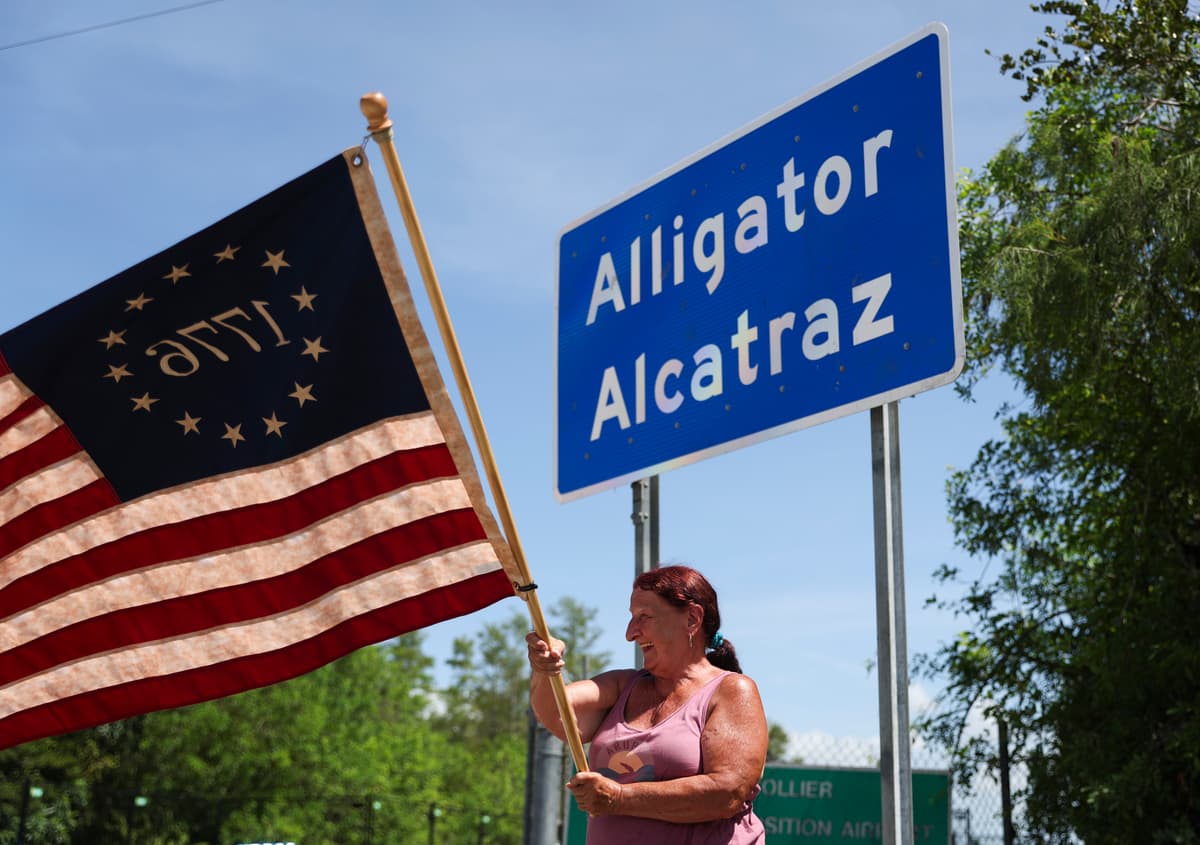

A federal judge says the Florida immigrant detention center known as “Alligator Alcatraz” must shut down, not over concerns about due process or complaints about the conditions the detainees are held in, but to protect the area’s alligators and other wildlife.
“Alligator Alcatraz” opened at an air strip deep in the Everglades on the edge of the Big Cypress National Preserve in July. The facility quickly faced complaints about the conditions the migrants were subjected to and questions about whether they were receiving due process protections.
On Thursday evening, a federal district court judge, Kathleen Williams, ruled that the Trump administration cannot continue to send migrants to the facility.
The Obama appointee also ordered the state to remove all generators, lighting, fencing, and sewage from the location within 60 days, effectively shutting it down. The transfer of migrants out of the facility, she added, should be done in a “safe, humane, and responsible manner.”
The state promptly filed a notice to appeal the decision with the U.S. Court of Appeals for the Eleventh Circuit.
“The deportations will continue until morale improves,” the communications director for the Florida governor, Alex Lanfranconi, said in a prepared statement.
Judge Williams’s preliminary injunction comes in response to a lawsuit filed by the Miccosukee Tribe and environmental groups that argued that the state government did not conduct a proper environmental review and that the facility risked causing “irreparable” harm to the Everglades.
The jurist said the National Environmental Policy Act required the government to conduct an environmental impact statement, but it “chose not to do so.”
“The Defendants’ decision to refrain from issuing an EIS or conducting an EA, and then building a detention camp, represents a determinative position on the matter and has adversely affected Plaintiffs’ recreational, conservational, and aesthetic interests,” she said.
The Trump administration argued that the NEPA did not apply in this case because “Alligator Alcatraz” is run by the state. However, Judge Williams said, “Defendants essentially tell the Court that the project is purely state action because its employees (presumably) wear uniforms bearing state agency logos, and because the federal government seems to have held back on sending its reimbursement until some unidentified impediment (perhaps, this litigation) has abated.”
She said the facility was “requested by the federal government; built with a promise of full federal funding; constructed in compliance with ICE standards; staffed by deputized ICE Task Force Officers acting under color of federal authority and at the direction and supervision of ICE officials; and exists for the sole purpose of detaining and deporting those subject to federal immigration enforcement.”
“In concluding the camp is a major federal action, the Court will ‘adhere to the test-tested adage: if it walks like a duck, quacks like a duck, and looks like a duck, then it’s a duck,’” Judge Williams said.
The executive director of the Friends of Everglades, Eve Samples, said the decision is a “landmark victory for the Everglades” and sends “a clear message that environmental laws must be protected.”
The Florida and Caribbean director for the Center for Biological Diversity, Elise Bennett, called the ruling a “relief” and said the facility was “burning a hole in the fabric of life that supports our most iconic wetland … and a whole host of endangered species, from the majestic Florida panthers to wizened wood storks.”
Judge Williams said that the facility, with its lights at night, could interrupt the ecosystem and adversely affect local wildlife, which includes the bonneted bat as well as the Florida panther.
The Trump administration has already begun moving detainees out of “Alligator Alcatraz” since Judge Williams issued a restraining order earlier this month, putting a stop to further construction. There were 1,400 detainees at the facility at the end of July but fewer than 400 remained at the time of Judge Williams’s latest ruling, the Miami Herald reported.
The state argues that the environmental case was filed in the wrong venue. A spokesman for Governor Ron DeSantis, Jeremy Redfern, posted on X after the ruling, “Just this week, a judge in the same district as Judge Williams refused to hear a case because the Southern District of Florida was the improper venue for suits about Alligator Alcatraz.”
Earlier this month, a judge in the same district, Rodolfo Ruiz, said that a case centered on legal rights for detainees should be heard in a different district. However, Judge Williams said the environmental issues were “entirely distinct” from that case and were heard in the proper venue.