Federal Judge Rules Trump Violated the Law by Deploying the National Guard and Marines to Los Angeles
He finds the move threatens to create a ‘national police force.’
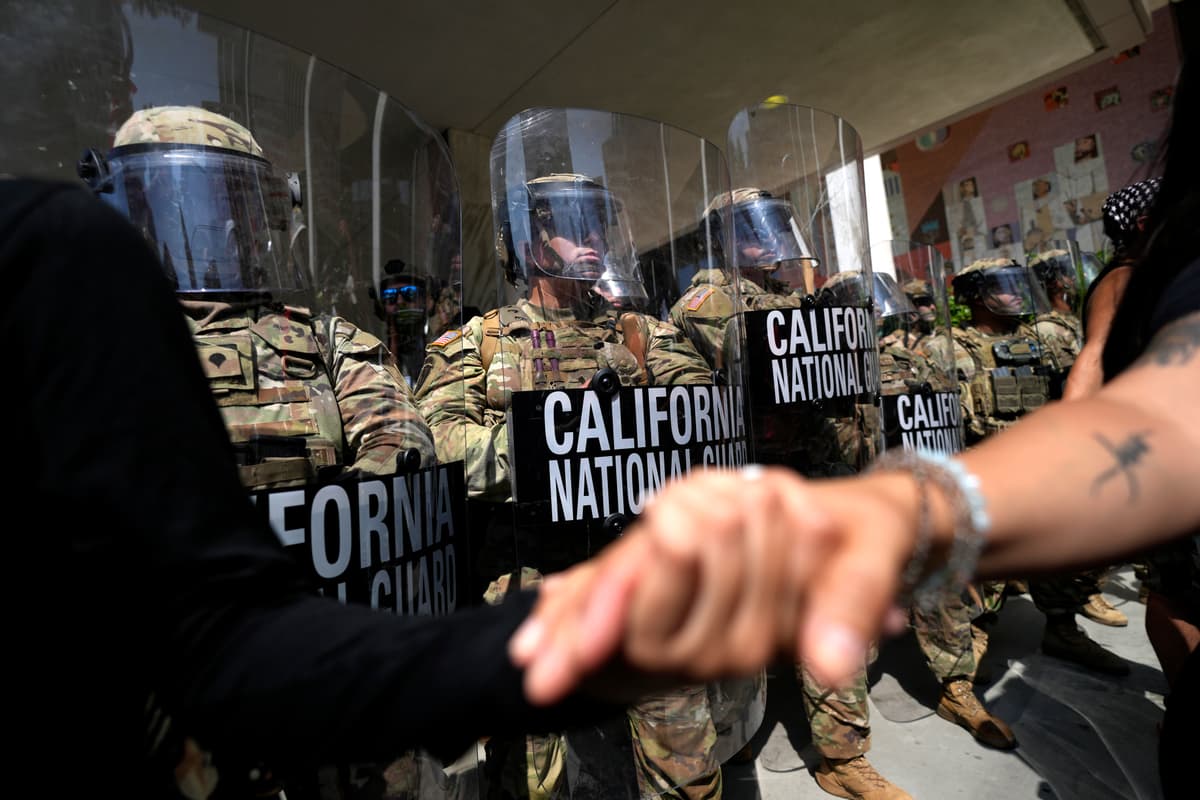
A federal judge says the Trump administration violated the law when it federalized the National Guard and deployed Marines at Los Angeles in response to anti-ICE protests in June.
In a ruling Tuesday, a federal judge, Charles Breyer, wrote, “Congress spoke clearly in 1878 when it passed the Posse Comitatus Act, prohibiting the use of the U.S. military to execute domestic law.”
Judge Breyer said that there were “indeed protests” at Los Angeles and “some individuals engaged in violence,” but he said there was “no rebellion, nor was civilian law enforcement unable to respond to protests and enforce the law.”
“Nevertheless, at Defendants’ orders and contrary to Congress’s explicit instruction, federal troops executed the laws,” the jurist wrote as he said evidence presented in court showed that “armed soldiers” helped set up traffic barriers and engaged in crowd control. “In short, Defendants violated the Posse Comitatus Act.”
The decision comes as President Trump has also deployed the National Guard at Washington, D.C., in an attempt to crack down on crime and has signaled he wants to do so in other blue cities.
In June, President Trump deployed 4,000 National Guard members and 700 Marines to Los Angeles to help protect federal property and personnel amid protests that broke out as immigration officials carried out deportation operations. Critics of the move said it violated the Posse Comitatus Act, which prohibits military personnel from engaging in domestic law enforcement activities with certain exceptions, such as when there is a rebellion.
However, the Trump administration argued it did not violate the law as it argued the troops were protecting federal property and not engaging in law enforcement activities.
The Trump administration is expected to appeal the ruling.
Judge Breyer said his injunction is “narrowly tailored to address Defendants’ statutory violations” and “applies only to Defendants’ use of the National Guard in California, not nationally.”
He wrote that the administration is “not required to withdraw the 300 National Guard troops currently stationed in Los Angeles,” and is not “barred from using troops consistent with the Posse Comitatus Act.”
“Thus, for example, federal troops can continue to protect federal property in a manner consistent with the Posse Comitatus Act,” he said.
Judge Breyer said the troops cannot be deployed to “execute the laws,” by, for example, engaging in “arrests, apprehensions, searches, seizures, security patrols, traffic control, riot control, evidence collection, interrogation, or acting as informants” until the administration satisfies “the requirements of a valid constitutional or statutory exception.”
He stayed his injunction until noon on September 12 to give the administration time to appeal.
Judge Breyer noted in his ruling that Mr. Trump has signaled he wants to deploy the National Guard to other cities, which the judge said would essentially create a “national police force.”
Although his ruling only applies to the National Guard troops in California, it might undermine the administration’s arguments for the legality of such deployments, as scholars and lawyers argue that the president does not have the authority to broadly use the National Guard to quell crime.
However, the acting director of the Constitution Project, David Janovsky, told CNN, “There’s very little to stop a president from doing this at the outset.”
“These powers unlock when specific circumstances exist. The problem is the president, under these laws, is the person who makes that determination,” Mr. Janovsky said. “And then it’s very hard to unring that bell.”
The White House did not respond to the Sun’s request for comment by the time of publication.