
Federal Trial To Determine Whether Virginia School District Can Restore Confederate Names to Public Schools

The trial will determine whether the decision to name the school after Confederate leaders discriminates against black students.
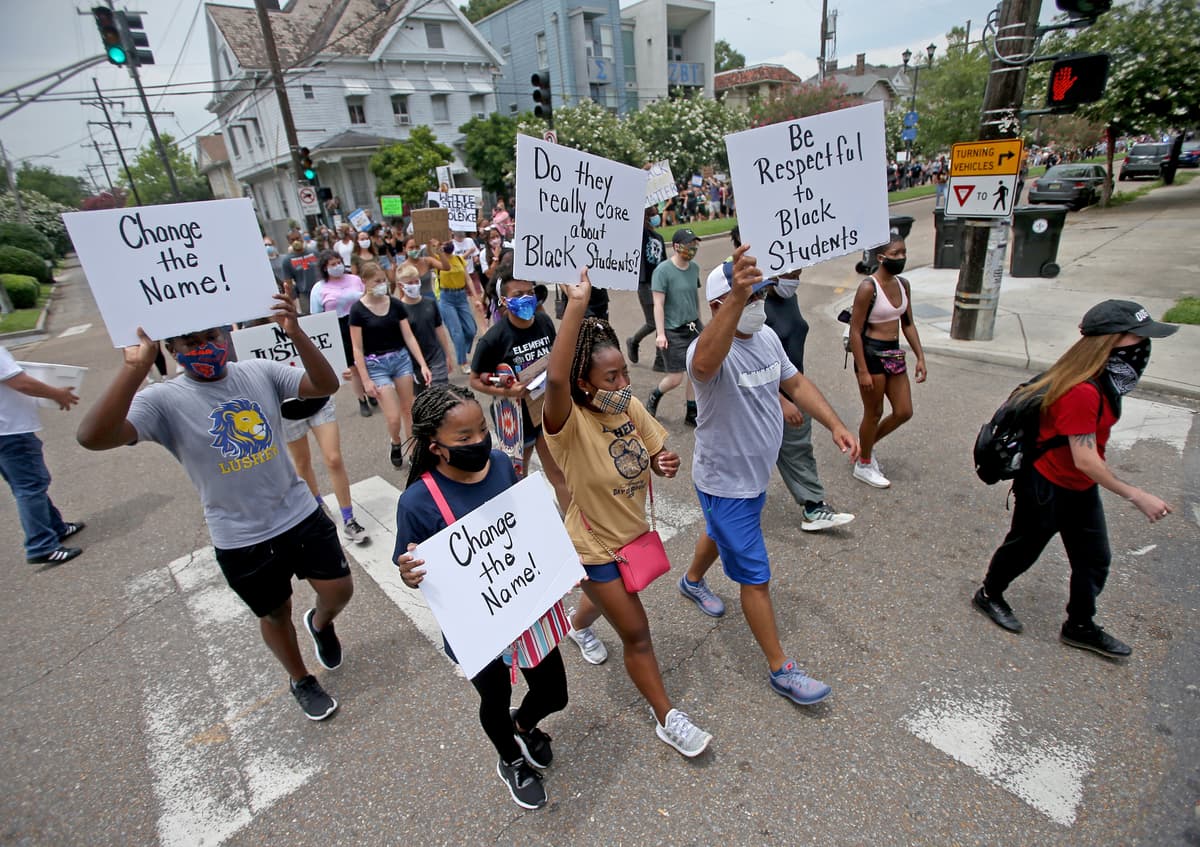
Michael DeMocker/Getty Images
People march to protest the names of two schools in New Orleans named after segregationists. Michael DeMocker/Getty Images

A trial is set to kick off on Thursday to determine whether restoring the names of Confederate leaders to Virginia schools discriminates against black students. 

The legal battle over the school names originated in 2020, in the wake of the killing of George Floyd, when the Shenandoah County School Board voted to rename Stonewall Jackson High School as Mountain View High School and Ashby Lee Elementary, which was named after Robert E. Lee and a Confederate cavalry commander, Turner Ashby Jr., as Honey Run Elementary School. 

Four years later, the Shenandoah school board — with new board members — voted 5-1 to restore the names of the schools following an uproar from community members who expressed disappointment with the stripping of the names of Confederate leaders from the schools. The vote came as some community members argued the decision to rename the school was a “knee-jerk” reaction against individuals who, in their view, represent a fight for states’ rights. Other community members questioned the process behind the 2020 move.

After that decision, which marked the first time a school decided to restore the name of a Confederate leader since 2020, a group of black students sued, arguing that the decision violated their First Amendment rights and denied them equal access to educational opportunities. The students alleged that by wearing uniforms during sporting events that bore Jackson’s name, they were being forced to endorse “Stonewall Jackson” and a “message of racial exclusion.”

In September, a federal judge on the U.S. District Court for the Western District of Virginia, Michael F. Urbanski, an Obama appointee, granted summary judgment for the plaintiffs for one portion of their complaint, ruling that restoration of Jackson’s name to the high school violated the students’ First Amendment rights by “compelling students to advance the school board’s chosen message favoring ‘Stonewall Jackson’ through the conduct of extracurricular activities.”

A lawyer for the plaintiffs, Li Reed, said the decision was a “key vindication” in the case and that “forcing [students] to constantly espouse pro-slavery, anti-Black messages is a violation of their First Amendment constitutional rights.”

On Thursday, a bench trial will begin to address the remaining question of whether restoring the original names to the schools discriminates against black students. 

Attorneys for the plaintiffs noted that Stonewall Jackson High School was built in the 1950s. An expert for the plaintiffs, Ty Seidule, told the court that at the time the school was constructed, “one way to protest integration and calls for equal rights was to name a school after a Confederate 
 to send a very particular message about the need to sustain a racial hierarchy.”

The school district’s expert, Gibson Kerr, said that “some people in those days chose to honor Confederates for racist reasons.” 

However, the school board has argued that the motivation for the name change was not racist, but instead was “motivated by nothing more than public will and 
 respect for the democratic process.”

The trial is expected to focus, in part, on the impact of students going to schools named after Confederate leaders. A lawyer for the students, Marja K. Plater, told the Washington Post, “Just try to imagine what it would feel like walking through the doors of a school that has a Confederate general name that they themselves have acknowledged their disagreement with, but yet they still have to go.”

The outcome of the trial will determine whether the schools will be allowed to have the names of the Confederate leaders restored. 

Shenandoah County Public Schools did not respond to the Sun’s request for comment by the time of publication. 

The trial comes as one other school district has announced plans to restore the names of Confederate leaders. In August, the Midland Independent School District in Texas decided to restore the name of its high school to Robert E. Lee High School, and is also planning to restore the name of its 9th-grade campus to the Robert E. Lee Freshman High School.


The New York Sun

© 2025 The New York Sun Company, LLC. All rights reserved.

Use of this site constitutes acceptance of our Terms of Use and Privacy Policy. The material on this site is protected by copyright law and may not be reproduced, distributed, transmitted, cached or otherwise used.

The New York Sun

Sign in or  create a free account

or
By continuing you agree to our Privacy Policy and Terms of Use