

Film Forum Screening an Unruly Artifact of History, ‘Who Killed Santa Claus?’

Alternately noirish and saccharine, ‘Who Killed Santa Claus?’ is too unwieldy to become a holiday staple, but movie-goers will discover a diversion worth attending to.
Via Film Forum
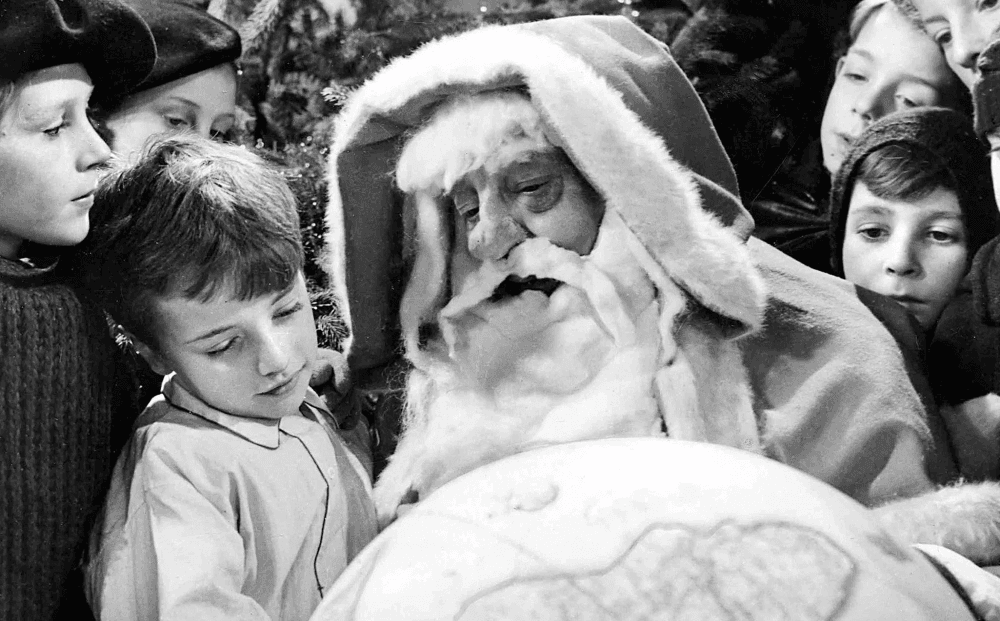
Harry Baur in 'Who Killed Santa Claus?' (1941). Via Film Forum

Christian-Jaque’s “Who Killed Santa Claus?” (1941), a film undergoing a revival at Film Forum in conjunction with the holiday season, was based on a 1934 book of the same name by Pierre Véry. To the extent that he is remembered at all, Véry is likely best known for being an adept hand at crime novels, a dabbler in science fiction, and a journeyman screenwriter. 

Why he wasn’t hired to adapt his own novel is unknown — that duty fell to Charles Spaak, co-writer with Jean Renoir of “La Grande Illusion” (1937). Thirteen years after the book’s publication, Véry couldn’t have foreseen how historical circumstances would come to color what was, essentially, a murder mystery draped with picturesque trimmings.

“L’Assassinat du Père Noël” was the first movie overseen by Continental Films, a production company set up by the Reich minister of propaganda, Joseph Goebbels, upon the Nazi occupation of France. Under the auspices of a German movie producer, Alfred Greven, Continental turned out 30 films between 1941 and 1944. Greven insisted on generous budgets and on employing the finest craftsmen: He was eager to beat Hollywood at its own game.

Greven eventually ran afoul of Goebbels, who felt the movies proffered by Continental were too elevated for a native populace whose taste was inclined toward “cheap trash.” The most highly regarded of the Vichy era films is Henri-Georges Clouzot’s “Le Corbeau” (1943), a thriller that takes place at a small town in which the local community is beset by a raft of mendacious letters from a correspondent known only as “The Raven.” It’s impossible not to read Clouzot’s essay on paranoia as anything other than a commentary on life under the occupation.

“Who Killed Santa Claus?” shares a few commonalities with “Le Corbeau,” not least an overriding sense of apprehension fostered by an isolated populace. Although portions of the film were shot in the studio, much of it takes place on location at the Savoy Alps in the southeastern region of France. The unnamed village could have been lifted from the pages of a fairy tale: It’s populated by a cadre of lovable eccentrics and distinguished by cozy environs. Navigating towering snow drifts is nothing for the hardy souls who call the place home.

Harry Baur in ‘Who Killed Santa Claus?’ (1941). Via Film Forum

Yet not everyone is lovable, especially Roland de La Faille (Raymond Rouleau). “The Baron” has returned to his castle after a failed 10-year journey to find a suitable bride, and hints that his travels have left him with a case of leprosy. In the meantime, the village priest (Georges Mauloy) has been knocked unconscious inside his parish, and the centerpiece of the annual nativity scene, a jewel of significant value, goes missing. Could the assailant and thief be a cloaked figure who is glimpsed scurrying through the township or, perhaps, a local artisan who specializes in hand-crafted globes, Gaspard Cornusse (a hammy Harry Baur)?

Other players include Cornusse’s catatonic but beautiful daughter, Catherine (Renée Faure), a sorceress searching for her missing cat (Marie-Hélène Dasté), schoolchildren with a knack for musical improvisation, and a cadre of gendarmes with little sense of direction. If you’ve guessed that the picture is a mish-mash of tone and character, rest assured that Christian-Jaque and Spaak have included a sickly child who is healed by the power of Christmas, and a Santa Claus with a taste for champagne. 

Alternately noirish and saccharine, “Who Killed Santa Claus?” is too unwieldy to become a holiday staple, but movie-goers curious to sample an unruly artifact of history will discover a diversion worth attending to.


The New York Sun

© 2025 The New York Sun Company, LLC. All rights reserved.

Use of this site constitutes acceptance of our Terms of Use and Privacy Policy. The material on this site is protected by copyright law and may not be reproduced, distributed, transmitted, cached or otherwise used.

The New York Sun

Sign in or  create a free account

or
By continuing you agree to our Privacy Policy and Terms of Use