
For Halloween, the Museum of the Moving Images Offers Nine Films Featuring ‘Dark Magic’

Incantations of a nefarious sort are the emphasis of the films in the MoMI series, and Kaneto Shindo’s ‘Onibaba’ (1964) is, arguably, the best of the bunch.
Via Wikimedia Commons
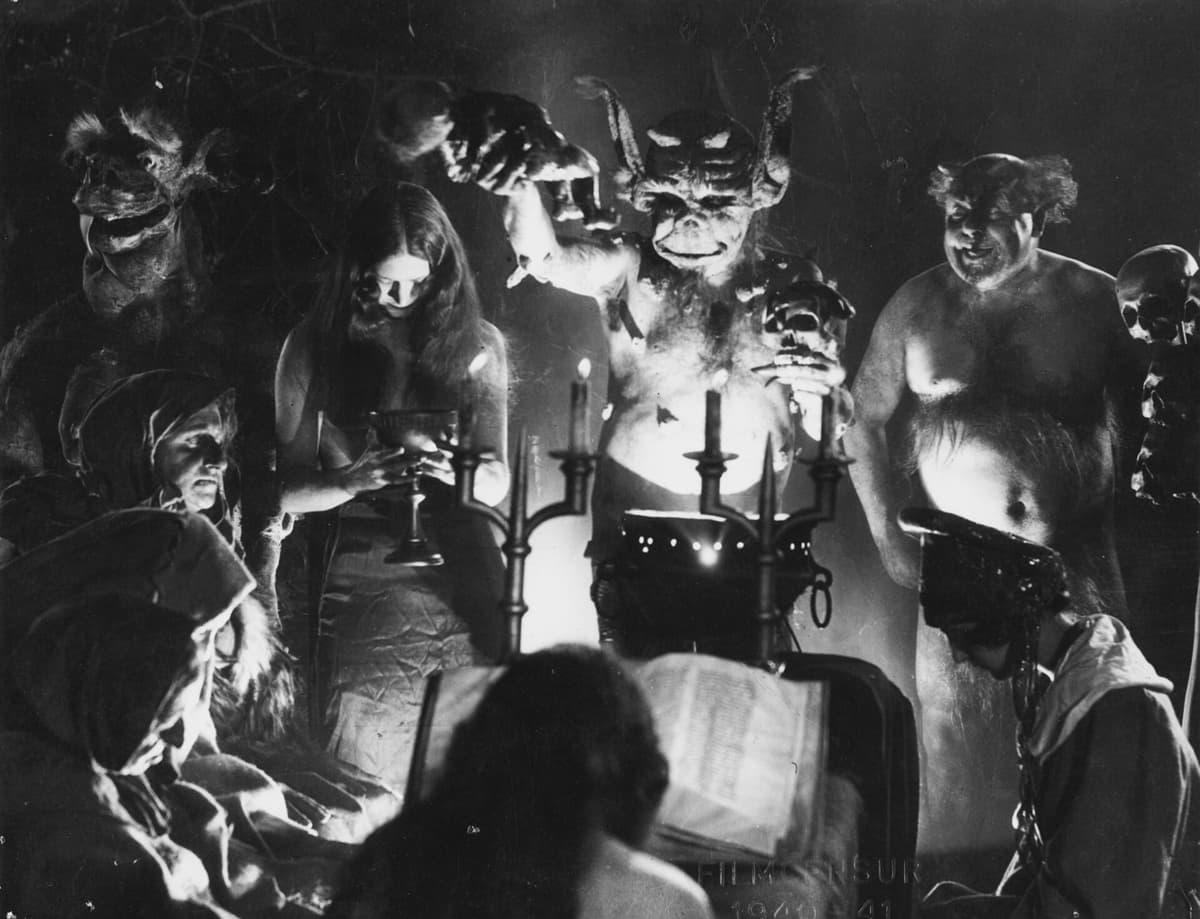
Scene from 'Häxan' (1922). Via Wikimedia Commons

A senior curator at the Museum of the Moving Image, Michael Koresky, has teamed up with an Oscar-winning filmmaker, Jeff Reichert, to organize a run of pictures peculiar to the fall season, “Dark Magic: Hexes and Haunts for Halloween.” The program has been mounted in conjunction with the publication of a compendium of essays culled from an online magazine affiliated with the museum, Reverse Shot, and Messrs. Koresky and Reichert promise that New Yorkers will be suitably “ensorcelled” by their curatorial choices.

Incantations of a nefarious sort are the emphasis of the nine films in the MoMI series. Fans of cinematic witchery will bemoan the exclusion of their own particular favorites — mine would be Carl Dreyer’s brutal “Days of Wrath” (1943) and Michael Reeves’s “Witchfinder General” (1968), with its flinty title performance by Vincent Price. Still, “Dark Magic” is rife with curiosities; you can’t always have your bubbling cauldron and sup from it, too. 

The earliest item on the docket is Benjamin Christensen’s “Häxan” (1922), a picture that should engage those who take pleasure when the distinctions between fact and fiction become muzzy. A Swedish production helmed by a Dane, “Häxan” couches its exploration of all things supernatural in didactic terms, posing as an academic lecture laid out in discrete chapters. At the time the most expensive film made in Denmark, “Häxan” was deemed by Variety as “absolutely unfit for public consumption.” Even at this late date, it is remarkably lurid and often disturbing.

The development of the horror film is unimaginable without “Häxan.” Christensen looked to Bosch, Bruegel, and Goya in setting up the various mises en scène and employed stop-motion animation, puppetry, and optical effects to impressive effect: They’re all the more gritty for a relative crudity. Johan Ankerstjerne’s brooding cinematography and Richard Louw’s cunning art direction bring an uncanny veracity to scenes that might otherwise have been laughable. Pianist Makia Matsumura will be on hand at MoMI to offer appropriately eerie accompaniment.

Via Wikimedia Commons

Jacques Tourneur’s “Cat People” (1942) set a cinematic standard for B-movies that, in terms of quality, belied the label. RKO Studios tasked producer Val Lewton to come up with horror movies on-the-cheap, providing him with suitably eye-catching titles. Lewton’s ingenuity and a gifted corpus of sidemen hunkered down to work on a sordid tale of “those who slink and court and kill at night.” The suits at RKO, initially skeptical about the results, kept their mouths shut when “Cat People” proved a smash.

Clocking in at an hour and a quarter, “Cat People” takes place in a Hollywood backlot that attempts to pass as New York City. Irena Dubrovna (Simone Simon) is a Serbian immigrant who lives in fear that she’s beholden to a curse that will transform her into a panther upon being sexually aroused. This puts a crimp in Irena’s marriage, and when husband Oliver (Kent Reed) begins to take a shine to his co-worker, Alice (Jane Randolph), the burdens of myth come true. All the while, Tourneur sustains a tenseness of mood and isolation.

Kaneto Shindo’s “Onibaba” (1964) is, arguably, the best of the bunch, though historians, critics, and film buffs are likely to haggle on how best to classify its barebones story about war, famine, sex, and retribution. Set in mid-14th century Japan, “Onibaba” follows a nameless mother and her daughter-in-law (respectively, Nobuko Otowa and Jutsiko Yoshimura) as they navigate a war-torn country, summarily killing stray soldiers, dumping the bodies, and selling the armor to a local black marketeer, Ushi (Taiji Tonoyama).

Our protagonists have this murderous routine down to an art until a deserter, Hachi (Kei Satō), shows up at the door. The daughter takes a shine to the wayward soldier and they begin an affair. 

Kei Satō and Nobuko Otowa in ‘Onibaba’ (1964). Via the Museum of the Moving Image

Mom begins to fret about mixed allegiances, and when she acquires an elaborately stylized mask from a recent kill she uses it as a means of intimidating her daughter. The trouble is the mask comes with its own set of prerequisites, all of which are unexpected and most of which prove catastrophic. There’s a lesson to be learned here, so it comes as no surprise to find out that “Onibaba” had as its basis a Buddhist fable about hubris and deceit.

Shindo’s picture is powered by some fierce performances — Otowa’s as the ruthless mother is particularly intense — and the atmosphere is dense with sweat and desperation. The overall mood of the piece is dour, and should you want to assign an overweening sense of dread to the aftermath of the bombings of Hiroshima and Nagasaki, well, that’s the way the director planned it. By turns poetic, erotic, horrific, and philosophical, “Onibaba” has more layers than you might initially think, and is well worth attending to.


The New York Sun

© 2025 The New York Sun Company, LLC. All rights reserved.

Use of this site constitutes acceptance of our Terms of Use and Privacy Policy. The material on this site is protected by copyright law and may not be reproduced, distributed, transmitted, cached or otherwise used.

The New York Sun

Sign in or  create a free account

or
By continuing you agree to our Privacy Policy and Terms of Use