

Fra Angelico Returns for a Ravishing Renaissance at the City of Dante and da Vinci

The pious painter painted brightly so that the faithful would believe deeply.
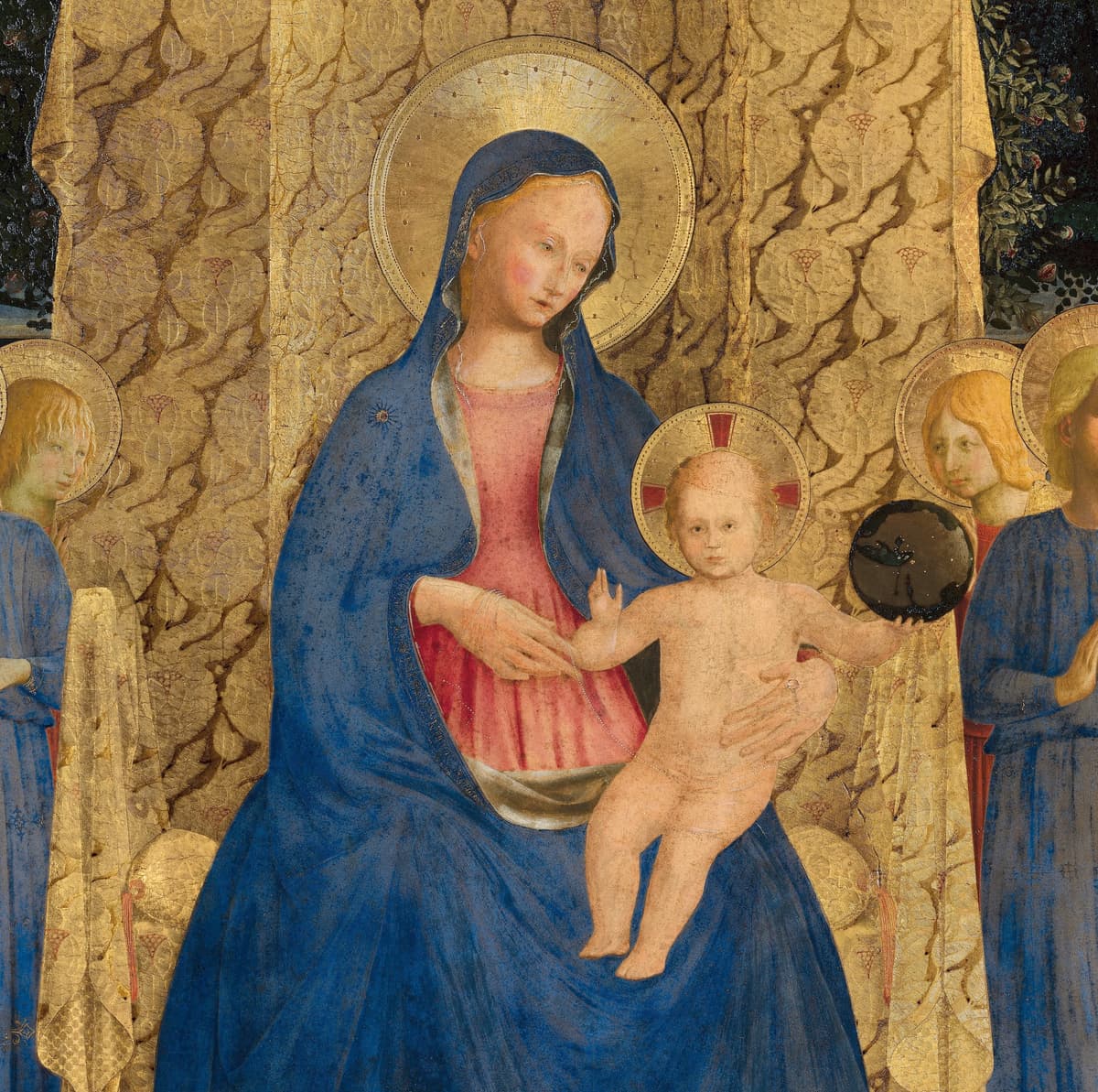
Courtesy Ministero della
Cultura - Opificio delle Pietre Dure
'San Marco Altarpiece' by Fra Angelico. 1438-42. Detail. Courtesy Ministero della Cultura - Opificio delle Pietre Dure

FLORENCE —“Beato Angelico” at the Palazzo Strozzi and the Convent of San Marco is a radiant ravishing of the eyes — and, if the pious painter has his way, the soul as well. Forget Jackson Pollock’s spilled paint and skip over Marcel Duchamp’s porcelain urinal. This is art in the service of the Almighty, a gold and God drenched riposte to the secular age. Angelico painted brightly so that the faithful would believe deeply. His magic has no expiry date.

The man who would become Fra Angelico was born Guido di Pietro at a small Tuscan hamlet around 1395 — not far from where Leonardo da Vinci would come into the world some six decades later. The artist and biographer Giorgio Vasari would describe Angelico as possessing a “rare and perfect talent,” but his contemporaries knew him as Fra Giovanni, or “Friar John.” By 1435 he was a Dominican friar, praying and — do I repeat myself? — painting at Florence.

Angelico’s move to the city of Dante was, one might say, providential. He came under the patronage of Cosimo de’Medici, whose family would bankroll the astounding art that would come to be created along the Arno. His triumphant “San Marco Altarpiece” — on display in this show — would come into the Vatican’s voracious vision. He would die at the Eternal City in 1455. In 1982 Pope John Paull II beatified the pious painter.

Angelico’s art shimmers at the seam separating the Middle Ages and the Renaissance. Behind him are Giotto and the medieval masters of the Gothic. Ahead would be da Vinci, Michelangelo, Raphael, and the rest. This betweenness augments rather than strands Angelico’s achievement. His work is the culmination of one tradition and the inauguration of a new one.

‘The Annunciation’ by Fra Angelico, c. 1443. Florence, Museo di San Marco, Dormitory,
North Corrido

Take the “Franciscan Triptych.” The gold background feels Byzantine, far from the conjured endlessness of, say, da Vinci’s backgrounds. Yet the figures are not at all flat. They are rendered with poses that convey action. Angelico’s art makes a theological point — Mary and the Child are both human and divine, the saints ordinary men possessed of uncommon virtue. The “San Marco Altarpiece” zooms out to present scenes of cinematic scope.

A more spare mien pervades “The Annunciation,” a fresco from 1443 that hung in a monastic dormitory. The colors are muted, as if to capture the small hours of the morning. The air is pensive and uncertain, clocking how the delivery of major news can create currents of anxiety and wracked nerves. Mary and the angel Gabriel look like twins, both of them demure in the face of destiny. The angel’s wings are ribboned with a rainbow of color.

A different moment in the Christian Bible is depicted in “Crucifixion.” This piece, usually at the Metropolitan Museum of Art, is blasted with gold and blood, less a history piece than a vision meant to shock believers into reckoning with a central and shocking event of their faith. The perspective is mid-air, with Jesus on the Cross dwarfing both the huddled masses below and the angels soaring in the near-distance. One could say it’s a God’s-eye view.     

Angelico manages to be both a bridge to the High Renaissance and a destination unto himself. He is in full command of the developing insights of perspective and volume that unlock a new realism. Angelico could have learned his delicacy and luminosity from his teacher, Lorenzo Monaco, whose work is sampled here. Another influence was Angelico’s Florentine contemporary, Masaccio, who innovated foreshortening and sleight-of-hand three dimensionality.

Angelic’s art, though, astounds even those who never took a day of Art History. It’s hard to think of  another painter whose work glows like this — radiant, glittering, backlit. It is as if Angelico’s paint is ablaze with his faith. Angelico’s compositions bring together Biblical scenes — of Mary, Jesus, the Apostles — with images of saints from across space and time. They are all presented with the simultaneity of eternity. Heaven has no past or future.

‘Christ With a Crown of Thorns,’ Fra Angelico. c. 1447-1450. Livorno, Cathedral of San Francesco, Bridgeman Images

The medium of the triptych allows Angelico to paint with both continuity and compartmentalization. His paintings were intended to be aids to devotion. That gives them the logic of the rosary or prayer book. At the same time, though, there is nothing gauzy about Angelico. His figures manage to be people as well as characters. The imprints of yearning, doubt, shock, and serenity all deliver the impression of human beings swept up in salvation.

The apotheosis of this achievement is “Christ With Thorns.” It is a zoomed-in, almost claustrophobic image of Jesus’s face from the neck up. His eyes are blood shot, pools of red that appear to be collecting the rivulets of blood streaming from his crown of thorns. His hair falls in tendrils. He wears a halo so enormous and baroque that it appears as its own kind of burden. This is suffering that is urgent, extreme, hideous and holy altogether.

Pope John Paul II, in the Apostolic Letter celebrating Angelico, writes that he “contributed and continues to contribute immense spiritual and pastoral benefit to the people of God, so that they may more easily make their way to God. For this is what sacred art is all about.” In a later Letter to Artists, the Polish Pope put it perfectly, declaring that Angelico’s work is an “eloquent example of aesthetic contemplation sublimated in faith.”


The New York Sun

© 2025 The New York Sun Company, LLC. All rights reserved.

Use of this site constitutes acceptance of our Terms of Use and Privacy Policy. The material on this site is protected by copyright law and may not be reproduced, distributed, transmitted, cached or otherwise used.

The New York Sun

Sign in or  create a free account

or
By continuing you agree to our Privacy Policy and Terms of Use