
Free China, in a David-v.-Goliath Struggle, Is Maximizing Its Defenses Against the People’s Republic

The Republic of China’s government formulates a program for creating a ‘Taiwan Dome’ at a cost of $40 billion.
AP/Chiang Ying-ying
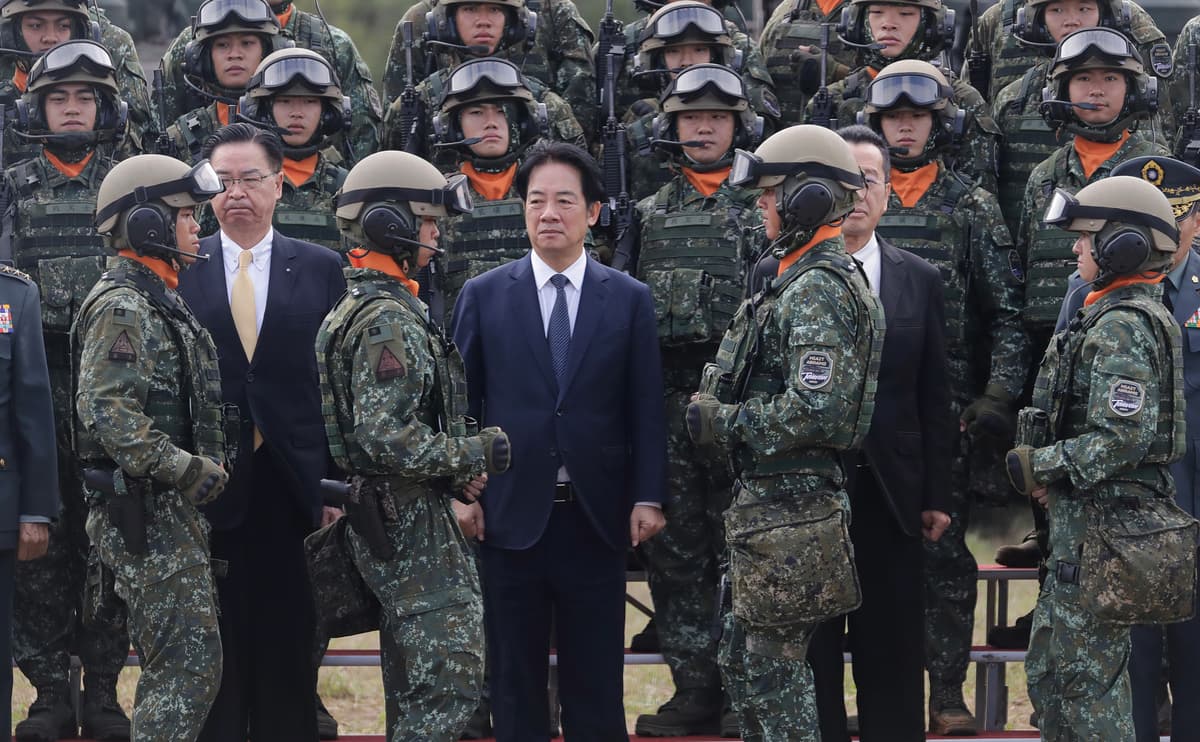
Taiwan's president, Lai Ching-te, center, with soldiers during the inauguration ceremony of M1A2T Abrams Main Battle Tanks. AP/Chiang Ying-ying

Tiny Free China is maximizing its defenses against mighty Communist China in a David-Versus-Goliath struggle that’s sure  to heighten tensions across the Indo-Pacific.

On the island democracy 90 miles off China’s east coast, the president of the Republic of China, Lai Ching-te, has formulated a program for creating over the next eight years the “Taiwan Dome” at a cost of $40 billion. It would aim to keep the People’s Liberation ARmy from ever overrunning the island as threatened by the mainland’s party boss, Xi Jinping.

Mr. Lai explained  his reasoning in an article that he wrote for the Washington Post, saying that he was “committed” to lifting Taiwan’s defense spending to 5 percent by 2030 from 3.3 percent for next year, the largest sustained military investment in Taiwan’s modern history.”

Mr. Lai left no doubt Taiwan was fed up with Beijing’s bullying and was ready to respond in a do-or-die struggle that would test the strength of China versus its main adversaries in the region, notably America but also Japan. He cited China’s  “unprecedented  military buildup, combined with intensifying provocations” not only around Taiwan but also in the South China Sea “and across the Indo-Pacific,” extending from the Indian Ocean to island states scattered across the Pacific.

Mr. Lai, before he was elected president two years ago,  had already upset Beijing by suggesting that Taiwan was acting like an independent country. He has refrained from saying Taiwan should simply declare its independence — a stance that would almost invite invasion — while the People’s Republic of China has gone on  encircling the island with planes and ships.

Mr. Lai made a point of crediting President Trump with having “made clear the importance of American leadership around the world.” He did not say Mr. Trump had promised to defend Taiwan, to which America has sold hundreds of millions of dollars of weaponry, but did say the world was “safer today because of the Trump administration’s leadership.”

At the same time, Mr. Lai threw down the gauntlet before the marauding Chinese, saying Taiwan was “equally committed to keeping the Indo-Pacific region safe” in the face of Chinese “incursions into Taiwan’s vicinity” — and “military drills  probing  the First Island Chain” from Japan to the Philippines.

Mr. Lai’s strong statement was sure to outrage the communist leadership in Beijing,  furious over his support of a remark by Japan’s new prime minister, Sanae Takaichi,  that a Chinese attack would threaten Japanese survival. Ms. Takaichi implied that Japan would join in Taiwan’s defense.

Chinese officials feasted on a photo of Mr. Lai sampling Japanese sushi  just to demonstrate his closeness to the Japanese.  Mr. Lai “dines on the scraps of groveling to Japan while engaging in the business of selling out Taiwan,” said a communist Chinese official quoted by Beijing’s propaganda newspaper Global Times. His “words and deeds are nauseating,” said the official, “laying bare once again his despicable countenance of forsaking his ancestors and betraying the nation.”

How, though, could Taiwan, population 23 million, stand up to the military power of China, population 1.4 billion? The answer lies in part in what’s called Taiwan’s “porcupine strategy” — comparing the island to a porcupine whose sharp quills can stave off the strongest predators.

“Taiwan’s defense strategy against a potential cross-strait invasion from China is widely known as the ‘porcupine defense,’ which aims to deny or significantly degrade a rapid ground assault,” begins an article in War Room, the journal of the U.S. Army War College. “The race to readiness,” the article headlines, reporting “the urgent need for greater innovation, synchronization and speed in preparing Taiwan’s defense” while “aligning U.S. security assistance with Taiwan’s domestic efforts.”

Naval News, an unofficial journal, cited Taiwan’s “efforts in developing area denial capabilities, including anti-ship missiles, attack drones and new coastal defense forces, to counter a potential Chinese invasion .” Taiwan, said Naval News, has  “doubled down on assets and strategies that can defeat enemy naval attacks and amphibious landings.” 

Analysts did not seem to doubt Taiwan’s ability to fend off invaders if only they had enough weapons to invest in what Taiwan’s defense ministry called its “ asymmetric capabilities.”

 “Plain and simple, we need to continue making strides so that Taiwan can increase production,”  a research fellow with Taiwan Security Monitor, James Ocon, was quoted as saying. “It goes back to the big three. Missiles, mines, and loitering munitions.”


The New York Sun

© 2025 The New York Sun Company, LLC. All rights reserved.

Use of this site constitutes acceptance of our Terms of Use and Privacy Policy. The material on this site is protected by copyright law and may not be reproduced, distributed, transmitted, cached or otherwise used.

The New York Sun

Sign in or  create a free account

or
By continuing you agree to our Privacy Policy and Terms of Use