From Bombs to Tweets: How Left-Wing Extremism Has Evolved Since the 1960s and the Threat It Poses
Experts say the potential for radicalization has grown because the internet makes it possible for people to mobilize instantly.

On a cold November morning in 1984, the calm of Cherry Hill, New Jersey, was shattered as federal agents stormed a rented storage facility. Inside, they found Susan Rosenberg, a 29-year-old activist tied to the May 19th Communist Organization, alongside a cache of over 700 pounds of explosives and weapons meant for a campaign of bombings against United States government targets.
Her arrest and subsequent conviction alongside that of accomplice Timothy Blunk — resulting in a 58-year prison sentence for each of them, the most severe ever for such a crime — made her an emblem of the militant left, a reminder that even after the turbulence of the Vietnam era, radical currents still ran deep beneath the surface of American life.
A former federal law enforcement officer who later oversaw Ms. Rosenberg at the Metropolitan Correctional Center, recalled the shock of her arrival.
“They brought in the skinny little woman, who seemed scared, and I wondered who the heck this was,” Craig Caine tells the New York Sun. “Then, I found out it was someone who basically had enough dynamite to blow up half of Manhattan.”
More than four decades later, the specter of that past is stirring once more. Today’s decentralized Antifa networks bear little resemblance in form or hierarchy to Ms. Rosenberg’s underground comrades. Yet, they carry strands of the same DNA – a conviction that entrenched systems cannot be challenged solely through conventional politics. For the first time in years, violence on the far left has reemerged and it is not hypothetical, but lethal.
The Backstory
To understand how we got here, rewind to the late 1960s, when the Weather Underground emerged from anti-war campuses with a stark belief: America was beyond reform, and only sabotage, confrontation, and armed struggle could force change.
Out of that crucible came the Rosenberg-connected May 19th Communist Organization, often referred to as M19CO, which was formed from splinters of the Weather Underground and the Black Liberation Army. Its members bombed government buildings throughout the 1980s.
Their targets, including the United States Capitol and the National War College, were symbolic; they intended to disrupt and send a message of resistance rather than cause mass carnage.
Rosenberg’s journey embodies the paradox of left-wing militancy – the pull between moral urgency and destructive means. To admirers, she was a revolutionary willing to sacrifice everything for justice; to critics, she was proof of how ideology could curdle into extremism.
The militants of Rosenberg’s generation faded from view and she had her sentence commuted by President Bill Clinton in 2001 after 16 years behind bars. But the notion that injustice demands something more than peaceful protest has never disappeared.
Mr. Caine, who later became a United States marshal, said the potential for radicalization is even greater today than back then.
“Now you can mobilize people instantly. People get their information from platforms. They’re mobile,” he said.
The difference between Rosenberg’s circle and today’s activists is that the modern cohort are “living with mommy and daddy, playing video games all day, and then going out to protest,” Mr. Caine said. “It’s like — for lack of a better word — zombies. They just follow one another.”
The Quiet Build-Up
Ever since the Weather Underground era, political polarization has frayed the center. Inequality, distrust of institutions, and cultural upheaval have created fertile ground for radicalization.
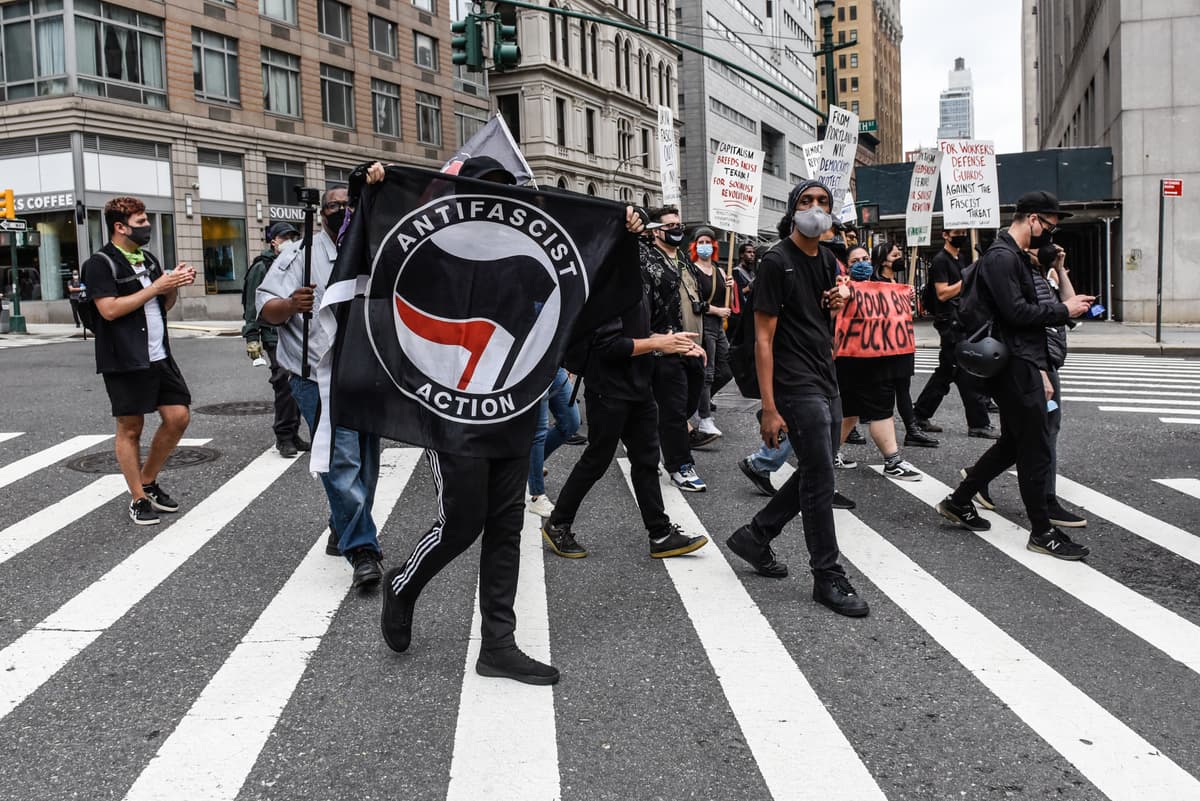
Modern-day Antifa, which is short for “anti-fascist,” emerged in the United States in the early 1980s, as a response to what its members perceived as a growing far-right threat, taking inspiration from European anti-fascist networks and adapting it to American cities. Unlike the hierarchical terrorist cells of the past, Antifa operates more like a constellation of collectives: decentralized, locally driven, and united by ideology rather than command.
Despite the notoriety of the name, Antifa is not a formal membership organization with dues or a defined leadership structure. Scholars estimate the number of active participants nationwide to be in the low thousands, with online support networks of sympathizers that are significantly larger.
A professor of the practice of criminal justice at the University of New Haven and former FBI special agent, Kenneth Gray, tells the Sun that Antifa is “comprised of local affinity groups that recruit locally to protest.”
The Rose City Antifa in Portland, for instance, describes itself as part of a coalition formed in 2007, but there is no central authority. It is more accurate to view Antifa as a loose network or brand — an umbrella under which small cells or individuals can act independently while claiming allegiance to a broader movement.
The tactics are familiar: property destruction, street confrontations, symbolic attacks against institutions and individuals perceived as oppressive. However, the difference today lies in scale and velocity.
Online communities amplify rhetoric, glorify past radicals, and coordinate actions across cities. The ideological lineage is clear: The “propaganda of the deed” favored by the Weathermen and May 19th members, finds echoes in modern acts of symbolic disruption.
The managing director of Nestpoint Associates, John Thomas, points to what he sees as social and institutional accelerants. He tells the Sun that “woke universities churning out grievance warriors, social media algorithms trapping kids in hate-filled bubbles, and big-money puppeteers like Soros funding the fury all accelerate the slide into extremism.”
Add to that economic despair “and you’ve got a perfect storm breeding tomorrow’s rioters,” said Mr. Thomas, who has worked as a Republican political strategist.
In one July 2019 case, Willem van Spronsen, an Antifa-aligned activist, attacked an ICE detention center in Tacoma, attempting to ignite gas tanks, and died in a shoot-out with police. The attack caused no mass casualties, yet it crystallized the narrative of resistance through violence.
Research studies show that left-wing extremist acts have historically caused fewer deaths than right-wing or jihadist attacks. Yet the trend toward radicalization, both online and in real-world networks, havs laid the groundwork for something potentially more lethal.
The Turning Point
By mid-2025, the pattern appeared to have changed. Left-wing actors were responsible for more attacks than right-wing actors, marking a historic shift. The killing of conservative commentator Charlie Kirk, coupled with a shooting at a Dallas ICE field office a couple of weeks later, signaled the rise of an emboldened, ideologically driven fringe.
In Dallas, one detainee was killed and two critically wounded. A bullet recovered from the scene bore the inscription “ANTI-ICE,” underscoring the political intent.
Mr. Gray pointed to the assassination of Kirk as a chilling marker of escalation.
“Charlie Kirk was penetrating college space, which the Left owned. He was assassinated due to his growing popularity and limited success in recruiting some college students to conservative views and Christianity,” he said.
Whether such violence backfires or emboldens imitators, he added, remains to be seen.
The Trump administration responded to the Kirk assassination swiftly, designating Antifa as a domestic terrorist organization via executive order and mandating federal agencies to dismantle left-wing extremist networks. Yet experts caution that overbroad measures risk conflating nonviolent protest with extremism, potentially fueling the very radicalization authorities seek to prevent.
Under current American law, there is no recognized mechanism for designating domestic groups as terrorist organizations. The concern is that broad language in the executive order could blur the line between violent extremism and peaceful protest, risking governmental overreach and suppression of dissent.
Mr. Thomas insisted that crackdowns are critical.
“Trump’s DOJ crackdowns and federal designations starved Antifa of safe havens, proving prosecution works,” he said. “Pushing a law-and-order agenda works. Pair that with exposing dark-money funders and promoting real economic wins to undercut their grievance narrative.”
What makes this moment dangerous is not just ideology or tactics, but the convergence of history, technology, and political polarization. Militant memory, transmitted through stories of past radicals and online forums, interacts with contemporary grievances. What starts as a symbolic action can quickly escalate into deadly violence once the social and technological infrastructure exists to support it.
Looking Ahead
Antifa and left-wing militancy show how radical ideas persist across generations, from the Weather Underground and May 19th Communist Organization to today’s decentralized collectives. The common thread is the belief that conventional politics are insufficient to address systemic injustice.
Mr. Gray emphasized the ideological continuity.
The decision by the Weather Underground and May 19th “to use any means necessary, to include the use of violence to achieve their goals, is similar to the advocacy of Antifa,” he observed.
For Mr. Caine, the lesson is that technology and scale have changed the stakes.
“Today it is even more dangerous,” he warned, because extremists have a “bigger capacity to monitor and use technology.”