Fuel Reprocessing Agreement Lifts Key Obstacle to South Korea Getting Its First Nuclear-Powered Submarine

The understanding, announced in a fact-sheet from President Trump’s October 29 talks in Seoul, bypasses restrictions under the Atomic Energy Act of 1954.
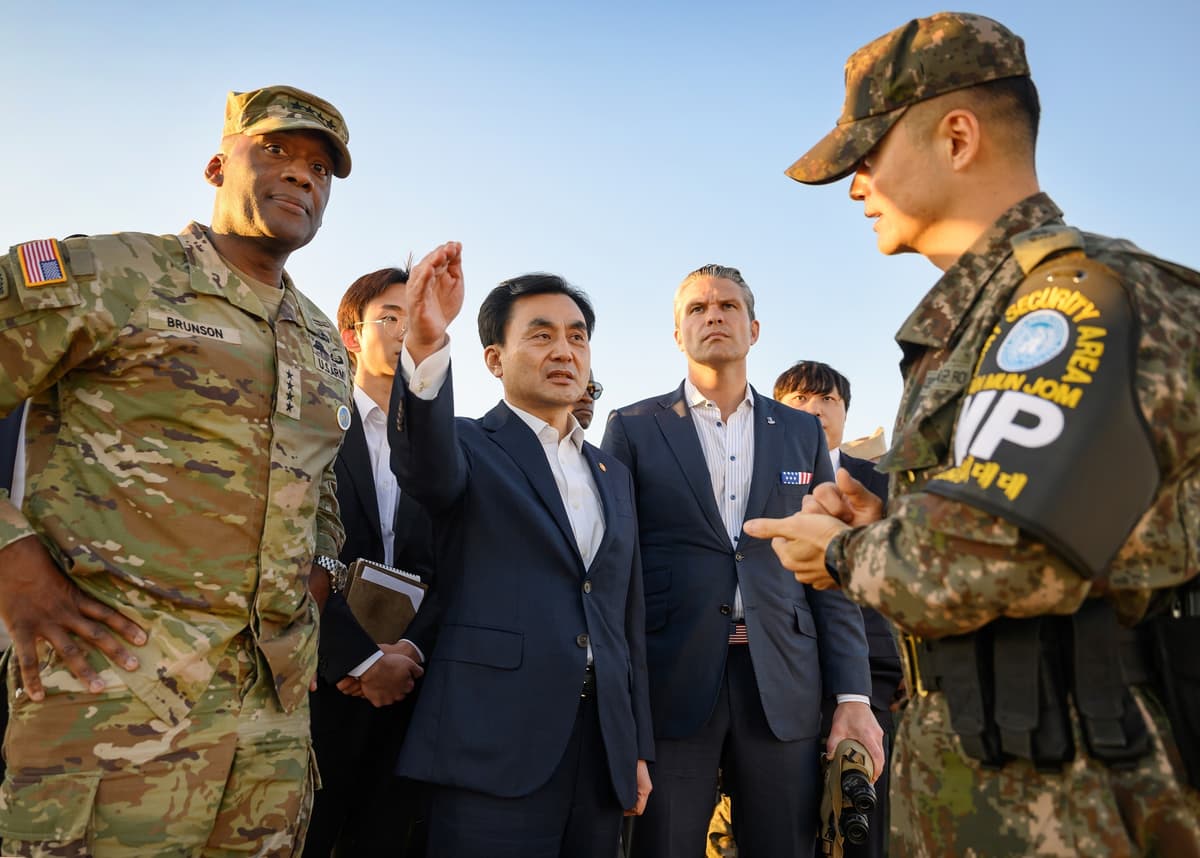
South Korea Defense Ministry via AP
South Korea’s defense minister, Ahn Gyu-back, Defense Secretary Pete Hegseth visit an observation post near the border village of Panmunjom, South Korea, on November 3, 2025. South Korea Defense Ministry via AP

SEOUL – In a breakthrough agreement, Washington has approved the nuclear fuel reprocessing needed to power a South Korean nuclear submarine that President Trump has said will be built “right here in the good old USA.”

The de facto waiver under American nuclear export controls appears in the terse final three sentences of a 2,100-word “fact sheet” on Mr. Trump’s October 29 summit with South Korea’s President Lee Jae-myung in the ancient Korean capital of Gyeongju.

The text also confirms the president’s widely reported approval for Korea “to build nuclear-powered attack submarines” for the first time. 

The “fact sheet,” however, does not confirm that the first submarine will be built in America – a bone of contention between Washington and Seoul. South Korea’s defense minister, Ahn Gyu-back, has stated that “domestic construction is the most rational approach” while Mr. Trump posted on Truth Social that it would be built “in the Philadelphia Shipyards.”

South Korea’s second largest shipbuilder, Hanwha Ocean, and another Hanwha subsidiary last year acquired the Philadelphia Shipyard for $100 million from the Norwegian firm, Aker ASA, and renamed it “Hanwha Philly Shipyard.” Hanwha’s eagerness to build South Korea’s first nuclear vessel shines through a statement provided to TheNew York Sun by the group’s chief strategy officer, Alex Wong.

“Hanwha Philly Shipyard was a centerpiece yard in America’s storied naval shipbuilding past,” Mr. Wong stated. “With new technologies, investment in American workers, and deep partnership with Korea, Philly Shipyard can again become a center for advanced commercial and naval construction.”

Mr. Wong expressed confidence that “our commitment” will “chart the way toward America’s advanced shipbuilding future.”

Those words will be welcomed by Mr. Trump, who has been campaigning to get South Korea and other major trading partners to invest heavily in flagging American industry in exchange for lower American tariffs, generally around 15 percent.

Indeed, the “fact sheet” issued here and in Washington reaffirms what it calls “the historic announcement” in July of the Korea Strategic Trade and Investment Deal, which reflects “the strength and endurance” of the American-Korean alliance.

The deal, it states, “includes $150 billion of Korean investment in the shipbuilding sector” as well as $200 billion “additional Korean investment,” while Washington sets a 15-percent rate for tariffs on most imports – a reduction in previous tariffs on motor vehicles.

Much of the factsheet deals with a fine-tuning of trade and tariff understandings on products ranging from pharmaceuticals to semiconductors. It also addresses Mr. Trump’s demand that South Korea pay as much as $5 billion a year toward the expense of maintaining American forces in Korea.

The agreement states that South Korea would increase defense spending from 2 percent to 3.5 percent of its gross domestic product, which the World Bank estimates will reach $18.6 trillion this year, the world’s 14th highest.

South Korea also promises to spend $25 billion on American military equipment over the next five years while providing “comprehensive support” totaling $33 billion for American forces in Korea. A sign of the difficulties, though, was that the pledge does not give an exact time span. Mr. Trump has said the South should increase by several times the $1.1 billion it’s paying annually for hosting about 28,500 American troops

Messrs. Trump and Lee also “reiterated their commitment to the complete denuclearization” of the Democratic People’s Republic of Korea – aka North Korea – “and peace and stability on the Korean Peninsula.” They will, they said, “work together to implement the Joint Statement of the 2018 U.S.-DPRK Singapore Summit” in which Mr. Trump and North Korea’s leader, Kim Jong-un, agreed to work for a “nuclear free” Korean peninsula.

Mr. Lee made clear, however, that the two sides spent a lot of energy hassling over wording. South Korea’s newspaper Chosun Ilbo quoted him as saying, “It was difficult to bear when people kept tripping us up from behind or demanded quicker concessions” – a frank jab at American negotiators.

Regardless, the shared vision of South Korea as a nuclear naval power marks a huge shift from past policy, in which Washington has stuck to the stringent requirements in the Atomic Energy Act of 1954 on the licensing of exports of nuclear material, including reactors and nuclear fuel. The deal amounts to a waiver – though that word does not appear in the statement.

The proposed entry of South Korean nuclear-powered submarines into the Pacific sparked a protest from Communist China, whose nuclear subs roam the Indo-Pacific.
“It is directly tied to the international nonproliferation regime and peace and stability in the region,” China’s ambassador to South Korea told reporters. “We have expressed our concerns through diplomatic channels and hope that Korea handles the matter with care.”


The New York Sun

© 2025 The New York Sun Company, LLC. All rights reserved.

Use of this site constitutes acceptance of our Terms of Use and Privacy Policy. The material on this site is protected by copyright law and may not be reproduced, distributed, transmitted, cached or otherwise used.

The New York Sun

Sign in or  create a free account

or
By continuing you agree to our Privacy Policy and Terms of Use