
Gaza Ceasefire Proves That Military Might, Often, Must Come Before Diplomacy 

Primary credit for the Gaza ceasefire goes to the Israel Defense Forces — and Prime Minister Netanyahu.
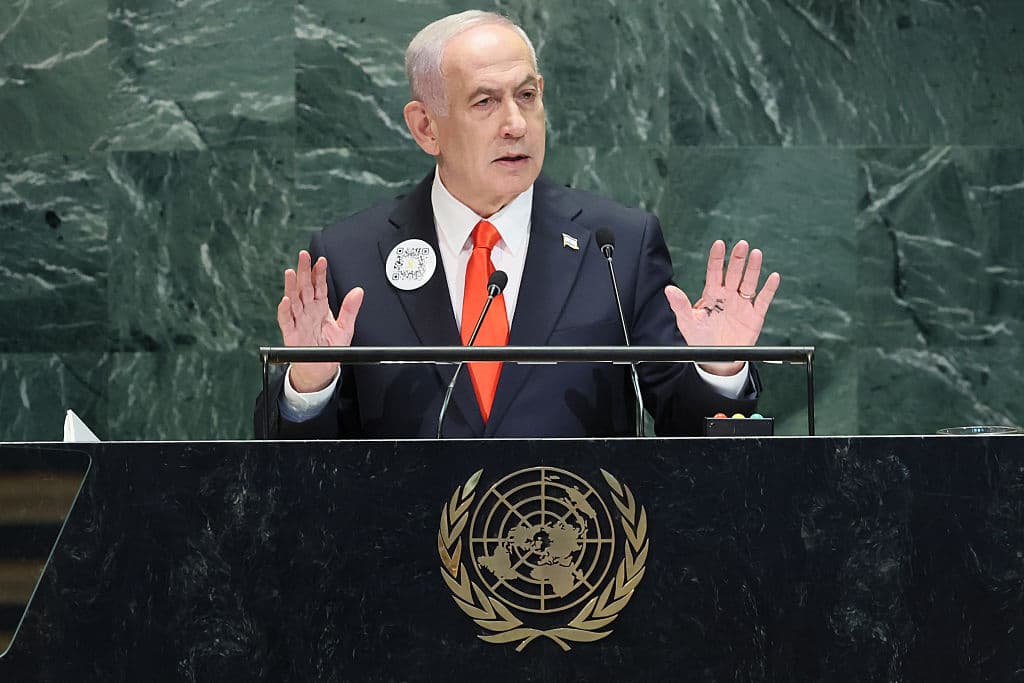
Michael M. Santiago/Getty Images
Prime Minister Benjamin Netanyahu addresses the United Nations General Assembly on September 26, 2025 at New York City. Michael M. Santiago/Getty Images

‘If you start to take Vienna, take Vienna.’ 
—Napoleon

Unminced words are now required lest we flinch from acknowledging the stark — and for many people, unsettling — lesson of Israel’s achievement since October 7, 2023. The lesson is: Often military might does, and often only it can, make room for diplomacy.

Primary credit for the ceasefire between Israel and those who still aspire to murder it goes to the Israel Defense Forces. So, credit also goes to the prime minister who wielded the IDF with a properly austere regard for the opinions of mankind, Benjamin Netanyahu.

Will the current ceasefire in the two-year war be more than merely this? If so, it will be because on October 7, 2023, Israel recognized that the necessary precondition for the cessation of warfare would also be sufficient: destruction of Hamas’s and Hezbollah’s capacity for waging war. 

The diplomats’ hour arrived after, and because of, the fighting by those who form the tip of Israel’s spear against unprovoked and wanton violence. Because of the mostly young men and women of the IDF.

The American Declaration of Independence acknowledges an obligation to have “a decent respect to the opinions of mankind” (emphasis added). Indecent respect occurs when the opinions of mankind are not respectable, or when respecting them involves indecent consequences. 

To the Trump administration’s credit, the United States has enabled Israel’s victory by not restraining its self-defense. American policy has too often restrained Ukraine since Russia attacked on February 24, 2022.

Historians will assess if and when Israel has used disproportionate force. The historians whose conclusions will deserve most respect will be those who grapple with Israel’s October 7 reality. 

Then it was contiguous to an enclave under the thumb of organized sadists who sheltered behind a captive civilian population. Historians should begin with the beginning — remembering the sexual and other violence recorded by Hamas body cameras on October 7.

Historians will have to acknowledge that Mr. Netanyahu, who is responsible for his nation’s safety, grasped the nettle. He acted on Napoleon’s axiom, which has various reported versions but one clear meaning: In large undertakings, avoid tentativeness.

All wars end. The Hundred Years’ War, the Thirty Years’ War, the Seven Years’ War, and all others, before and since, ended. Some did so from mutual or asymmetrical exhaustion, some with difference-splitting negotiations. 

The war that paused and perhaps ended last week reminded the world that Israel has never known a day of peace, properly understood.

Peace is more than the absence of violence. It is a condition where threats of violence are not the constant white noise of existence. Israel was attacked by non-state actors, Hamas and Hezbollah, committed to the destruction of the Israeli state, continuing a condition that preceded the Israeli state.

On May 14, 1948, when Israel declared its independence, this aspiration was as far from fulfillment, as was the independence that 13 North American colonies declared from the world’s mightiest empire on July 4, 1776. Israel, born out of World War II, became independent during a war that had been waged for years by Arab nations attempting to forestall Israel’s existence.

Israel has always had, because it has earned it, American support. It has never, however, been dependent on it. In the final scene of Tennessee Williams’s play “A Streetcar Named Desire,” Blanche DuBois exclaims, “I have always depended on the kindness of strangers.” 

Centuries of hard experiences, culminating in Auschwitz, have taught the Jewish people the lethal risks of dependence on others. Israel’s birth was a post-Holocaust proclamation: “Never again.”

Mr. Netanyahu’s post-October 7 decision to destroy Hamas and Hezbollah was that Israel shall never again have an occasion to say “Never again.” His use of violence has perhaps economized violence. 

The destruction of two enemy organizations might mean, in subsequent years, fewer deaths than would otherwise have occurred on both sides.

For decades, American officials belabored Israel with reasons why, in negotiations with bellicose enemies, it should “take a risk for peace.” To one official, Mr. Netanyahu, referring to a tranquil Washington suburb, replied, “You live in Chevy Chase. Don’t play with our future.”

For Israel, as for Ukraine since the dissolution of the Soviet Union, being has been risky. Israel has refused to trim its sails to accommodate gusts of critical opinions from people living comfortably at a safe distance from violence. 

Like Ukraine’s example of fortitude, Israel’s is a gift to an only intermittently resolute West.

The Washington Post


The New York Sun

© 2025 The New York Sun Company, LLC. All rights reserved.

Use of this site constitutes acceptance of our Terms of Use and Privacy Policy. The material on this site is protected by copyright law and may not be reproduced, distributed, transmitted, cached or otherwise used.

The New York Sun

Sign in or  create a free account

or
By continuing you agree to our Privacy Policy and Terms of Use