Grassley, Bondi Revive Clinton Email Probe With New ‘Annex’ Allegedly Showing FBI ‘Cut Corners’

The Trump administration is conducting a total review of the intelligence and justice probes over which the president has long feuded.

Voice of America/
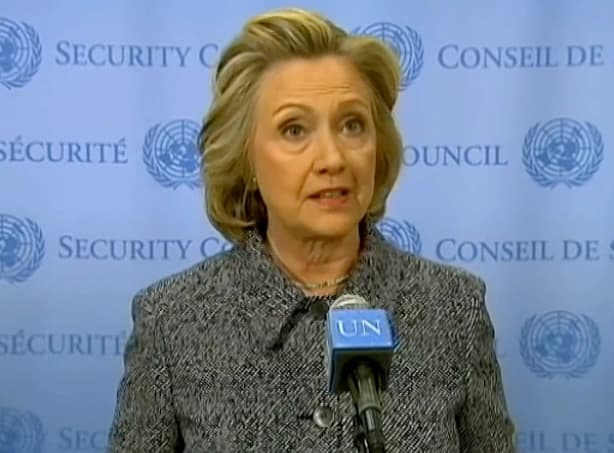
FILE: Hillary Clinton at a press conference about her use of personal email while in office as United States Secretary of State, taken March 10, 2015. Voice of America/

The FBI failed to thoroughly and completely investigate Secretary Clinton’s private email server or its national security implications, the Senate Judiciary Committee’s chairman, Charles Grassley, claimed Monday as he released documents declassified by the Trump administration as part of an effort to revisit intelligence and Department of Justice probes conducted in previous administrations.

Mr. Grassley said he was sharing the “annex” of files withheld from the inspector general’s 2018 report, in an effort to be more transparent. The documents, handed over by Attorney General Bondi, were part of an investigation that was closed nearly nine years ago.  

Mrs. Clinton has long denied any wrongdoing. The FBI closed its probe on the eve of the 2016 presidential election after the then-FBI director, James Comey, concluded that the Democratic presidential candidate was “extremely careless” with her emails while secretary of state, but no prosecution would be brought. 

The Clinton investigation — on top of the “Russiagate” probe and the Epstein files debacle — has long frustrated the MAGA base, considering no arrests were made. On Monday, Mr. Grassley criticized the FBI’s handling of the case compared to one conducted against Mr. Trump not long afterward.

“Under Comey’s leadership, the FBI failed to perform fundamental investigative work and left key pieces of evidence on the cutting room floor,” Mr. Grassley said in a statement Monday. “The Comey FBI’s negligent approach and perhaps intentional lack of effort in the Clinton investigation is a stark contrast to its full-throated investigation of the Trump-Russia collusion hoax, which was based on the uncorroborated and now discredited Steele dossier.”

Mr. Grassley says the 31-page, heavily redacted files allegedly show that the FBI “failed to thoroughly and completely investigate the Clinton matter … as well as vet the serious national security risks created by Clinton’s careless handling of highly classified information.” 

He says the justice department’s inspector general found the FBI failed to investigate a number of thumb drives obtained during the investigation, as well as communications between the then-DNC chairwoman, Debbie Wasserman Schultz, and George Soros’s Open Society Foundation. 

A document in the files claims that a source identified only as “T1” provided eight thumb drives to the justice department and FBI for review. Those files included communications related to FBI operations and other information from the executive office of the president and the U.S. House of Representatives. There were also Department of State communications included in the files. 

Mr. Grassley alleges that investigators “never comprehensively reviewed five of the thumb drives, despite there being information that could be relevant to their email investigation.” A lawyer for the FBI allegedly told the office of inspector general that it did not review the files due to executive and congressional privilege concerns. 

The release is the latest in the Trump administration’s dig through Obama-era intelligence and law enforcement activity that officials say were weaponized against Mr. Trump. Just this week, the director of national intelligence, Tulsi Gabbard, declassified documents in the release of her own report showing alleged political bias in the “Russiagate” investigation. 

Ms. Gabbard pointed to a December 2016 draft of the president’s daily briefing for President Obama, which stated that the intelligence community believed the Russians “did not impact recent US election results by conducting malicious cyber activities against election infrastructure.”

The following day, Mr. Obama’s national security team met to discuss Russia at the White House, after which the staff of the then-director of national intelligence, James Clapper, asked “per the President’s request” to create a new intelligence assessment on “information we have on the tools Moscow used and the actions it took to influence the 2016 election.”


The New York Sun

© 2025 The New York Sun Company, LLC. All rights reserved.

Use of this site constitutes acceptance of our Terms of Use and Privacy Policy. The material on this site is protected by copyright law and may not be reproduced, distributed, transmitted, cached or otherwise used.

The New York Sun

Sign in or  create a free account

or
By continuing you agree to our Privacy Policy and Terms of Use