

Guillermo del Toro Brings to Netflix a New Version of ‘Frankenstein’

Welcome to the 21st century’s version of the studio system. As ‘Frankenstein’ proves, there are worse things that could be reanimated.
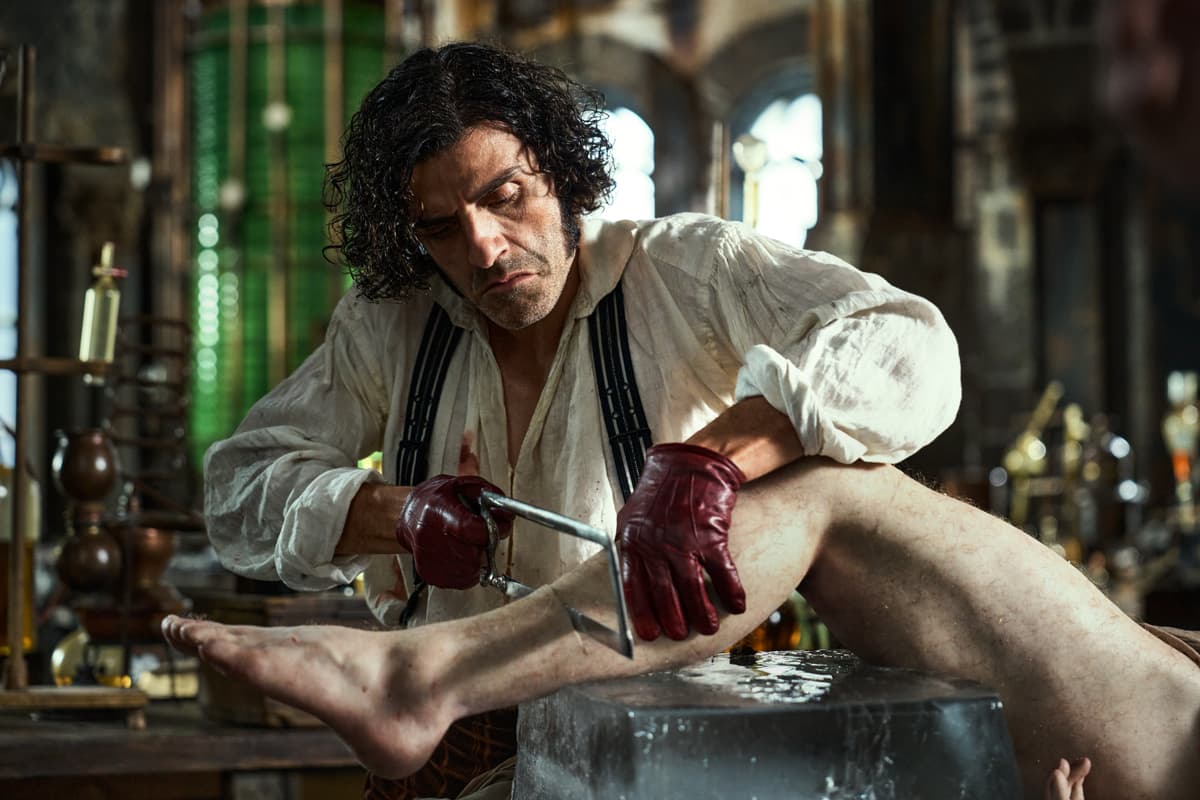
Ken Woroner/Netflix © 2025.
Oscar Isaac as Victor Frankenstein in 'Frankenstein.' Ken Woroner/Netflix © 2025.

Guillermo del Toro’s “Frankenstein,” a movie set to stream on Netflix starting Friday, is the closest any contemporary filmmaker has come to achieving the romanticism and sweep of old Hollywood. Mr. del Toro has an antiquarian’s taste for fine detail, burnished surfaces, and immaculate craftsmanship. 

His collaborators match him step-for-step, whether it’s Alexandre Desplat’s stirring soundtrack, Tamara Deverell’s elaborate and often outrageous production design, or Dan Lausten’s cinematography, which is operatic in its play of light and shadow. “Frankenstein” is a resplendent visual experience.

As a filmmaker, Mr. del Toro is remarkably warm-hearted. Bereft of either cynicism or irony, he embraces sentiment with nary a qualm. His knowledge of cinema is as deep as his gratitude toward those who preceded him. The Paris Theater has been hosting an ongoing series, “Monsters and Makers: The Gothic Visions of Guillermo del Toro,” in which the auteur’s corpus is being juxtaposed with films that have inspired him, including Jean Cocteau’s “La Belle et la Bête” (1946) and Terence Fisher’s “The Curse of Frankenstein” (1957).

Mr. del Toro has spoken, in energetic and often moving terms, about the decisive impact made on his life by James Whale’s “Frankenstein” (1931) and “The Bride of Frankenstein” (1935). Movie fans will recognize nods to these films in the current picture — if not through outright quotation, then in mood and atmosphere. Mr. del Toro’s movie also brings to mind Mel Brooks’s “Young Frankenstein” (1974), another film whose love for classic movie monsters is as plain as the bolts in the character’s neck.

Oh, and then there’s Mary Shelley: How true is Mr. del Toro, who also wrote and co-produced “Frankenstein,” to her story of “The Modern Prometheus?” Truer than most, I suppose, but in the great cinematic tradition of book adaptation, he plays fast-and-loose with the original text. New characters are introduced, the time frame is scuttled, and there are moments of explicit physical trauma that would have put Shelley in a swoon. Still, Mr. de Toro’s version of the monster, here played by 6-foot, 5-inch Jacob Elordi, is as philosophical as its author intended.

Jacob Elordi as The Creature in ‘Frankenstein.’ Ken Woroner/Netflix © 2025.

As for the story: What’s to tell? Victor Frankenstein (Oscar Isaac), a surgeon who is as brilliant as he is headstrong, has some curious ideas about the reinvigoration of dead tissue. He is summarily booted out of a hospital gig after showcasing his first halting experiments with bits-and-pieces scavenged from an accumulation of corpses. 

A dealer in military weaponry, Henrich Harlander (Christoph Waltz), approaches the good doctor with an offer he can’t refuse: a laboratory built to his specifications, unlimited funding, and vague intimations of repaying his kindness at some point in the future. Victor is taken with Harlander’s niece, Lady Elizabeth (the aptly named Mia Goth), who is set to marry his half-brother, William (Felix Kammerer).

What follows is an epic exegesis on the illusions fostered by hubris. Mr. del Toro leavens his “Frankenstein” with a heady dollop of Christian iconography, as well as a Christian notion of forgiveness. Although the company with which I saw the movie complained of its portentousness, there’s not a dull moment in its proceedings. 

Granted, one might wonder if the world needed another accounting of well-trod ground. Like his remake of Edmund Goulding’s “Nightmare Alley” (1947), “Frankenstein” is a venture whose necessity remains a nagging question. Mr. del Toro may have realized a dream project and done so with considerable panache, but, in the end, “Frankenstein” redounds less for the audience than it does for the company who provided the bankroll, Netflix.

In other words, welcome to the 21st century’s version of the studio system. As “Frankenstein” proves, there are worse things that could be reanimated.


The New York Sun

© 2025 The New York Sun Company, LLC. All rights reserved.

Use of this site constitutes acceptance of our Terms of Use and Privacy Policy. The material on this site is protected by copyright law and may not be reproduced, distributed, transmitted, cached or otherwise used.

The New York Sun

Sign in or  create a free account

or
By continuing you agree to our Privacy Policy and Terms of Use