
Gustav Klimt, Visionary of Vienna, Soars to the Stratosphere With $236.4 Million Sale That Sets Record for Modern Art

‘Portrait of Elisabeth Lederer,’ a painting that survived the Holocaust, is sold for an astonishing sum.

Via Sotheby's
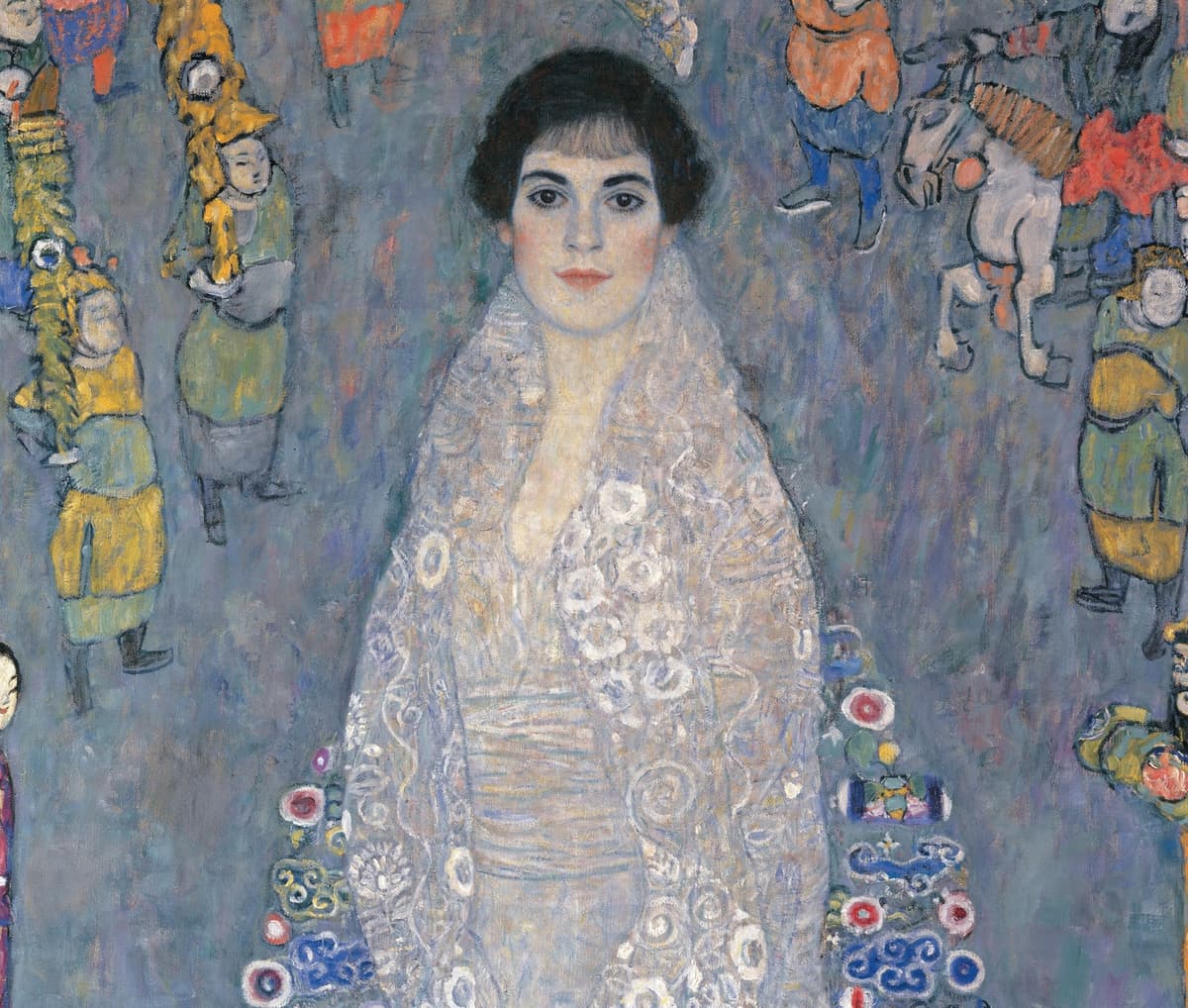
'Portrait of Elisabeth Lederer' by Gustav Klimt, 1914-16. Detail. Via Sotheby's

The sale at Sotheby’s this week of the Austrian artist Gustav Klimt’s “Portrait of Elisabeth Lederer” for $236.4 million makes it the most expensive work of modern art ever sold at auction. Never before has Sotheby’s, now installed at its new home at the Breuer building on Madison Avenue, sold a painting for so much money. The Klimt was the jewel of the Leonard A. Lauder Collection, which together with other works brought in more than $700 million. 

The buyer of the Klimt is as of yet unknown. The previous record for a work of modern art was the $195 million fetched three years ago at Christie’s by an Andy Warhol concoction, “Shot Sage Blue Marilyn.” The dearest painting ever sold by an auctioneer’s gavel is “Salvator Mundi,” purported to be from the hand of Leonardo da Vinci. In 2017 a buyer thought to be acting on the command of  Prince Bader Al Saud paid $450.3 million.

Klimt painted “Portrait of Elisabeth Lederer” between 1914 and 1916. Elisabeth was the daughter of his wealthy Jewish patrons  Serena and August Lederer. Serena was the grandniece of Joseph Pulitzer and her husband was a towering industrialist who patronized Vienna’s most visionary artists. When Klimt painted this life-sized rendering of Elisabeth the Lederers counted themselves the richest Jewish family of Vienna save for the Rothschilds.

'Porträt der Adele Bloch-Bauer I' by Gustav Klimt, 1907.
‘Porträt der Adele Bloch-Bauer I’ by Gustav Klimt, 1907. Via Wikimedia Commons

The Lederer’s landmark art  collection was one of the first seized by the Gestapo following the Anschluss of 1938. The portrait survived the war unscathed, and in 1948 was returned to Elisabeth’s brother, Erich. In 1985, after changing hands several times, it was bought by Lauder, an heir of the Estée Lauder cosmetics fortune, who hung it up above his dining room table at New York City. The Lauder collection numbered some 55 works before its sale.

“Portrait of Elisabeth Lederer” is every inch a Klimt. One look confirms that the viewer is in the world of, say, “The Kiss,” “Woman in Gold,” and “Lady With a Fan.” There was arguably  no more glorious painter of women — and certainly of Jewish women — in the 20th century than Klimt. Elisabeth here is poised on the precipice between the girl she was and the woman she will become. She is not haughty but confident in the manner of the blessed.

Elisabeth wears an imperial Chinese dragon robe, reflecting pre-war Vienna’s craze for the Far East— the netsuke figures at the center of Edmund de Waal’s “Hare With the Amber Eyes” come to mind — as well as the cosmopolitan horizons of a young Lederer lady. Klimt had painted Serena in a similar gown, suggesting a close eye for what was à la mode. The carpet beneath Elisabeth’s feet is a vibrant orange with electric flecks of Chinese jade.

The painting’s background is mysteriously filled with smaller Chinese figures in various poses and positions, all dwarfed by the towering Elisabeth. The tableaux possesses a dream-like quality, a vision of transport and imagination run wild. Vienna was, at this moment, a city of dreamers — Sigmund Freud interpreted dreams, Theodor Herzl dreamed of Zion, and a Viennese artist and army veteran named Adolf Hitler was readying to launch his nightmare.

'The Kiss' by Gustav Klimt, 1907.
‘The Kiss’ by Gustav Klimt, 1907. Via Wikimedia Commons

Elisabeth’s own life outside of this triumphant canvas was the stuff of disappointed dreams. She married an Austrian baron in 1921, converting to Protestantism for her new husband. By 1934 she was divorced and returned to the faith of her ancestors. When the swastika rose over Vienna Elisabeth, astonishingly, secured a document that averred that Klimt was her father. Her former brother-in-law was also a Nazi official who offered protection.

The deportations of Vienna’s Jews began in October of 1939 at the orders of Adolf Eichmann, who ran his Central Office for Jewish Emigration from the city. By 1942, almost all of Vienna’s Jews had been sent to the East, where the overwhelming majority were murdered. Elisabeth evaded the trains. When she died in 1944, it was from illness. In this portrait, now forever associated with a price far above rubies, the darkness is banished by brilliant light.


The New York Sun

© 2025 The New York Sun Company, LLC. All rights reserved.

Use of this site constitutes acceptance of our Terms of Use and Privacy Policy. The material on this site is protected by copyright law and may not be reproduced, distributed, transmitted, cached or otherwise used.

The New York Sun

Sign in or  create a free account

or
By continuing you agree to our Privacy Policy and Terms of Use