
Hamas Winning Propaganda War as Israel Changes Gaza Policies After Deceptive Images Go Viral
Two images of supposedly starving children that were splashed on social media, world television screens, and newspaper front pages reportedly depict individuals with medical conditions unrelated to the war.
President Trump says images of starving children can’t be faked, perhaps reflecting a grim reality in Gaza. Yet, fakery is behind at least some of a growing global anger at Israel’s war policies
“That’s real starvation stuff. I see it, and you can’t fake that,” Mr. Trump said Monday at his Scotland golf resort alongside Prime Minister Starmer of Britain. “Based on television” images, he added, “those children look very hungry.”
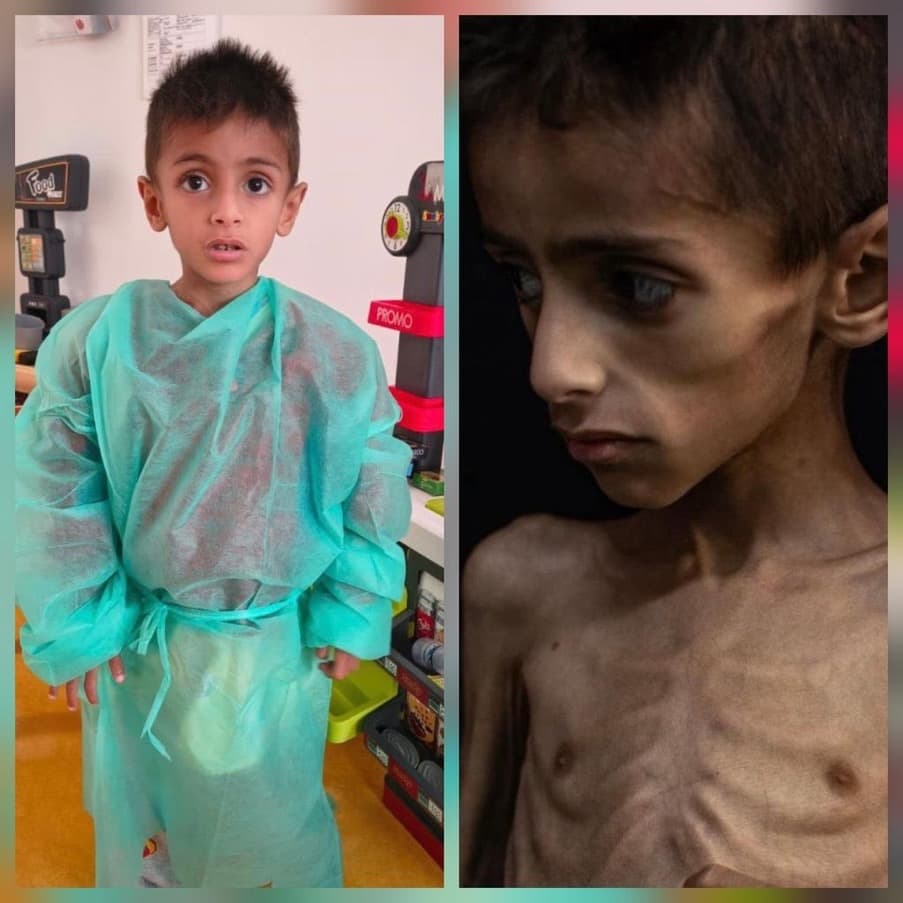
Yet two misleading images that over the weekend were splashed on social media, world television screens, and newspaper front pages — in the process becoming symbols of the hunger of children — reportedly depicted individuals with medical conditions unrelated to the war.
Gaza does suffer from worsening humanitarian conditions. Yet, over-amplification due to global street protests and reactions by world governments are forcing Israel to change policies, even if those moves could diminish the hope of eradicating the terror group behind many of the problems in Gaza, Hamas. With Israel reacting slowly to fast-moving memes, Hamas is winning the propaganda wars even as it loses on the battlefield.
“A photo of 5-year-old Osama al-Rakab has gone viral, used to falsely depict Israel as responsible for his condition, claiming Israel is starving children,” the Israel Defense Force’s coordinating body in Gaza, Cogat, wrote on X Monday. The photo, published a few weeks ago, showed a body reduced to skin and bones.
In reality, “Osama suffers from a serious genetic illness unrelated to the war,” Cogat wrote. “On June 12, we actively coordinated Osama’s exit from Gaza with his mother and brother through the Ramon airport. He is now receiving treatment in Italy.”
Another photo, which first appeared on the front page of Britain’s Daily Express last week and was later highlighted by the BBC, CNN, the New York Times, and others, shows a very thin-looking Mohammed Al-Matouq being held by his mother and watched over by a brother.
The first clue that something could be wrong should have been the stark difference between Mr. Matouk’s appearance and that of the apparently well-fed mother and brother. “Any honest journalist should have immediately questioned, and reported, what we were actually seeing,” an independent journalist, David Collier, wrote on X.
Mr. Collier obtained a May 25 medical report from Gaza, according to which Mr. Matouq suffers from cerebral palsy, has hypoxemia, and was born with a serious genetic disorder. None of this was “disclosed in a single major outlet,” Mr. Collier writes.
Yet, the photos, and the real humanitarian hardships that they falsely claimed to represent, became so prominent that they forced Israel to alter strategies. Over the weekend the IDF announced it would effectively apply a one-sided cease-fire in Gaza population centers during daylight time to facilitate aid deliveries. Alongside America and Jordan, it also started parachuting food, medicine, and other products into northern Gaza.
Such measures were enacted even as Prime Minister Netanyahu said Monday, “There is no starvation in Gaza, no policy of starvation in Gaza.” Mr. Trump disagreed, saying America is discussing policy changes like operating “food centers” in Gaza. “I’m speaking to Bibi Netanyahu, and we are coming up with various plans,” he said. “It’s a very difficult situation.”
Hamas, Mr. Trump said, can hardly be defeated while it holds 20 live hostages that it sees as insurance against defeat. Israel and America know where most hostages are held, and “you don’t want to go riding roughshod over that area, because that means those hostages will be killed. Now, there are some people that would say, well, that’s the price you pay, but we don’t like to say that. And I don’t think the people of Israel want to say that either.”
Other world leaders, though, are less sympathetic to Israel’s dilemma. “Seeing those images of starving children in particular are revolting,” Mr. Starmer said. “There’s a sense of revulsion in the British public and what they’re seeing, and they know, we know that humanitarian aid needs to get in at speed, at volume.”
A conference led by France and Saudi Arabia to promote recognition of a Palestinian state opened at the United Nations on Monday. “Nothing can justify the obliteration of Gaza that has unfolded before the eyes of the world, the starvation of the population, the killing of tens of thousands of civilians,” the UN secretary-general, Antonio Guterres, said at the event’s opening.
Israel accuses the UN of abetting Hamas in preventing aid distribution and amplifying the suffering for tactical gains. “The UN is used to working in war zones all over the world, why can’t they do it here?” the IDF spokesman, Brigadier General Effie Efrin, said to reporters Sunday.
Some Israelis disagree. “As a people that went through the Holocaust, we need to be more sensitive to the sufferings of others, especially children,” the Tel Aviv University dean, Ariel Porat, said Monday. Yet, Mr. Netanyahu’s supporters say increased military pressure across Gaza would force Hamas to release the remaining hostages.