

‘Hamnet,’ With Paul Mescal as a Shakespeare Mad With Grief, Could Be the Year’s Best Movie 

A silver screen adaptation of Maggie O’Farrell’s novel is a bruising backstory of the Bard’s towering tragedy.
Agata Grzybowska for Focus Features
Jessie Buckley stars as Agnes in director Chloé Zhao’s 'Hamnet.' Agata Grzybowska for Focus Features

The names “Hamlet” and “Hamnet” were interchangeable 500 years ago in England, a linguistic quirk that is used to great effect by the Northern Irish novelist Maggie O’Farrell in “Hamnet: A Novel of the Plague.” That book, released in March 2020, delivered a Shakespeare for the age of COVID-19. Now comes a luminous and bruising film adaptation that paints the Bard in tones of grief that mingle tragedy and triumph. 

“Hamnet,” from director Chloé Zao, hews to Ms. O’Farrell’s margins — she wrote the screenplay — and approaches Shakespeare slantwise by focusing on the playwright’s anonymous early days with considerable literary license. Shakespeare’s father, John, was a glover. Ms. O’Farrell imagines their relationship as unhappy. History records that Shakespeare’s wife was named Anne Hathaway and that she was older than he was. It records not much else. 

In Ms. O’Farrell’s hands Anne becomes Agnes, a wild woman of the forest gifted with intuitions so strong they abut prophecy. It is she who encourages her husband to go to London to meet his destiny. She could be a cousin of the weird sisters from “Macbeth,” The Shakespeares had three children — Susanna and the twins Hamnet and Judith. Hamnet died in 1596 at age 11 just as the bubonic plague — the Black Death— ripped through England.

Five years later “The Tragedy of Hamlet, Prince of Denmark” premiered at the Globe Theater. Susanna and Judith both lived into old age, but Hamnet became “Hamlet,” arguably the most important play ever written. Could it be a coincidence that Shakespeare’s greatest play bears the same name as the son he lost? Ms. O’Farrell thinks not, and that link between loss and literature is rendered as an unbearable tradeoff: Hamnet died so “Hamlet” lives.

Paul Mescal stars as William Shakespeare in director Chloé Zhao’s 'Hamnet.'
Paul Mescal stars as William Shakespeare in director Chloé Zhao’s’Hamnet.’ Agata Grzybowska for Focus Features

Ms. Zao’s movie stars Paul Mescal as Shakespeare and an extraordinary Jessie Buckley as Agnes. No less exceptional are the rest of the cast, including Jacobi Jupe as Hamnet. Agnes’s brother is played by the ex-boyfriend, Joe Alwyn, of a second sonneteer, Taylor Swift, whose latest album features a single called “The Fate of Ophelia,” yet another limning of Shakespeare’s lore. This is no pristine costume drama. The movie has dirt under its fingernails.

Ms. Zhao has said of Mr. Mescal that “there’s something vibrating inside, like volcanic, like there’s an animal that wants to break out,” and some of the movie’s best scenes surface the cost of immortal writing. Wounded by rage at the loss of his son, Shakespeare snarls at his actors to speak the lines he wrote with passion, as if they were ripped from deep in the entrails. The “to be or not to be” soliloquy comes to a man half in love with death.

Shakespeare in “Romeo and Juliet” writes of a “a mad blood stirring,” and both Mr. Mescal and Ms. Buckley deliver performances that have a cracked open feeling that radiates rawness. Hamnet’s loss blows them apart rather than soldering them together, as Will’s off-screen trips to London become longer and longer. He is away when the plague strikes his family — first his daughter Judith, who survives, and then his son. Guilt and helplessness make for an agonizing brew. 

“Hamnet” shows the agony of illness and the pain of childbirth in the age before modern medicine. Bodies are put through the wringer. Death stalks everyone and is especially avid for women and children. Agnes’s knowledge of the wisdom bound in the tubers and xylem of roots and herbs — in the call of her hawk— does not avail to protect her family. She is outraged when she is handed a playbill with the names of her absent husband and dead son.

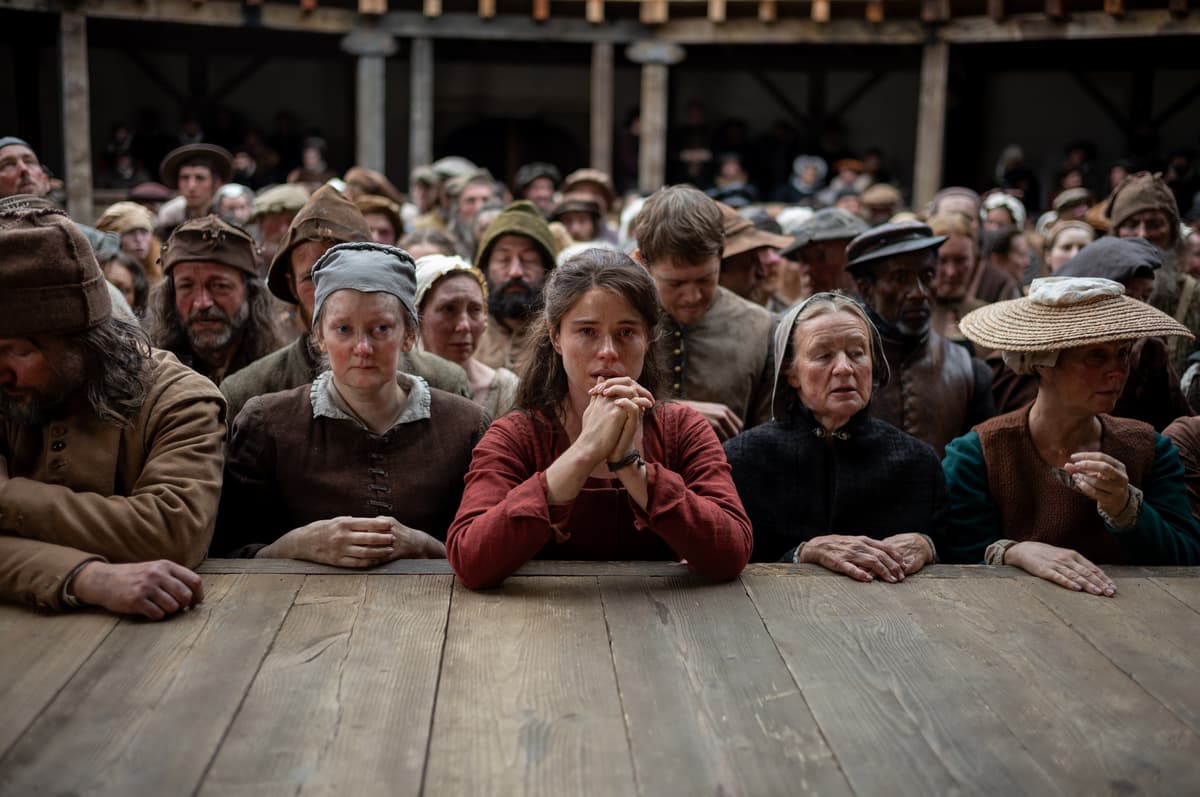
The movie glides from good to great in its final scene, where Agnes travels to London to see for herself what her husband, now on his way to attaining a stature that another playwright, Ben Jonson, called “not of an age, but for all time.” Agnes crowds in close, her hands touching the wood of the stage. Ms. Buckley’s face is the ravaged and mutable canvas that registers the sense that her tragedy  — their family’s catastrophe—  has been looted for the stage.

Ms. Buckley also captures another experience — that of a woman seeing a play for the first time in her life. The actor on her stage has her son’s name but is not her son. Her husband, caked in white paint that flakes as his throat pulses with emotion, plays the ghost of Hamlet’s father, a role the records show Shakespeare originated. “Hamlet” features a play within a play, and “Hamnet” is a movie about a play that is in turn about the loss of a boy.

The most powerful scenes are seen sideways. Mr. Mescal, in his dressing room off-stage, listening to the words he wrote as he sobs in ghostly garb and Ms. Buckley absorbs this strange memorial to their son. One of the film’s most beautiful songs is titled “Undiscovered Country,” after that terrain that Hamlet eyes — but ultimately abjures  —  in his famous soliloquy. The end of the  movie, like the play, turns grief into glory and tragedy into triumph.   


The New York Sun

© 2025 The New York Sun Company, LLC. All rights reserved.

Use of this site constitutes acceptance of our Terms of Use and Privacy Policy. The material on this site is protected by copyright law and may not be reproduced, distributed, transmitted, cached or otherwise used.

The New York Sun

Sign in or  create a free account

or
By continuing you agree to our Privacy Policy and Terms of Use