

Harvard Astronomer Claims Interstellar Object Barreling Around Our Solar System Could Be Alien Technology

The object, estimated to be the size of a city block, is only the third known interstellar visitor to our solar system since scientists began keeping track of such things.
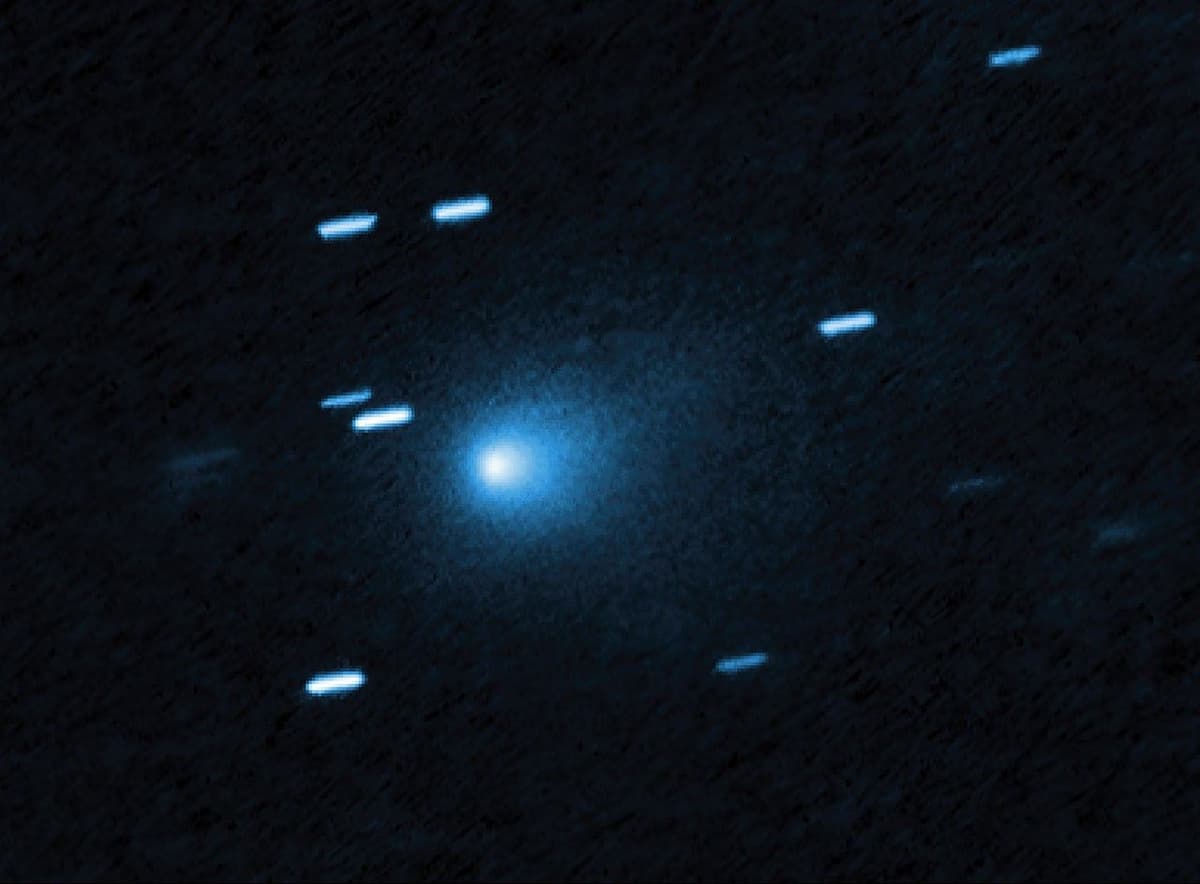
Image: NASA, ESA, David Jewitt (UCLA); Image Processing: Joseph DePasquale (STScI)
The Hubble telescope captured this image of the interstellar comet 3I/ATLAS on July 21, 2025, when the comet was 277 million miles from Earth. Hubble shows that the comet has a teardrop-shaped cocoon of dust coming off its solid, icy nucleus. Image: NASA, ESA, David Jewitt (UCLA); Image Processing: Joseph DePasquale (STScI)

A Harvard astronomer is making waves by suggesting that a massive interstellar object hurtling through our solar system might be an alien spacecraft. 

Professor Avi Loeb, who also serves as director of the Institute for Theory and Computation at the Harvard-Smithsonian Center for Astrophysics, has theorized that the object, named 3I/ATLAS, is exhibiting unusual behaviors inconsistent with a natural comet.

The object, estimated to be the size of a city block, is the third known interstellar visitor to our solar system and is expected to make its closest approach to Earth in mid-December, passing within about 167 million miles.

While NASA has dismissed Mr. Loeb’s more dramatic claims, the Harvard professor insists the anomalies surrounding 3I/ATLAS warrant serious consideration.

Mr. Loeb points to several puzzling characteristics of the object. He notes its path is closely aligned with the plane of our solar system’s planets, a coincidence he says has a “one in 500” chance of occurring randomly. Its sheer size is also anomalous, being 1 million times more massive than Oumuamua, the first interstellar object detected in 2017.

Most strikingly, recent images captured on November 8 show at least seven distinct jets of material emanating from 3I/ATLAS. In a recent analysis, Mr. Loeb noted that some of these jets appear to point towards the sun, which is contrary to the behavior of a typical comet, whose tail usually is pushed away by solar wind.

“Its jet path was not away from the Sun like comets,” Mr. Loeb said in a Monday piece on Medium. “In July and August, the glow extended from the object towards the Sun, not away.”

Mr. Loeb has provocatively speculated that these jets could be “coming from a set of thrusters used for navigation of a spacecraft,” though he concedes they could also be natural pockets of ice vaporizing on a comet’s surface.

“Houston, we have a problem with the natural comet hypothesis!” Mr. Loeb wrote after calculating that the energy required to produce the observed mass loss is far greater than what the sun could provide to an object of 3I/ATLAS’s estimated size. He suggests this discrepancy either means the comet is disintegrating or it isn’t a natural object at all.

Mr. Loeb’s theories have often been met with skepticism from the scientific establishment, a reaction he compares to historical resistance to groundbreaking ideas.

“This is an example from the modern world of what the Vatican did at the time of Galileo,” Mr. Loeb said, recalling an editor who asked him to remove a sentence suggesting 3I/ATLAS might be targeting our solar system. “People have their own prejudices.”

He argues that the scientific community should remain open-minded. “The whole idea of doing science is to maintain an agnostic point of view, be curious, wonder over the possibilities,” he said. “It’s what makes science exciting.”

Comparing the search for extraterrestrial life to checking one’s own backyard before exploring the neighborhood, Mr. Loeb explained his reasoning in a recent appearance on Joe Rogan’s podcast. “Suppose this is a visit from alien technology to the solar system,” he said. “It’s something we should all know about. It would change everything.”

“There is an appeal,” Mr. Loeb said, about the “fundamental questions that will affect our future, which we can address with scientific curiosity. It appeals to kids and the public.”

As 3I/ATLAS approaches its closest point to Earth on December 19, telescopes on the ground and in space will be watching closely. Whether it proves to be a natural phenomenon or something more extraordinary, Mr. Loeb has ensured that all eyes are on this mysterious visitor from another star system.


The New York Sun

© 2025 The New York Sun Company, LLC. All rights reserved.

Use of this site constitutes acceptance of our Terms of Use and Privacy Policy. The material on this site is protected by copyright law and may not be reproduced, distributed, transmitted, cached or otherwise used.

The New York Sun

Sign in or  create a free account

or
By continuing you agree to our Privacy Policy and Terms of Use