Harvard Hillel Calls Crimson’s Anti-Zionist Advice Worse Than ‘Genteel Antisemitism’ of Past

What makes the Crimson article ‘more troubling’ is its ‘morally tinged call to exclude Jews,’ Hillel’s executive director argues.

Scott Eisen/Getty Images
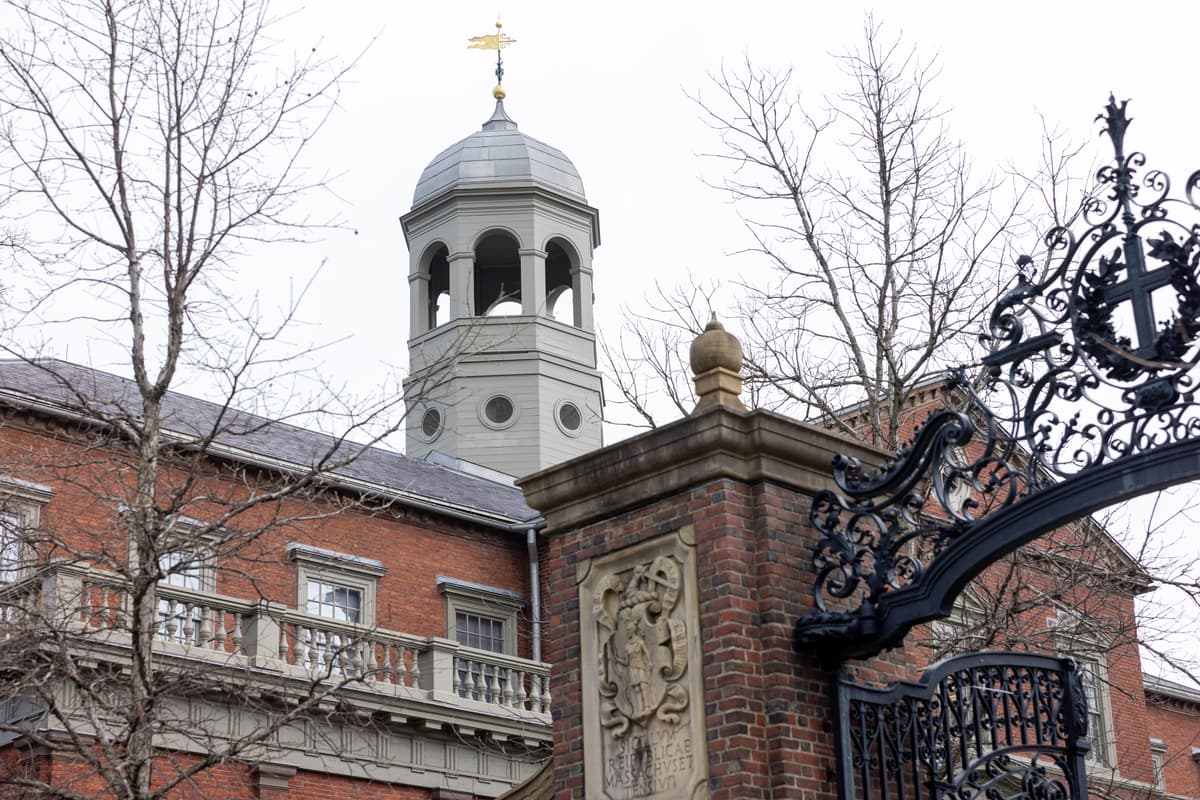
A tower on one of the Harvard University buildings April 15, 2025 at Cambridge, Massachusetts. Scott Eisen/Getty Images

Harvard University Hillel has issued a forceful rebuke of the school’s student-run newspaper after its “Ethicist” columnist told readers they are “justified” in cutting ties with Zionist friends.

In an email sent Friday to Harvard’s Jewish community, the Jewish life center expressed “shock, hurt, and concern” over the Harvard Crimson’s controversial advice column, making clear it would not tolerate the exclusion of Zionists on campus.

Harvard Hillel’s executive director, Jason Rubenstein, drew a stark contrast between this incident and historical antisemitism at elite universities.

“It’s a critical thing to understand that this is not like the genteel antisemitism at the elite universities in the mid-20th century,” he said, noting that alumni from Princeton’s eating clubs in the 1960s who restricted Jewish membership “didn’t say they should” nor did they cite a “a moral obligation” to do so.

What makes the Crimson article “more troubling,” Mr. Rubenstein argues, is its “morally tinged call to exclude Jews, to exclude Jewish nationalism from the purview of one’s friend circle, from your circle of sympathy.”

He emphasized Harvard Hillel’s commitment to ensuring that Zionists have a place “among the political fabric of America, the social fabric of our communities, no less than anyone else,” adding that “any call to the contrary is a form of bigotry and discrimination.”

Mr. Rubenstein concluded his statement by saying he would ask the Crimson’s ethicist “what it’s like to write in the context of widespread discrimination against Jewish students” and how they address concerns about “contributing to a plausibility structure of discrimination, marginalization, demonization, and bigotry.”

The backlash centers on a recent edition of the paper’s “Amateur Ethicist” column responding to a self-described “Jewish and anti-Zionist” student questioning whether to end friendships with peers who support the Jewish right to self-determination in their ancestral homeland. 

“I am still friends with a few Zionist students, but have become increasingly unsure about how to navigate my relationships with them,” the student wrote. “My friends are good people, I want to believe, but their Zionism taints my certainty of that — especially after two years of Israel’s genocide in Gaza. Should I let go of my Zionist friends in the same way that many of them have already let go of me?”

Harvard junior Andrés Muedano, an opinion writer at the Crimson who authors the ethics column, concluded the answer was straightforward. “The answer is yes,” he wrote, affirming the student was “justified” in “letting go” of Zionist friends.

Mr. Muedano went further, exploring whether there might even be an obligation to sever such friendships. Citing Aristotle’s Nicomachean Ethics, he noted the philosopher’s position that “we do have an obligation to unfriend morally condemnable people” whose views might corrupt “our own moral ideas.”

Yet Mr. Muedano ultimately disagreed with Aristotle, arguing that “our moral and political beliefs can and should be strong enough to withstand disagreement, even within our closest relationships.”

The column prompted Harvard’s campus Chabad to issue a similarly sharp reprimand. “Would the Crimson publish: ‘Should I let go of my Muslim friends?’ or, ‘Should I let go of my gay friends?’”the Jewish religious and cultural center asked on X.

“If they would, read the published response to letting go of Zionist friends, and replace Zionism and Zionist with Islam and Muslim, ask yourself if the ‘Amateur Ethicist’ would respond this way if it was about letting go of Muslim or gay friends.”


The New York Sun

© 2025 The New York Sun Company, LLC. All rights reserved.

Use of this site constitutes acceptance of our Terms of Use and Privacy Policy. The material on this site is protected by copyright law and may not be reproduced, distributed, transmitted, cached or otherwise used.

The New York Sun

Sign in or  create a free account

or
By continuing you agree to our Privacy Policy and Terms of Use