Harvard Students Sob, Skip Class, Plan Protests Over Grade Inflation Report  

As the university considers reforms to address rampant A’s, Harvard students are losing their minds.
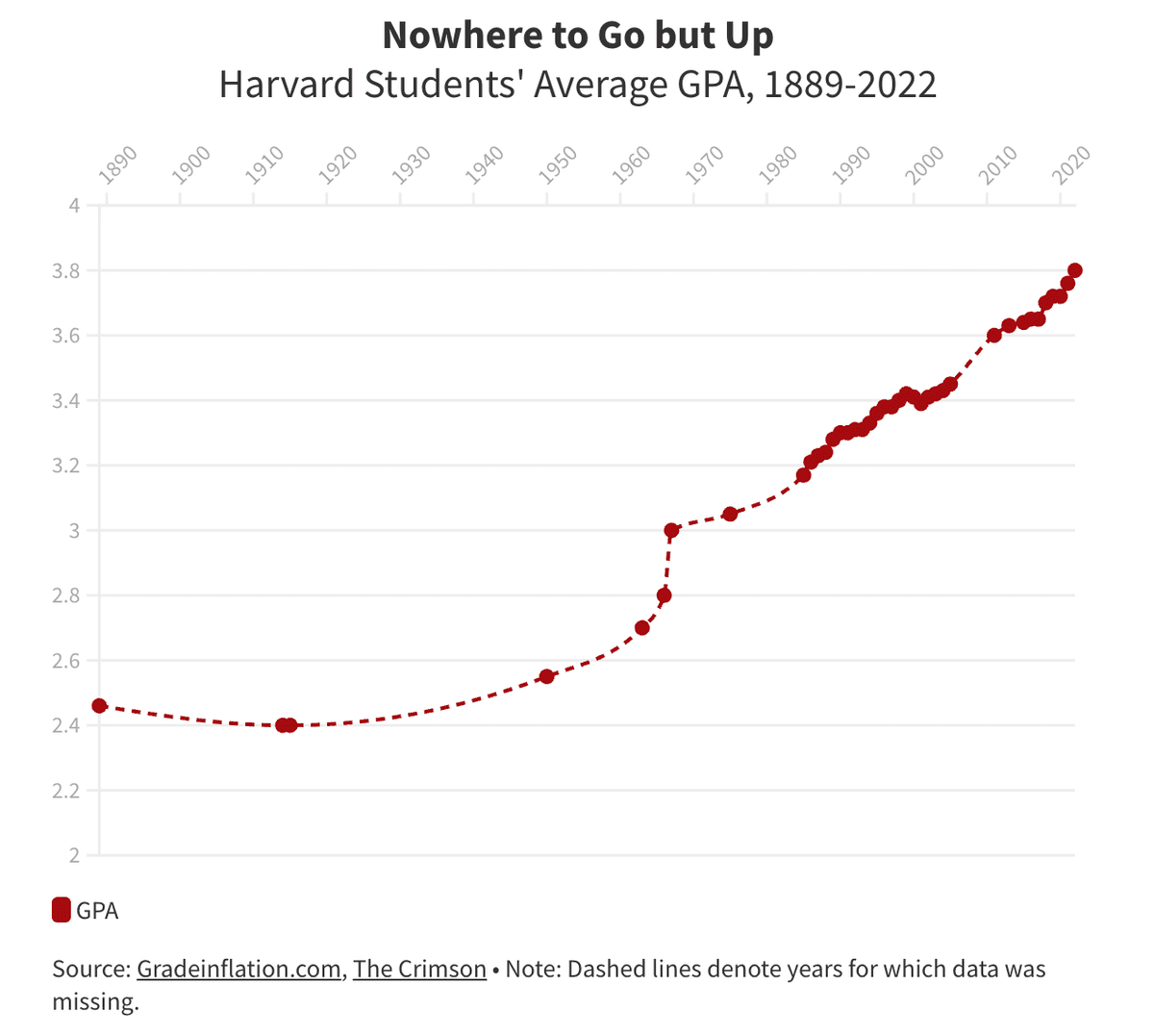

Via Harvard Crimson
A chart from Harvard Crimson, 'Grade Inflation: What Goes Up Must Come Down.' Via Harvard Crimson

Harvard University appears poised to finally address its rampant grade inflation problem — and its Ivy League students are not happy about it. 

A recent article from the student-run Harvard Crimson captures the visceral reactions of many undergraduates to the possibility of grading reforms following an internal report that uncovered the alarming extent of grade inflation at the prestigious institution. 

Published Wednesday, just two days after the report’s release, the Crimson article draws on interviews with approximately 20 Harvard students who collectively argue that the report “misrepresented their academic experience” and that “stricter grading could heighten stress without improving learning.” 

The individual student responses are particularly telling.

 “The whole entire day, I was crying,” one freshman shared. “I skipped classes on Monday, and I was just sobbing in bed because I felt like I try so hard in my classes, and my grades aren’t even the best.” She added that the report’s findings “just felt soul-crushing.”

Another first-year student said the report made her question her decision to attend Harvard altogether. “I killed myself all throughout high school to try and get into this school,” she explained. “I was looking forward to being fulfilled by my studies now, rather than being killed by them.”

The interviews offered common threads of anxiety — concerns about mental health, heightened test pressure, and fears about sacrificing commitments beyond academics.

“What makes a Harvard student a Harvard student is their engagement in extracurriculars,” another freshman argued. “Now we have to throw that all away and pursue just academics. I believe that attacks the very notion of what Harvard is.”

The backlash extended beyond the Crimson article. On an anonymous posting platform popular among Harvard students, Sidechat, one user called for a protest “against deflation” the following evening, urging peers: “Bring your books. Bring your syllabus. Bring your lighters.” The post garnered 303 upvotes.

The students’ intense reactions came in response to a 25-page report from Harvard’s Office of Undergraduate Education, released Monday, which delivered the sobering finding that more than 60 percent of grades awarded to Harvard undergraduates are now A’s. 

The report concluded that grade inflation has grown so severe that “grading no longer performs its primary functions,” and it offered recommendations to “restore the integrity of our grading.”

For some higher education observers, however, the students’ emotional reactions proved more shocking than the school’s troubles with grade inflation. 

“This is honestly worse than the report itself. My jaw just literally dropped,” remarked the director of higher education policy at the Manhattan Institute, John Sailer, in response to the Crimson article. 

A research fellow at the National Association of Scholars, Neetu Arnold, sought to make sense of the students’ outrage. “Students now expect constant validation, emotional comfort, and engagement,” she explained on X. “Raising standards disrupts these expectations, which feels like betrayal to students.” She argued, however, that “these are short-term reactions” and urged universities to “push past the complaints to reestablish rigor.” 

Scientist Jason Locasale, a tenured professor at Duke University, found the Harvard students’ responses less surprising. “The Harvard undergrads who worked with me were often the least capable researchers — not because they lacked intelligence, but because they’d never learned to focus deeply on one thing,” he shared on X. “They treated research like another extracurricular, always chasing a new club, cause, or volunteer trip instead of sitting with one hard problem for months.” 

Columnist and scholar the Hudson Institute, Walter Russell Mead, suggested that the issue originates elsewhere. “The biggest problem would appear to be in the Admissions Office,” he wrote plainly. 


The New York Sun

© 2025 The New York Sun Company, LLC. All rights reserved.

Use of this site constitutes acceptance of our Terms of Use and Privacy Policy. The material on this site is protected by copyright law and may not be reproduced, distributed, transmitted, cached or otherwise used.

The New York Sun

Sign in or  create a free account

or
By continuing you agree to our Privacy Policy and Terms of Use