
Headlong Rush To Ban Communist China’s Deepseek Ignores Potential Upside of the AI Breakthrough

As our forebears teach us, we simply don’t always know how things will turn out.
Justin Sullivan/Getty Images
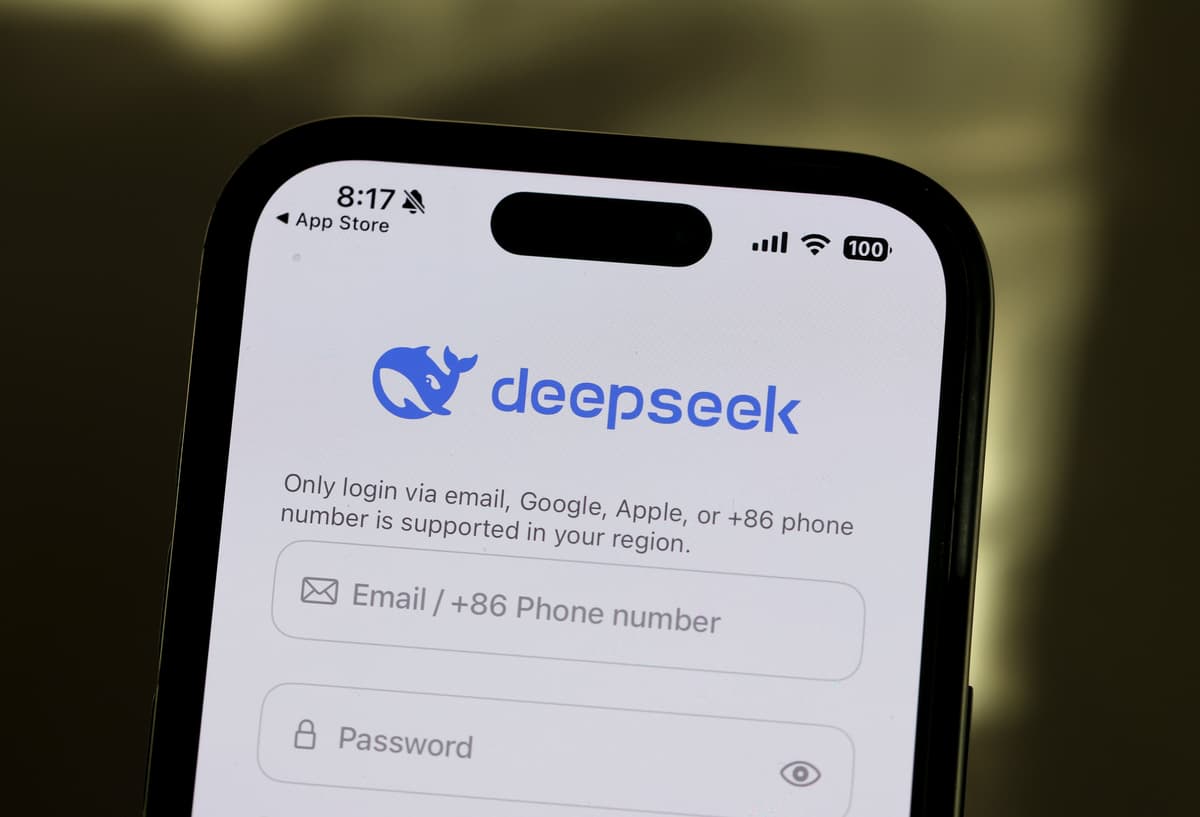
The DeepSeek app is displayed on an iPhone screen, January 27, 2025. Justin Sullivan/Getty Images

South Korea is the latest in a string of nations to prohibit Deepseek’s groundbreaking chatbot from operating, joining Australia, the Republic of China on Taiwan, Italy, and many others, including America, that have barred government employees from access to the platform.

Over the course of the last month, Deepseek has become a Rorshach test of sorts for those who use, develop, study, write about, and invest in AI, all of whom have drawn varying and often opposing conclusions. Above all, though, Deepseek’s explosion on the scene, and the concerted pushback against its advance, teaches us two key lessons: inspiration and humility. 

For AI cheerleaders, Deepseek’s swift ascendance presents further evidence of how rapidly machine learning breakthroughs have transformed technical, economic, and political landscapes.

The cheap, efficient capabilities of the new platform, maintain these advocates — whom in my forthcoming book on AI I label “positive autonomists” because of their belief that machines have already attained a measure of independence from their programmers — will democratize AI and hasten its rapid adoption across industries and geographies. 

Alex Rampell of Andreesen Horowitz, one of AI’s most enthusiastic venture funds, called Deepseek “a gift to the American people” that’s “radically reducing the cost of cutting-edge AI.”

For AI skeptics, though, the advent of Deepseek confirms their prior assumptions that the tens of billions of investment dollars thrown at large language models might as well have been tossed into an incinerator.

These skeptics, whom I call “negative automatoners,” because they doubt today’s machines can do much beyond what they’re coded to do, also indulge in a certain amount of schadenfreude at assertions by American LLM developers that Deepseek violated their terms of service and infringed their copyrights — especially given that those companies stand accused of similar infractions.

For AI doomers, or “negative autonomists” as I call them, Deepseek’s launch reinforces their terror at the rapidity with which our future robot overlords have advanced. This group has lauded South Korean and other efforts to suppress Deepseek’s rise.

And finally, for those who applaud machine innovation but contend today’s machines are little more than glorified word processing tools — the “positive automatoners” group — Deepseek’s materialization represents yet more proof of how simple and straightforward the technology has been all along.

In certain respects, each of these approaches has merit. Yet more fundamentally, both the rise of inexpensive, readily available AI and the risks it presents provide crucial instruction in inspiration and humility.

On one hand, Deepseek highlighted how exponentially fast machine technology has grown over the course of the past decade. If early indications are to be believed, the company has harnessed powerful LLM advances to shockingly austere computational power, thereby making them widely accessible at a much lower cost.

If true — assuming Deepseek hasn’t simply taken inappropriate or unrealistic shortcuts — then the cost of AI-dependent technology will have plummeted, unlocking drug discovery, protein-folding, language tools, and more that will enhance and extend life the world over. 

And humanity can take justifiable pride in midwifing the birth of such impressive capabilities. The Babylonian Talmud records that the Fourth Century scholar Rava “created a man,” a forerunner of the legendary golem and an astounding achievement. In keeping with the wisdom of our ancestors, we are fulfilling our unique, God-given potential as creative beings.

Deepseek’s arrival also laid bare just how poorly we understand or appreciate the unpredictability of emergent technologies. The dominant approach to developing LLMs involved showering money on computing clusters, multiplying power resources, and reaping the profits.

Sometimes genuine innovation takes the form of wringing more production out of fewer resources, though, and Deepseek appears to have done so. No wonder, then, that the red-faced chief executive of OpenAI, Sam Altman, said earlier this month that his company was “on the wrong side of history.” The golem, too, eluded the control of its creators and had to be forcibly reined in. As our forebears teach us, we simply don’t always know how things will turn out.

Then, too, humility must inform our regulatory behavior. President Trump wisely revoked his predecessor’s top-down, one-size-fits-all executive order on AI that would have locked in the advantages of the LLM giants and impeded innovation. Unfettered by pending regulation — although, to be sure, under the powerful shadow of the Chinese government — Deepseek built a juggernaut. 

At the same time, the company’s apparent lack of privacy safeguards threatens the integrity of its users’ data, as numerous countries have realized. The West would be wise to heed these lessons and encourage the adoption of rigorous, enforceable industry-wide standards developed by AI innovators themselves.

Will AI solve our most pressing societal problems or turn us all into paper clips? Nobody knows, of course. Yet if history is any guide, platforms like Deepseek should both inspire and chasten us to channel AI’s best attributes and jettison its worst.


The New York Sun

© 2025 The New York Sun Company, LLC. All rights reserved.

Use of this site constitutes acceptance of our Terms of Use and Privacy Policy. The material on this site is protected by copyright law and may not be reproduced, distributed, transmitted, cached or otherwise used.

The New York Sun

Sign in or  create a free account

or
By continuing you agree to our Privacy Policy and Terms of Use