Illinois Sues To Block Trump’s Attempts To Federalize National Guard, Send Texas Troops to Chicago

Governor Greg Abbott is offering to send his own National Guardsmen to blue states at the behest of the Trump administration.

Anthony Vazquez/Chicago Sun-Times via AP
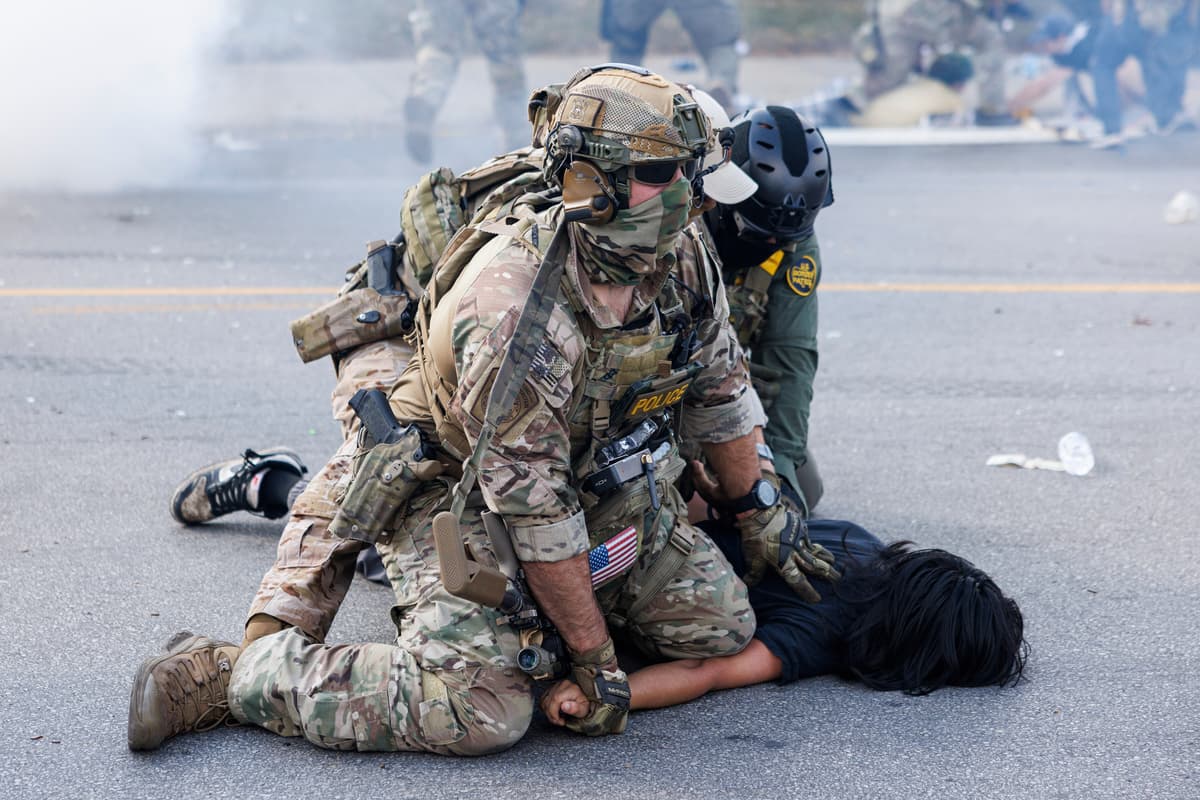
Federal officers hold down a protester in the Brighton Park neighborhood of Chicago, on October 4, 2025, after protesters learned that U.S. Border Patrol shot a woman Saturday morning on Chicago's Southwest Side. Anthony Vazquez/Chicago Sun-Times via AP

The state of Illinois is suing President Trump to block his attempts to federalize the state National Guard and deploy Texas National Guardsmen within Illinois’s borders, according to a new lawsuit filed Monday morning. The president has been running into legal challenges in his push to deploy soldiers to American cities, most recently as Sunday night when a judge he nominated to the bench blocked him from sending them to Portland, Oregon. 

Mr. Trump and his administration have been feuding with Governor JB Pritzker for weeks as part of their mass deportation operation. The Department of Homeland Security has surged Immigration and Customs Enforcement officers to conduct deportation raids, leading to protests at ICE facilities. The White House says anti-ICE protests necessitate the deployment of the National Guard. 

In the lawsuit filed Monday, Illinois argues that the president’s plans for National Guard mobilization violate the state’s constitutional rights, among other things. 

The administration’s “federalization of members of the Illinois National Guard usurps the Governor of Illinois’s role as Commander-in-Chief of the National Guard in Illinois, which he could and would use if necessary, and violates the State’s sovereign role over local law enforcement,” Illinois says, arguing that Mr. Trump is violating the Tenth Amendment. “Under our system of federalism, policing and crime control remain one of the most basic rights reserved to the States.”

The state argues that it is being punished not because of any violent crime problem, but because it does not share the policy prerogatives of the president — namely those policies related to mass deportations. It says that Mr. Trump’s attempts to federalize the National Guard represents an illegal targeting of a state’s sovereignty under Supreme Court precedent. 

“Defendants have treated certain States differently based solely on whether the administration approves of the State and local policies within those States,” the lawsuit argues. “Such disparate treatment without any basis violates the principle of equal sovereignty. Defendants’ selection of Illinois for National Guard federalization and deployment is, at best, arbitrary and, at worst, a politically motivated retaliation.”

Illinois is also suing Secretary Pete Hegseth, who has called up hundreds of National Guardsmen in both Illinois and Texas for law enforcement purposes in and around the city of Chicago. Illinois is asking the court to block both Mr. Hegseth’s order federalizing the Illinois National Guard, as well as his order calling up the Texas National Guard. 

Illinois further claims that the administration is violating the Posse Comitatus Act, a 19th century law aimed at limiting the federal government’s power in using the military for domestic law enforcement purposes. “Neither the Constitution nor any Act of Congress permits Defendants to use the armed forces, including the National Guard, for routine law enforcement, such as protest management or the suppression of violent crime or property damage,” the state argues. 

Mr. Trump’s attempts at deploying the National Guard in other states have run into legal challenges, which could bolster Illinois’s hope for relief from the courts. Just on Sunday, a federal judge in Oregon — who was nominated to the bench by Mr. Trump himself during his first term — ruled that the administration was violating her previous order to not deploy the state National Guard to Portland by simply calling up the California National Guard to conduct the operation. 

The White House, however, does not seem too concerned with that judge’s order. After she ruled that the administration could not move California guardsmen into Oregon, Deputy Chief of Staff Stephen Miller posted several messages to X about the judge’s order, saying she has “no conceivable authority” to block the president from directing military operations. 

“The President has undisputed authority under both statute and the Constitution to deploy troops, stationed in any state, to defend a federal facility from domestic terrorism or violent assault. (Just as he has the authority to dispatch any federal protective asset from and to any state),” Mr. Miller wrote in one message. “A district court judge has no conceivable authority, whatsoever, to restrict the President and Commander-in-Chief from dispatching members of the US military to defend federal lives and property.”

He called the order one of the “most egregious and thunderous violations of constitutional order we have ever seen.”

In another post, Mr. Miller reiterated his feeling that the judge has no role in overruling military operations which are directed by the president. 

“There is no legal distinction between a state volunteering guardsmen to guard the border and volunteering guardsmen to guard a federal immigration facility,” Mr. Miller wrote. “Either we have a federal government, a supremacy clause, and a nation, or we don’t.”


The New York Sun

© 2025 The New York Sun Company, LLC. All rights reserved.

Use of this site constitutes acceptance of our Terms of Use and Privacy Policy. The material on this site is protected by copyright law and may not be reproduced, distributed, transmitted, cached or otherwise used.

The New York Sun

Sign in or  create a free account

or
By continuing you agree to our Privacy Policy and Terms of Use