In Possible Warning Sign for Lisa Cook, Supreme Court Allows Trump To Fire FTC Commissioner as It Reviews Presidential Dismissal Powers

The justices also say they are going to review a landmark 1935 decision protecting certain executive appointees from presidential dismissal.

Mark Schiefelbein/AP
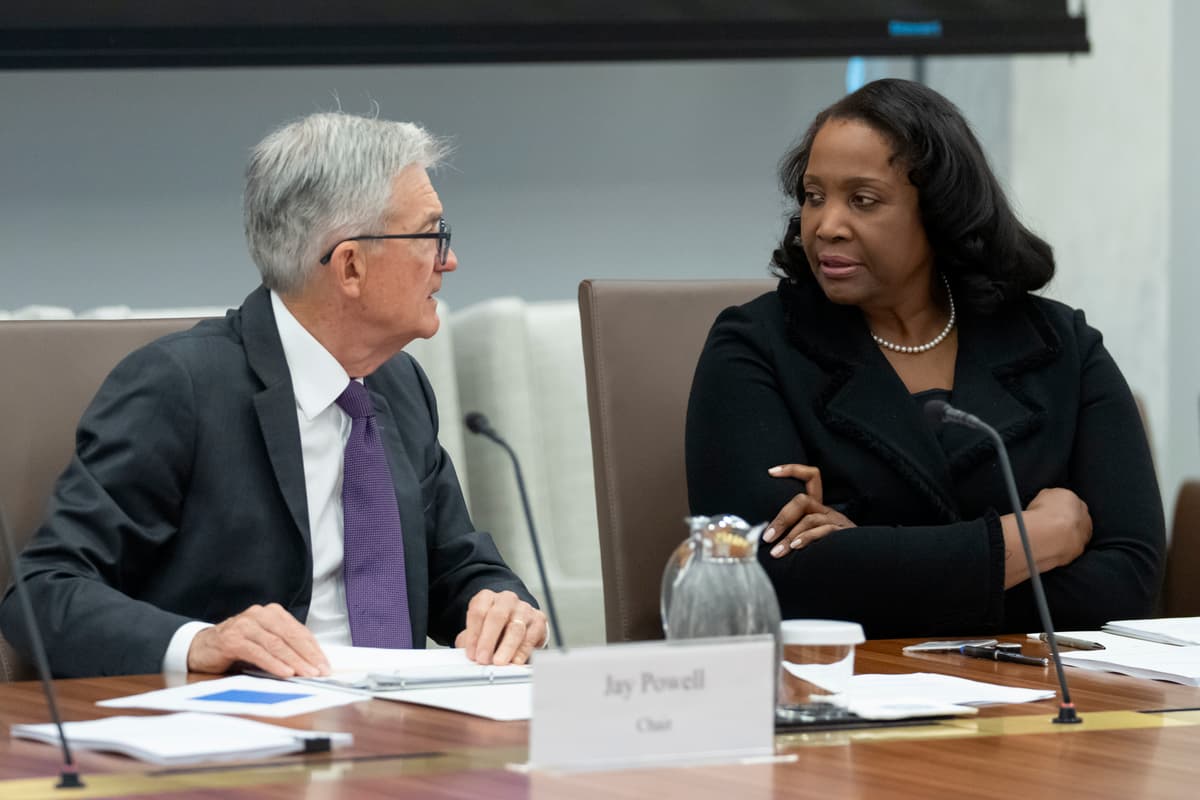
The Federal Reserve chairman, Jerome Powell, talks with Lisa Cook during a Board of Governors meeting at Washington on June 25, 2025. Mark Schiefelbein/AP

In what could be a potential warning sign for a Federal Reserve governor whom President Trump is seeking to fire, Lisa Cook, the Supreme Court is allowing the president to dismiss a member of the Federal Trade Commission. The court also says that later this year it will revisit a landmark 1935 decision protecting certain executive appointees from presidential dismissal. 

In March, Mr. Trump dismissed both Democratic members of the FTC, Rebecca Slaughter and Alvaro Bedoya. Days later, Ms. Slaughter sued to keep her job, citing the 1935 unanimous Supreme Court decision Humphrey’s Executor v. United States, which held that the president could not fire certain executive officials due to policy disagreements. 

“In short, it is bedrock, binding precedent that a President cannot remove an FTC Commissioner without cause. And yet that is precisely what has happened here,” Ms. Slaughter’s lawyers wrote in March. 

Both a district court judge and an appellate court panel sided with Ms. Slaughter, saying that the president, under the Humphrey’s Executor precedent, did not have the power to dismiss her. 

On Monday, the Supreme Court temporarily overruled the lower courts in a 6–3 decision, with all Republican appointees finding that she could be removed as the legal process plays out. They further ordered that they would take up the question of whether Ms. Slaughter’s firing was legal in December. 

They deal with more than just Ms. Slaughter’s dismissal, however. The justices are asking lawyers for both Ms. Slaughter and the Department of Justice to argue the constitutionality of the Humphrey’s Executor decision, as well as the question of whether “a federal court may prevent a person’s removal from public office, either through relief at equity or at law.”

Associate Justice Elena Kagan, joined by the court’s two other Democratic appointees, argued in her dissent that the court’s Monday order allowing Ms. Slaughter’s dismissal to take effect violates the court’s precedent. She also sounded the alarm about the court’s continued use of the emergency docket to “permit what our own precedent bars.”

“The majority, stay order by stay order, has handed full control of all those agencies to the President,” Justice Kagan writes, referring to the court’s affirmation of Mr. Trump’s dismissal of other executive officials from the National Labor Relations Board and the Merit Systems Protection Board earlier this year.

“He may now remove — so says the majority, though Congress said differently — any member he wishes, for any reason or no reason at all. And he may thereby extinguish the agencies’ bipartisanship and independence,” Justice Kagan writes of the president. 

The decision from the Supreme Court in reviewing Humphrey’s Executor could be a monumental one for the scope of presidential power in dismissing members of independent agencies and boards that are a part of the executive branch. If the president gets his way, it could also clear his path to dismiss a Federal Reserve governor, Lisa Cook, whom the president has accused of mortgage fraud as a pretext to remove her. 

Like in the case of Ms. Slaughter, Ms. Cook has won relief from district and appellate court judges in her quest to keep her job. After Mr. Trump tried to dismiss her in August, she sued to hold on to her position. Just as Ms. Slaughter did, Ms. Cook cited Humphrey’s Executor as a binding precedent that protected her from presidential dismissal. 

There is one bright spot for Ms. Cook, however. Earlier this year, in that case in which the court allowed Mr. Trump to fire members of the National Labor Relations Board and the Merit Systems Protection Board, the justices wrote a brief, yet significant, defense of the Federal Reserve as an independent organ of the executive branch. 

“The Federal Reserve is a uniquely structured, quasi-private entity that follows in the distinct historical tradition of the First and Second Banks of the United States,” the justices wrote in response to arguments from board members who claimed that they had similar protections as Fed governors. 

In a dissent in that case, Justice Kagan questioned why the conservative majority would offer a cryptic defense “out of the blue” for Fed members, when she believed that civil service protections for central bank governors also applied to members of other boards, agencies, and commissions. 

“The majority closes today’s order by stating, out of the blue, that it has no bearing on ‘the constitutionality of for-cause removal protections’ for members of the Federal Reserve Board or Open Market Committee. I am glad to hear it, and do not doubt the majority’s intention to avoid imperiling the Fed,” Justice Kagan wrote at the time. 

“But then, today’s order poses a puzzle. For the Federal Reserve’s independence rests on the same constitutional and analytic foundations as that of the NLRB, MSPB, FTC, FCC, and so on — which is to say it rests largely on Humphrey’s,” she continued. 


The New York Sun

© 2025 The New York Sun Company, LLC. All rights reserved.

Use of this site constitutes acceptance of our Terms of Use and Privacy Policy. The material on this site is protected by copyright law and may not be reproduced, distributed, transmitted, cached or otherwise used.

The New York Sun

Sign in or  create a free account

or
By continuing you agree to our Privacy Policy and Terms of Use