
In Simultaneous Summits, American Ally France and Good Friend India Make Nice With Putin and Xi Jinping
France’s Emanuel Macron and India’s Narendra Modi exchanged kind words but sealed few deals in meetings with the leaders of America’s most potent adversaries.
In a challenge to American security interests in Europe and Asia, America’s two greatest adversaries are courting Washington’s Indo-Pacific friend, India, and its NATO ally, France.
Russia’s President Putin has just wound up two days in New Delhi in a visit that was high on pomp and circumstance but short on what has Washington most concerned — real deals that would have Russia heaping both arms and oil on India.
“After the ceremonies,” a BBC commentary dourly observed, “was the absence of any blockbuster announcement.”
The statement issued by Messrs. Putin and Modi left no doubt they want to increase economic cooperation by the end of the decade and even consider India’s entry into a Eurasian Economic Union whose members are largely under Mr. Putin’s thumb. But the two sides appeared to have fired blanks in their bid to reach targets on arms and oil.
It wasn’t for lack of trying by Mr. Putin. He was willing to offer India just about everything that might be on Mr. Modi’s wish list.
Like an aggressive salesman pitching a new car, Mr. Putin “highlighted Russia’s role as India’s most reliable fuel and energy partner,” said the Times of India. “He said Moscow will ensure uninterrupted supplies needed for India’s fast-growing economy” and “stressed that energy cooperation extends beyond oil and gas to nuclear power projects.”
That wasn’t all. Mr. Putin also “reaffirmed half a century of military cooperation with India, as New Delhi prepares to request additional units of S-400 [air defense systems] and evaluates the next-generation S-500 Prometheus system,” the Times of India reported, marking “India’s biggest air-defense leap yet.”
Mr. Modi, sticking to Indian leaders’well-worn habit of appearing to get along just great with their foreign counterparts while hedging their bets diplomatically, had nothing but fine words for his guest. Mr. Putin “remains a source of great strength for the India-Russia friendship,” Mr. Modi tweeted. “Under his visionary leadership, bilateral and multilateral cooperation between our nations has scaled new heights.”
But to what heights? Faced with 50 percent tariffs imposed by President Trump for importing Russian oil, Mr. Modi didn’t bite right away on the bait dangled by Mr. Putin. That’s because he prefers to “walk a tightrope,” as Indian commentators have put it, between Russia — India’s biggest source of arms — and America, to which India is bound in “the Quad,” a four-sided “dialogue” that also includes Japan and Australia.
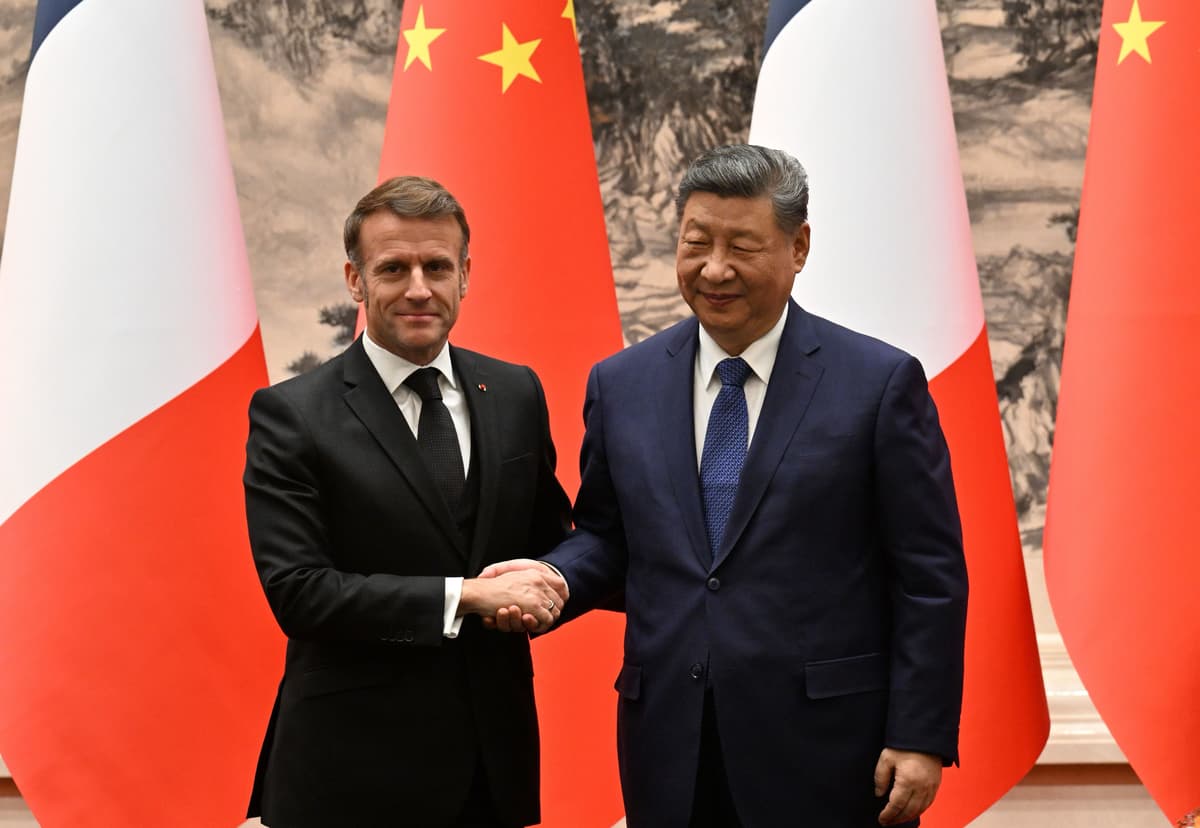
The visit to China by the French president, Emanuel Macron, and his wife, Brigitte, was no less portentous as a sign of China’s bid to drive a wedge among partners — in this case the members of the European Union and NATO — and negotiate separately with each of them.
For France, the challenge is to slash China’s huge trade surplus, which accounts for nearly half of the total French trade deficit.
By the time Messrs. Xi and Macron had signed a dozen agreements, including one on “panda conservation,” it seemed clear that they had yet to come down to specifics other than agreement for China not to impose tariffs on French cognac — surely a welcome concession to Chinese bon vivants.
As Mr. Xi put it, “China and France are special friends and win-win partners” — a line that did not guarantee much follow-through on vague promises to work on fields ranging from aerospace and aeronautics to nuclear energy.
Unlike Mr. Putin, however, Mr. and Ms. Macron were delighted to mingle tourism with formal negotiations. They flew to Chengdu in southwestern Sichuan province, where they sipped tea and said bonjour to a French-born giant panda, which France had sent to China.
Hanging over Mr. Putin’s visit to India and Mr. Macron’s to China was the war in Ukraine. All sides had evidently figured out how to dance around the rights and wrongs of the war without offending anyone.
Mr. Modi stoutly denied “neutrality” on the war — but avoided taking sides. Rather, he declared, “We support every effort for peace, and we stand shoulder to shoulder with every initiative taken for peace.”
Like Mr. Modi, Mr. Xi said China “supports all efforts that work toward peace” and called for a deal acceptable to all sides in response to Mr. Macron’s plea for “a moratorium on strikes targeting critical infrastructure.”