‘The Poems of Seamus Heaney’ Crowns the Irish Bard as the Peer of Yeats and Joyce

The Nobel-winning poet wrote of bogs and bombs with brilliance but never bombast.
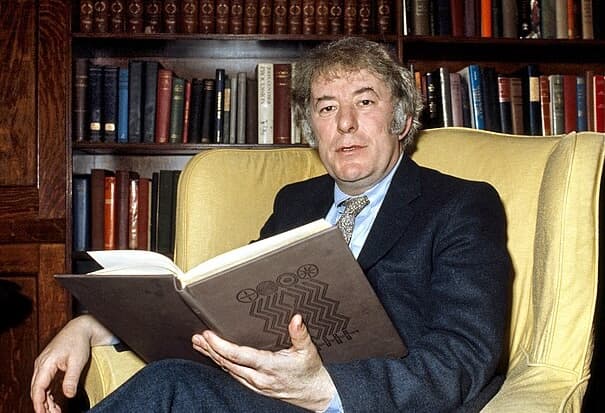
Bernard Gotfryd via Wikkimedia Commons

‘The Poems of Seamus Heaney’
Edited by Rosie Lavan, Bernard O’Donoghue, and Matthew Hollis

Farrar, Straus and Giroux, 1,296 pages

The publication of “The Poems of Seamus Heaney” is an occasion to celebrate the Nobel Prize winning poet whose work extends Ireland’s extraordinary literary lineage. Heaney takes his place alongside Oscar Wilde, William Butler Yeats, James Joyce, and the rest as one of the Emerald Isle’s preeminent writers. Heaney’s poetry scrapes the extraordinary while also sparkling with the gift of ordinary grace.

Robert Lowell — himself no slouch at the typewriter — called Heaney “the most important Irish poet since Yeats.” Heaney was born in 1939, the first of nine children to a Northern Irish Catholic family. The Heaneys were farmers and cattle dealers, meaning that Heaney’s poems of the earth were learned firsthand. He studied at Queens University at Belfast, lived and wrote in the city during the bloodiest years of the Troubles, moving to Dublin in 1976.

Heaney, while ineluctably Irish, also developed an American aspect. He was affiliated with Harvard for a quarter century, spending several months every year at an undergraduate residence, Adams House — “The arts and bohemia were represented there,” he said — where he was roundly acclaimed as a generous teacher. His simple quarters were, after his death, converted to a suite for writing and reading that this critic enjoyed on more than one occasion.

“The Poems” gathers all of Heaney’s published volumes, along with uncollected verse. His breakout was “Death of a Naturalist,” from 1966. The first poem in that volume is the celebrated “Digging.” It begins with a battle cry — “Between my finger and my thumb / The squat pen rests; snug as a gun.” The writer’s grandfather “cut more turf in a day / Than any other man on Toner’s bog.” The poet, though, has “no spade to follow men like them.” He’s a writer. 

Six years later came “Wintering Out,” a volume that deepens Heaney’s engagement with the Irish landscape while also bearing the imprint of a sabbatical at Berkeley just as the 1960’s kicked into gear — as did the Troubles. Heaney saw in these poems “signs of that loosening, the California spirit.” Still, he hears “in the shared calling of blood” a need for “antediluvian lore” where “an old chanter” breathes “its mists / through vowels and history.” 

Some of Heaney’s most indelible poems riff on the phenomenon of bog bodies, cadavers found embalmed in peat, some of them in Heaney’s home soil of Londonderry. “The Tollund Man” links one such corpse, found not in Ireland but in Denmark, to the slaughter of the Troubles. The poem ends with the speaker lamenting that “In the old man-killing parishes / I will feel lost / Unhappy and at home.” Heaney feels drawn to “Something of his sad freedom.”

In “Bog Queen” Heaney writes from within the peat, declaring that “my body was braille / for the creeping influences.” In “The Grauballe Man” he reflects on the “black river of himself / his hips are the ridge and purse of a mussel / his spine an eel arrested / under a glisten of mud.” To a young woman in the bog he writes “I almost love you/ but would have cast, I know, / the stones of silence. / I am the artful voyeur/ of your barin’s exposed/ and darkened combs.”

That poem ends with an invocation of “the exact and tribal, intimate revenge.” The Bard of Belfast knew whereof he spoke, though he was not one for straightforward politics. In “Whatever You Say, Say Nothing” he reflects that “The times are out of joint / But I incline as much to rosary beads / As to the jottings and analyses / of politicians and newspapermen.” Another poem, “Casualty,” is an elegy to an acquaintance killed on Bloody Sunday.  

In “Station Island” Heaney confronts, as all Irish writers must, the shade of Joyce. The author of “Ulysses” speaks to him with “a voice like a prosecutor’s or a singer’s / cunning, narcotic, mimic, definite / as a steel nib’s downstroke, quick and clean / and suddenly he hit a litter basket / with his stick, saying, “Your obligation / is not discharged by any common rite / What you must do must be done on your own / The main thing is to write for the joy of it.”

In “Song,” from 1979, Heaney shares an aspiration to catch “the music of what happens.” Something of that sound is achieved in “Clearances,” from eight years later. The poet remembers a scene with his mother — “When all the others were away at Mass/ I was all hers as we peeled potatoes.” When she lies dying he remembers “her head bent towards my head / Her breath in mine, our fluent dipping knives- / Never closer the whole rest of our lives.”  

Heaney once said in an interview that “good poetry reminds one  that writing is writing … you want it to touch you at the melting point below the breastbone and the beginning of the solar plexus. You want something … that has come through constraint into felicity.” He also wrote that “a poem is, among other things, a process of coming to for the first time in a place which nevertheless feels like home ground.”     

The Nobel committee cited Heaney’s “works of lyrical beauty and ethical depth, which exalt everyday miracles and the living past.” When asked how it felt to join Yeats, George Bernard Shaw, and Beckett as Irish winners of the literature award, Heaney likened it to “being a little foothill at the bottom of a mountain range. You hope you just live up to it.”  


The New York Sun

© 2025 The New York Sun Company, LLC. All rights reserved.

Use of this site constitutes acceptance of our Terms of Use and Privacy Policy. The material on this site is protected by copyright law and may not be reproduced, distributed, transmitted, cached or otherwise used.

The New York Sun

Sign in or  create a free account

or
By continuing you agree to our Privacy Policy and Terms of Use