India, Frustrated by Trump’s Tariff Stance, Nevertheless Optimistic a Better Trade Deal Will Be Reached

While India is viewed as a counterweight to Communist China, its ties to Russia are seen as too close, as Trump sours on Putin over the war in Ukraine. Under Washington pressure it has reportedly started canceling contracts with Russian oil companies.
AP/Ben Curtis
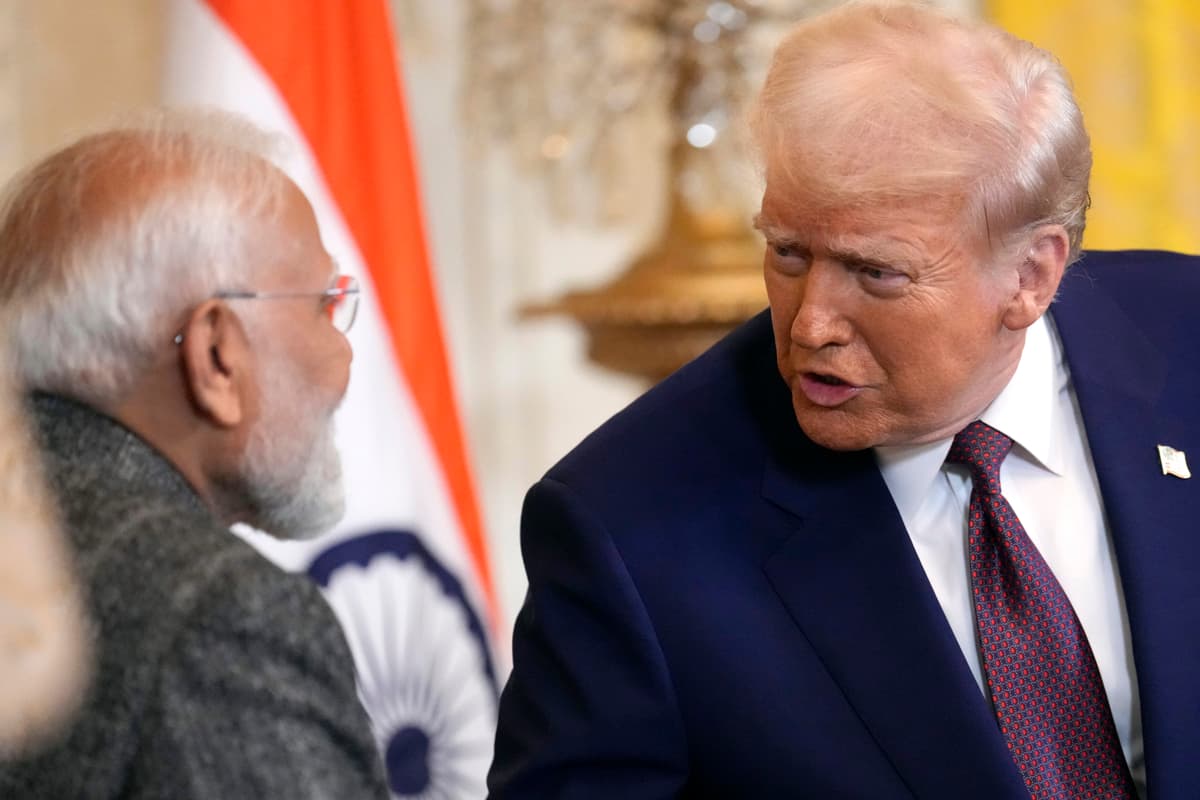
President Trump speaks with India's prime minister, Narendra Modi, during a news conference in the East Room of the White House. AP/Ben Curtis

Flummoxed by President Trump’s decision to impose a 25 percent tariff on American trade with India, the world’s fourth largest economy, Delhi nevertheless is hopeful that a deal can and will be struck in short order. 

Prime Minister Modi, who has steered India toward ever-closer relations with America, is looking on as Washington strikes trade deals with Britain, the European Union, South Korea, and Japan. Trump officials are talking about nearing agreement for a deal with America’s largest competitor, Communist China, while India, a country that is widely seen as Asia’s most formidable counterweight to Beijing’s power, so far has been left out. 

Perhaps even more insulting, from Delhi’s point of view, is Mr. Trump’s deal with India’s neighboring foe, Pakistan, which includes an agreement for a yet-to-be-named American energy company to explore for oil there. “Who knows, maybe they’ll be selling oil to India one day,” Mr. Trump wrote on Truth Social. 

“Using Pakistan’s name as leverage to pressurize India is a very, very poor move, it’s a counterproductive move,” the executive editor of Hindustan Times, Shishir Gupta, tells the Sun. “I hope the U.S. government finds a lot of oil in Pakistan, just like China has found a lot of minerals,” he added.

Beijing is Islamabad’s largest booster, and its deal to explore for rare earth and other minerals in Pakistan is widely seen in India as a failure.

“The oil that Trump is talking about is in Balochistan, and as the Chinese know, projects there are beset with violence directed at military control, and investment made there to mine Baloch riches goes waste,” the vice president of Manipal Academy, Madhav Das Nalapat, tells the Sun. “President Trump will get a reality check, ideally sooner rather than later.”

Mr. Trump’s negotiation style might be behind the barbs at India, which this week also included comparing the large and fast-growing Indian economy to the much smaller and failing Russian economy.

Will such slights yield a better deal with Delhi, which sees itself — as do many in Washington — as a linchpin to America’s strategy in Asia?

“India is an ally, it’s a strategic partner,” but it has “huge energy needs and that includes the ability to buy oil and coal and gas and things that it needs to power its economy,” Secretary Rubio told Fox News. “And it buys it from Russia because Russian oil is sanctioned and cheap, and in many cases they’re selling it under the global price because of the sanctions.”

Delhi, the world’s third-largest energy importer, buys 35 percent of its crude oil from Russia. Under Washington pressure it started canceling contracts with Russian companies this week, according to Reuters. Veering to other markets, though, risks creating inflation.

In recent years, India has also slowly moved away from heavy reliance on Russian arms, buying weapons from America, France, and Israel. Yet, their ties are still seen as too close, as Mr. Trump sours on President Putin over the war in Ukraine. “I don’t care what India does with Russia,” Mr. Trump wrote on Truth Social. “They can take their dead economies down together, for all I care.”

That comparison irked many at Delhi. America’s economic growth is at 1.5 percent, while India’s is at 6.4 percent, Mr. Gupta says.  “It’s the fastest-growing large economy in the world. Shooting from the hip doesn’t really help.” 

Beyond Russia, a major sticking point for closing a trade deal is India’s heavily protected agricultural markets, including dairy. Indians say part of the reason for Delhi’s red lines in this sector involve domestic politics and cultural issues. “For instance,” Mr. Gupta says, “you use animal feed for cows, we can’t. India is largely a vegetarian country.” 

Personalities can also either promote or hinder a deal. Mr. Modi “has made it very clear that his agenda is India first,” Mr. Gupta says. “That was way before Trump called it MAGA. These are two very strong personalities who are friends also, but at the same time, they want to do their own thing for their countries.”

More than personalities might be involved. A trade deal “is important not just for India but for the U.S. as well,” Mr. Nalapat says. “Geopolitically, India is an indispensable cog in the almost invisible flywheel of isolation of China that President Trump is creating not just in the Indo-Pacific but worldwide.” 

Washington negotiators are expected to arrive at Delhi in late August as both sides remain engaged. The Indian team is well-aware of Mr. Trump’s negotiating style, and is keeping a low profile as it attempts to iron out differences. “The ball is still in play, and both sides are working,” Mr. Gupta says. “I am very positive that the deal will take place.”


The New York Sun

© 2025 The New York Sun Company, LLC. All rights reserved.

Use of this site constitutes acceptance of our Terms of Use and Privacy Policy. The material on this site is protected by copyright law and may not be reproduced, distributed, transmitted, cached or otherwise used.

The New York Sun

Sign in or  create a free account

or
By continuing you agree to our Privacy Policy and Terms of Use