India’s Modi Prepares Welcome Mat for Putin With Russian Arms and Oil Topping the Agenda
Although Indian-American relations have improved in recent years, Mr. Modi still pursues a middle ground between Washington and Moscow.
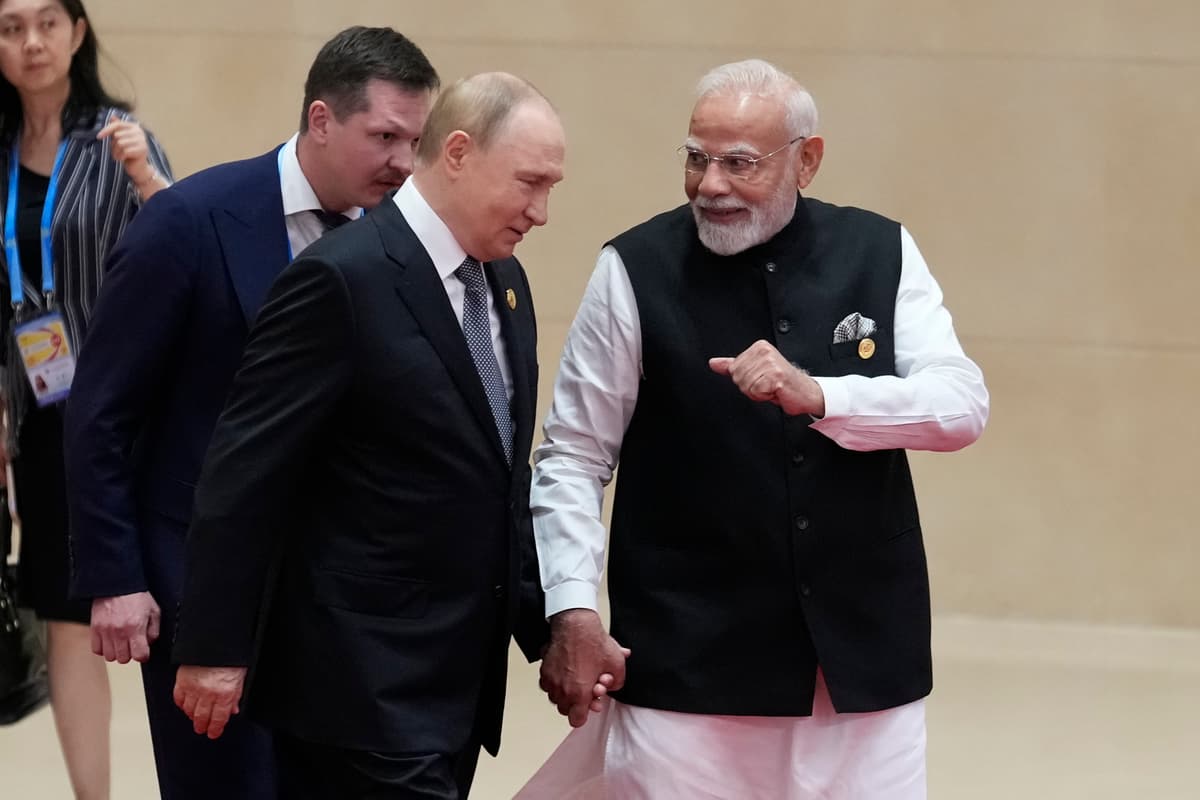

India’s prime minister, Narendra Modi, will reinforce his nation’s historic neutrality among the world’s great powers when he welcomes Russia’s president, Vladimir Putin, to New Delhi Thursday for talks that are sure to focus on importing Russian arms and oil.
At a time when India might appear to be veering toward America and its Asian allies, Messrs. Modi and Putin will be talking about increasing Russian arms exports to India after several years of decline while Russia has focused on its war in Ukraine. India would also like to go on importing Russian oil in defiance of President Trump.
“Putin’s India visit aims to reaffirm New Delhi-Moscow relations — just as Trump applies pressure to downgrade them,” headlines a study by a British think tank, Chatham House. “The visit comes at a time of strain on the bilateral relationship, with New Delhi under growing pressure from the West, and America in particular, to downgrade relations with Moscow,” writes a Chatham House senior research fellow, Chietigj Bajpaee.
In two days, on Thursday and Friday, Mr. Putin, who has not been to New Delhi since the Russian full-scale invasion of Ukraine in February 2022, and Mr. Modi, who last visited Moscow in July 2024, are expected to place as much emphasis on the sale of Russian Sukhoi fighter planes and air defense systems as on oil imports despite the high punitive tariffs imposed by Mr. Trump.
Although Indian-American relations have improved in recent years, Mr. Modi still pursues “neutrality” or diplomatic “non-alignment” and has been careful not to take sides in disputes from Northeast Asia to Ukraine.
The closest he has come to a shift in that policy is participation in the Quadrilateral Security Dialogue, or Quad, a grouping of America, Australia, Japan and India, but he has deemphasized India’s participation while improving relations with the People’s Republic of China.
For Mr. Putin, the challenge will be to reassert Russia’s place as by far the leading exporter of arms to India. While Russia retains that position, India in recent years has sought to diversify sources of weaponry while manufacturing more of its own.
Mr. Putin “is expected to devote a large part of his meeting with Narendra Modi to finding ways to keep the strategic relationship alive amid New Delhi’s continuing attempts to arrive at a compromise trade deal with Donald Trump’s America,” says an analysis in The Interpreter, a digital magazine published by an Australian think tank, the Lowy Institute.
When it comes to defense, Russia “is still number one, but not what it once was,” says New Delhi Television.
NDTV cites a raft of reasons for going to the Russians. First, there’s “the legacy of Soviet origin systems that still require Russian maintenance, big ticket platforms like nuclear submarines and air defense systems.” And then there”s “India’s interest in next-generation missile defense and hypersonic systems, where Russia remains ahead of many Western suppliers.”
Russia accounted for about 89 percent of arms sales to India in 2002, according to the Stockholm International Peace Research Institute, but saw its share fall to about 36 percent between 2019 and 2023. France became the second largest source of Indian arms while American arms exports to India languished.
For Mr. Modi, getting out from under America’s 50-percent tariffs may be just as important as acquiring Russian arms. “New Delhi appears to have capitulated to American pressure to decrease its crude imports from Russia and sign a deal for importing liquefied petroleum gas from the United States,” writes the Lowy Institute’s Shanthie Mariet D’Souza.
Mr. Putin is likely to argue that India would do better importing Russian crude oil at bargain prices despite American tariffs. Appealing to old-style Indian nationalism, he said in October that “the Indian people will closely monitor the decisions made by the political leadership and will never allow any humiliation [by the US] in front of anyone.”