Is the Killer of American Troops in Syria Tied to the Jihadi Regime at Damascus?

The Syrian leader feels ‘very badly’ about the weekend attack, which ‘had nothing to do with the Syrian government,’ President Trump says.
Iowa National Guard via AP
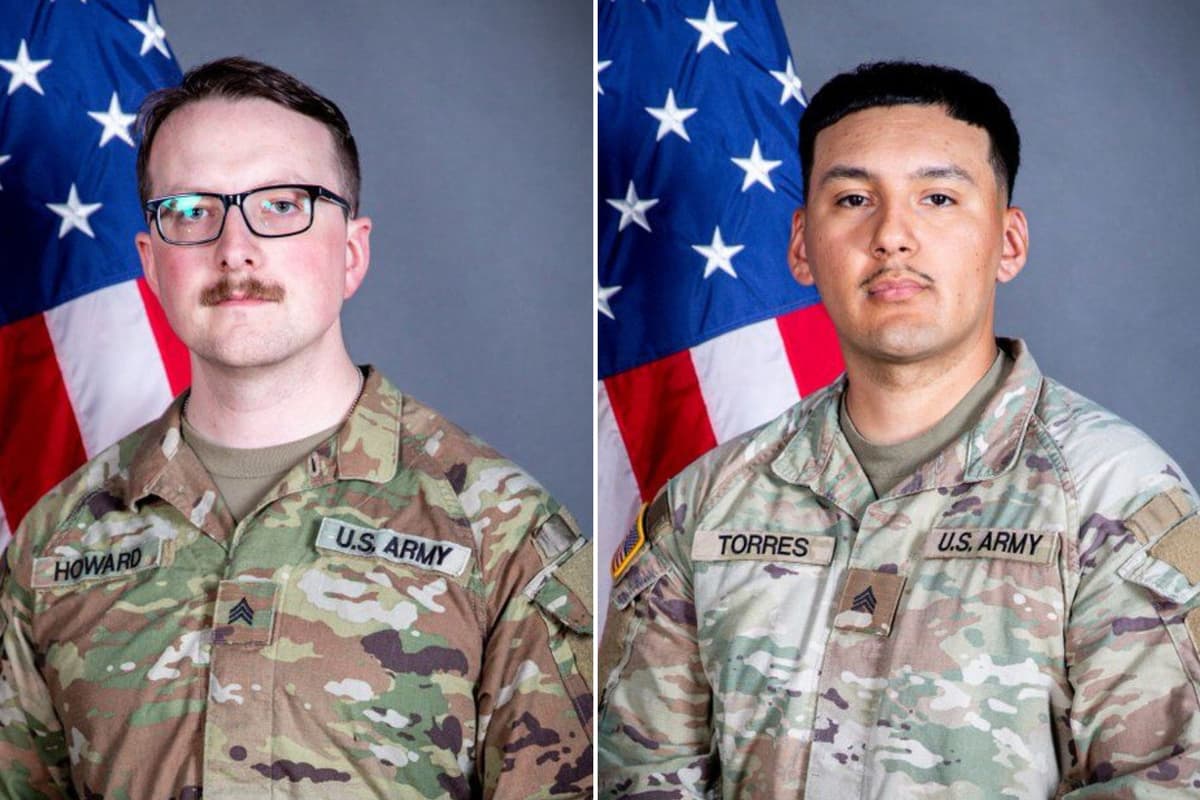
Sergeants William Nathaniel Howard, left, and Edgar Brian Torres-Tovar, both of whom were killed in Syria. Iowa National Guard via AP

The mystery surrounding an unidentified gunman who killed three American troops in Syria over the weekend highlights concerns over a Damascus government led by an interim president, Ahmed al-Sharaa, who until last year was designated a terrorist with a $10 million reward on his head. 

One year after seizing power from the Assad regime, officials of Mr Sharaa’s government acknowledge the difficulties involved in ridding its security ranks of committed jihadists. The Syrian government is yet to identify the gunman who killed two members of the Iowa National Guard and an interpreter on Sunday.

Also unidentified are five Syrians arrested at Palmyra in relation to a weekend attack nearby.

Damascus was planning to “reassign” the gunman, a member of Syria’s security forces, because he held “extremist Islamist ideas,” the interior ministry’s spokesman, Nour al-Din al-Baba, told Syrian television. The killer reportedly entered a room where Americans and Syrian officials were planning an assault on ISIS.  

“We were shocked that in 11 days we took all of Syria, and that put a huge responsibility in front of us from the security and administration sides,” Mr. Baba said, hinting at Damascus’s difficulty to rid security services of all Jihadists in the aftermath of last year’s power change at Damascus. 

More than 1,000 American troops are stationed in Syria to combat the Islamic State. According to the U.S. Central Command, the three national guardsmen were killed and three troops were injured “as a result of an ambush by a lone ISIS gunman in Syria.”

Mr. Baba’s statement, though, acknowledged that the man was a member of the new Syrian armed forces. 

“I’m surprised that the Syrians were actually more transparent” than Centcom, the editor of the “Long War Journal,” Bill Roggio, tells the Sun. Mr. Sharaa, formerly known as al-Jolani, was the leader of Hayyat Tahrir al-Sham, which was the Syrian branch of al-Qaeda, Mr. Roggio notes. “So now we’re shocked that one of their own would turn around and kill Americans?” 

ISIS has not taken credit for the attack near Palmyra even though it would be happy to boast of killing Americans, Mr. Roggio notes. “The absurdity of all this is that we’re sitting there going, well, these jihadists said it was the other jihadists who did it, or he might have wanted to become another jihadist,” he says. “The fact remains, we think that we could work with jihadists to fight jihadists.”

With both Washington and Damascus mum about the identity of the Palmyra gunman, unconfirmed rumors in Syria zero in on a former HTS commander known as Abu Jaber Sufyan. A picture of him attending an event alongside Mr. Sharaa is widely distributed by regime opponents. Some regime opponents claim he was the gunman who killed the American troops, while others are indicating that a bodyguard for Mr Sufyan was the gunman. 

The weekend shooting occurred in “a part of Syria that they really don’t have much control over,” President Trump told reporters Monday, referring to the Syrian government. Mr. Sharaa, he added, “feels very badly about it. He’s working on it. He’s a strong man.” The attack, he added, had “nothing to do with the Syrian government,” but “with ISIS,” and the perpetrators will “be hit hard.” 

Mr. Trump was first introduced to Mr. Sharaa by Crown Prince Mohammed bin Salman of Saudi Arabia during a visit to Riyadh in May. Last month, the president hosted the Syrian leader at the White House, where the former Jihadist vowed to join America’s fight against ISIS. In the interim, America rescinded all sanctions against Mr. Sharaa, and convinced the United Nations to remove him from its own list of active terrorists. 

Syrian security forces, meanwhile, were implicated in at least two incidents of massacres committed by Sunni Jihadists against Syrian minorities in the Summer. Members of Syria’s Alawite community were attacked at Latakia. Israel mobilized its air force to block the advance of Jihadists that assailed the Druze at Suweida, whom Prime Minister Benjamin Netanyahu called “our brothers.”

At Damascus, parades to mark the first anniversary of the fall of the oppressive Assad regime last week, Mr. Sharaa vowed “peaceful coexistence.” He didn’t mention Israel by name, though, while marchers chanted slogans in support of Hamas and against Israel. 

“Of course they hate Israel, of course they hate America,” Mr. Roggio says. Mr. Sharaa is “getting what he wants from us, while not having to give anything.”


The New York Sun

© 2025 The New York Sun Company, LLC. All rights reserved.

Use of this site constitutes acceptance of our Terms of Use and Privacy Policy. The material on this site is protected by copyright law and may not be reproduced, distributed, transmitted, cached or otherwise used.

The New York Sun

Sign in or  create a free account

or
By continuing you agree to our Privacy Policy and Terms of Use