Israel Standing Strong Against UN as It Seeks To Increase Pressure To Create a Palestinian State
With an international conference on the Palestinian question scheduled for next week at the United Nations, the Knesset votes Wednesday on a symbolic motion to apply Israeli sovereignty to Judea and Samaria.
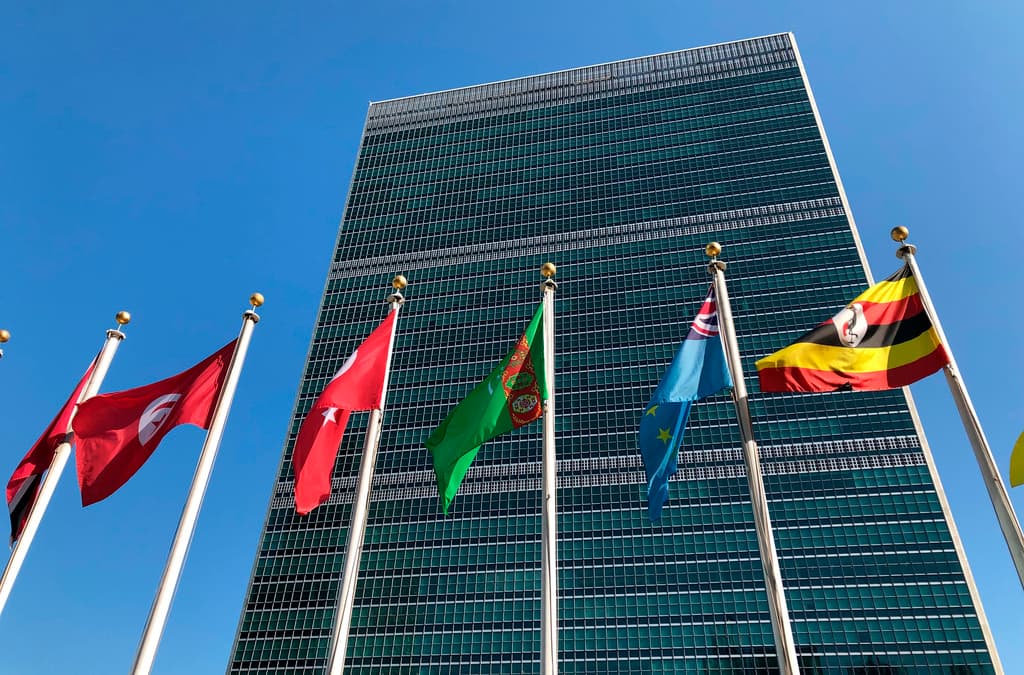

As global pressure intensifies on Israel to accept the establishment of an ever-elusive Palestinian state, including the scheduling next week of an international conference at the United Nations, the Knesset voted Wednesday on a symbolic motion to apply Israeli sovereignty to Judea and Samaria.
Originally scheduled for June, the international conference organized by France and Saudi Arabia was postponed after the American-Israeli strikes on Iranian nuclear sites. It is now scheduled to open as a two-day gathering starting Monday at the UN’s Turtle Bay headquarters. The venue only exacerbates the rift in relations between Israel and the world body.
The Israeli ambassador to Turtle Bay, Danny Danon, announced Wednesday that Jerusalem will block access to a major UN agency, the Office for the Coordination of Humanitarian Affairs, including its chief, Tom Fletcher, and its representative in Israel and Gaza. OCHA has ceased to be a humanitarian organ and turned into a “Hamas propaganda arm,” Mr. Danon said.
At Jerusalem, a majority of 71 of 120 Knesset members, including opposition parties, voted on a symbolic measure on Wednesday to guarantee future sovereignty over Judea and Samaria. Only 13 Arab and left-wing Knesset members opposed the motion, while two major opposition parties were absent.
“This is our land, this is our home, the land of Israel belongs to the people of Israel,” the Knesset chairman, Amir Ohana, said. “Jews cannot be an ‘occupier’ in a tract of land that for 3,000 years has been known as Judea.” The declarative vote is unbinding, and falls short of annexing the territory.
The declarative resolution “won’t change the situation on the ground, but it’s potentially explosive,” the Foreign Policy Forum said in a statement. The forum’s former Israeli diplomats warned that the Knesset resolution would increase Israel’s international isolation and encourage further terrorism. Yet, they refrained from endorsing a Palestinian state at this time.
At New York, the UN Security Council conducted on Wednesday its recurring debate on the “Middle East and the Palestinian question.” Most speakers hailed next week’s conference on promoting a Palestinian state as a panacea to the war in Gaza and a ray of hope for the region’s future.
France, which had originally hinted it might recognize “Palestine” during the conference, has since tamed its goals. President Macron, who was the main catalyst behind the initiative, will now be absent from next week’s event. The conference is unlikely to agree on tangible results.
In June, America circulated a memo warning likely participants against unilateral recognition of a Palestinian state. “The future for the Palestinians must start in Gaza without Hamas,” the American acting UN ambassador, Dorothy Shea, told the Security Council Wednesday. “Quiet diplomacy, not performative actions in New York or elsewhere, will achieve that goal.”
UN officials, though, are hailing next week’s performative action. The two-day conference is a “key to highlight international consensus,” the assistant secretary-general for the Mideast, Khaled Khiari, told the council. He delineated a decades-old formula of “two States, Israel and a viable and sovereign Palestinian State, of which Gaza is an integral part, living side by side in peace and security within secure and recognized borders, on the basis of the pre-1967 lines, with Jerusalem as the capital of both States.”
The French UN ambassador, Jerome Bonnafort, sounded a bit less ambitious. The conference, he said, “will strive to foster the recognition of Palestine, a normalization of its relations with Israel and regional integration, as well as the reform of Palestinian governance and the disarmament of Hamas.”
Far from the UN halls, that “solution” is losing steam fast. The Palestinian Authority president, Mahmoud Abbas, said Sunday that a new Palestinian election will take place by the end of the year. Hamas immediately announced it would not participate. Palestinians note that since 2006, when Mr. Abbas was elected to a four-year term, the 86-year-old president has promised new elections numerous times, most recently in 2021, only to pull the plug at the last minute.
While Palestinians and Israelis shrug off the two-state idea under the current circumstances, Wednesday’s participants in the UN Security Council debate were enthusiastic.
Britain is “resolute in our commitment to a two-state solution,” London’s UN ambassador, Barbara Woodward, said. Next week’s conference “is a vital opportunity to demonstrate the strength of international resolve to secure a better future for Israelis, Palestinians, and the region.”
Israel, though, “won’t be taking part in a conference that doesn’t first urgently address the issue of condemning Hamas and returning all of the remaining hostages,” Mr. Danon’s spokesman, Jonathan Harounoff, tells the Sun. After all, he noted, Hamas’s massacres on October 7, 2023, were “what triggered this conflict to begin with.”