Israeli Raids on Syria Aim To Guarantee Security While Diplomacy Finds Room To Work
President Trump’s envoy says it is ‘safe to say that Israel will go where they want, when they want, and do what they want to protect the Israelis.’
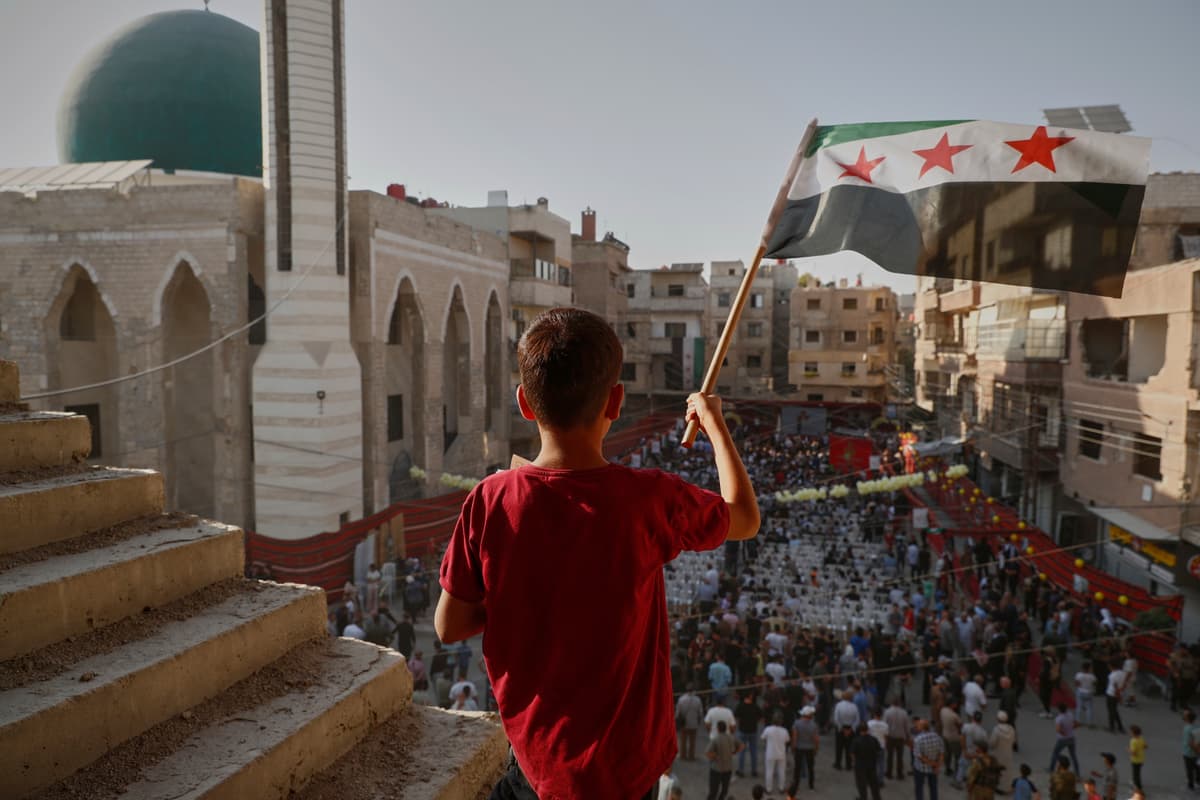

A series of raids deep into Syrian territory this week laid bare the challenges facing Israel as it seeks to explore a better relationship with the country’s new leadership while ensuring its longtime enemy remains unable to threaten its security.
Figuring into the calculus is the vision of President Trump, whose special envoy to Syria says he believes the country’s new president, Ahmed Al-Sharaa, a “Sunni fundamentalist warrior chief,” is committed to working toward a lasting security agreement with Israel.
Those prospects were tested this week when Israel staged two days of air strikes around an army barracks near Damascus, where Hezbollah and Syrian troops had operated under Syria’s ousted president, Bashar al-Assad.
Killed in the strikes were six Syrians soldiers, part of a group that had discovered wiretapping and eavesdropping equipment left behind at the site by the deposed Assad regime, according to the Syrian news agency, SANA.
Israel followed up Thursday morning by airdropping a team of commandos into the base and seizing the spy equipment. Al Jazeera reported that the raid involved four helicopters, two fighter jets, and dozens of soldiers.
Israel’s defense minister, Israel Katz, posted about the operation later Thursday, saying that Israeli forces “are operating in all combat zones day and night for the security of Israel.”
Syrian authorities condemned the actions, calling the incursions a violation of sovereignty and territorial integrity as well as an attempt to undermine the security and stability of the new government.
“These aggressive practices constitute a flagrant violation of the U.N. Charter, international law, and relevant Security Council resolutions, and constitute a direct threat to peace and security in the region,” Syria’s foreign ministry said in a statement.
Israel has increased its presence in Syrian territory since the fall of the Assad regime, including incursions in mid-July to protect the Druze minority from sectarian violence committed by jihadists now operating as Mr. Al-Sharaa’s military. Nonetheless, leaders from both sides are looking for more permanent solutions.
Led by Mr. Al-Sharaa and Prime Minister Benjamin Netanyahu’s strategic affairs minister, Ron Dermer, the two sides have attended meetings at Paris and in Azerbaijan in what America’s special envoy to Syria, Tom Barrack, describes as highly successful trust-building exercises.
Although Mr. Al-Sharaa is not prepared to join the Abraham Accords — a bridge too far for the fundamentalist allies that he relies on to maintain his position — he is pragmatically “leaning in” rather than risking battle with Israel, Mr. Barrack said in an interview with an independent reporter, Mario Nawfal, on Mr. Nawfal’s X program.
Fighting with Israel is “not a good idea. Hasn’t fared well for anybody and you have America as an ally to Israel,” Mr. Barrack said.
He added that Israel’s strike earlier this year on Damascus’s defense ministry was “kind of a little teaser” to Mr. Al-Sharaa, sending the message, “By the way, just so you know how vulnerable you are, if you don’t listen to us, not only can we take out your defense building, we can take out your palace.”
Mr. Barrack said that “nobody” in the Arab world trusts Israel’s intentions after watching its response to October 7, but several neighbors are exercising caution in how they approach Israel.
“I think it’s safe to say that Israel will go where they want, when they want, and do what they want to protect the Israelis and their border to make sure an October 7th never happens again. Full stop, period,” he said.
He said that while he is “certain” that the Syrian leader’s objectives today align with those of America, the problem is that “every constituency around him,” as well as neighboring Iran and Turkey, is trying to interfere with that progress.
Talks between the two sides, which have not engaged directly in 30 years, would determine whether to make permanent border lines set up in 1974 after the Yom Kippur War. Israel is also pushing for a security corridor to Suwaida, where the Druze minority lives, as well as a commitment from Damascus to protect the group.
As talks progress, Israeli leaders have said they are committed to ensuring the country’s security even if that means additional cross-border incursions. That earned a rebuke from three American lawmakers.
Two senators, Jeanne Shaheen of New Hampshire, a Democrat, and Joni Ernst of Iowa, a Republican, along with Representative Joe Wilson of South Carolina, said Israel’s “destabilizing strikes” were making it more difficult for the new Syrian government to succeed.
“The Syrians are prepared to move forward with Israel to advance peace. It is unclear how long the door to this opportunity will remain open,” the lawmakers said in a joint statement.
“We call on Israel to seize the moment and immediately cease hostilities so the progress made by Syrians and Special Envoy Barrack can continue.”