

It’s Not Aliens: New Evidence Suggests Mysterious ‘Interstellar Visitor’ 3I/Atlas Is Just a Comet

A Harvard astronomer made waves recently by suggesting that the object might be an alien spacecraft.
NASA/JPL-Caltech
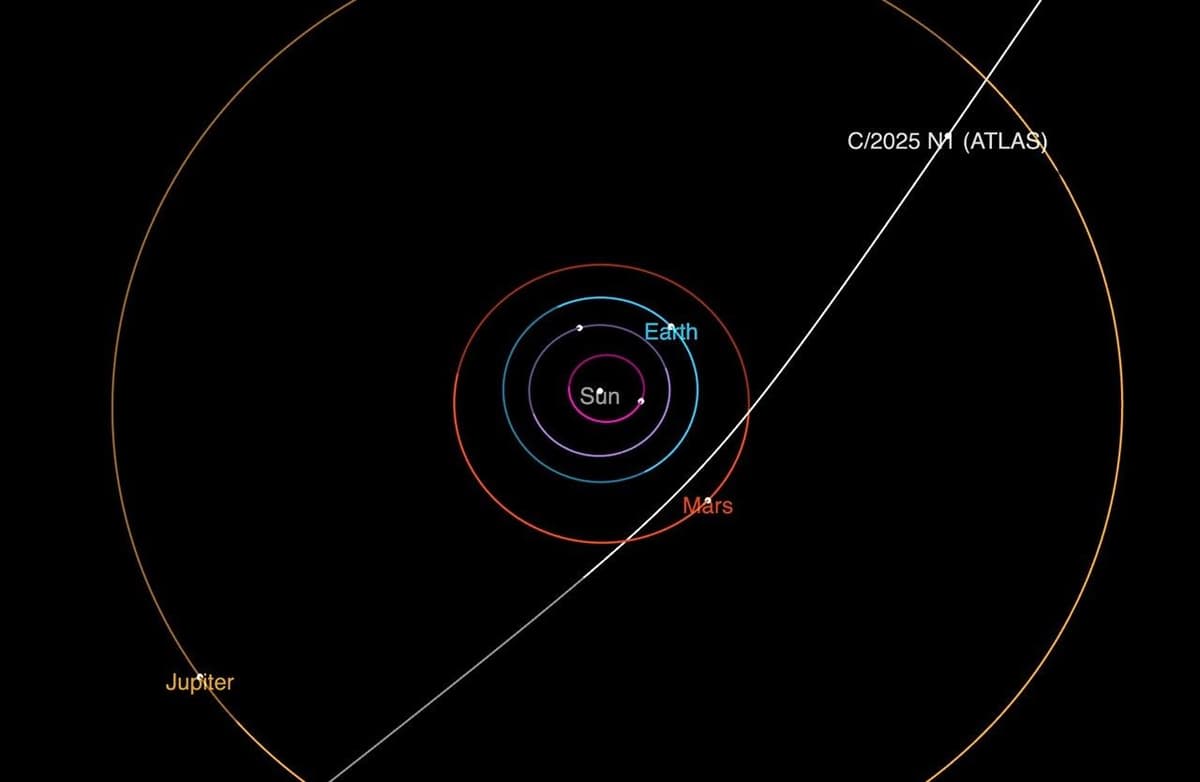
This diagram shows the trajectory of interstellar comet 3I/ATLAS as it passes through the solar system. It will make its closest approach to the Sun in October. NASA/JPL-Caltech

After weeks of conspiracy theories and social media debates, new evidence has emerged to put the speculation surrounding interstellar object 3I/Atlas to rest — it is, in fact, a comet.

The confirmation comes from the MeerKAT radio telescope in South Africa, which detected the first radio signal from the object, according to researchers, who posted on The Astronomer’s Telegram on Tuesday. 

For the record, it’s not the kind of signal you might hear about in science fiction. Instead of a transmission from a spacecraft, the observatory detected a specific radio frequency pattern consistent with natural comet activity.

The pattern was identified as radio absorption by hydroxyl radicals, known as OH molecules. As researchers noted, “OH absorption was detected on the 1665 MHz and 1667 MHz lines.” This phenomenon occurs when a comet, like 3I/Atlas, gets close to the sun. 

The intense radiation causes ice on its surface to sublimate, releasing molecules like OH into space, which then absorb radiation at specific frequencies. This process also explains the comet’s non-gravitational acceleration, which had previously puzzled some observers. The detection of these OH spectral lines is a common method astronomers use to study comets, nebulae, and star-forming regions.

The effort to monitor the comet, estimated to be the size of a city block, was spurred on by Harvard astrophysicist Avi Loeb, a vocal proponent of the theory that 3I/Atlas could have an extraterrestrial, technological origin.

“Five weeks ago, I encouraged radio observatories like MeerKAT to search for radio emission from 3I/ATLAS,” Mr. Loeb wrote in a Medium post

Mr. Loeb provocatively speculated that jets streaming from the interstellar visitor could be “coming from a set of thrusters used for navigation of a spacecraft,” though he conceded they could also be natural pockets of ice vaporizing on a comet’s surface. 

He noted the comet’s arrival direction was close to that of the mysterious “Wow! Signal” detected in 1977. “In response, I was assured that 3I/ATLAS will be monitored by radio observatories like MeerKAT,” he wrote.

Following the latest discovery, Mr. Loeb acknowledged that “no radio detection of 3I/ATLAS has been reported so far, other than the OH absorption signal.”

While the new finding strongly supports a natural origin, further observation is needed to draw more definitive conclusions, the scientists said, noting that they will continue to monitor the object to see if the OH production is constant and to study the structure of its tail.

Mr. Loeb remains undeterred and is already looking ahead to the next opportunity for observation. “On March 16, 2026, 3I/ATLAS is expected to pass within 53 million kilometers from Jupiter. At that time, the Juno spacecraft will use its dipole antenna to search for a radio signal from 3I/ATLAS,” he wrote on X.

For now, space enthusiasts can track the comet’s path online and mark their calendars for December 19, when 3I/Atlas will make its closest approach to Earth.


The New York Sun

© 2025 The New York Sun Company, LLC. All rights reserved.

Use of this site constitutes acceptance of our Terms of Use and Privacy Policy. The material on this site is protected by copyright law and may not be reproduced, distributed, transmitted, cached or otherwise used.

The New York Sun

Sign in or  create a free account

or
By continuing you agree to our Privacy Policy and Terms of Use