

Jack Smith, Trump’s Long-Time Tormentor, Faces Fresh Danger From the President He Sought To Jail

The 47th president opens a new investigation into the prosecutor who sought to convict him twice over.
AP/Alex Brandon
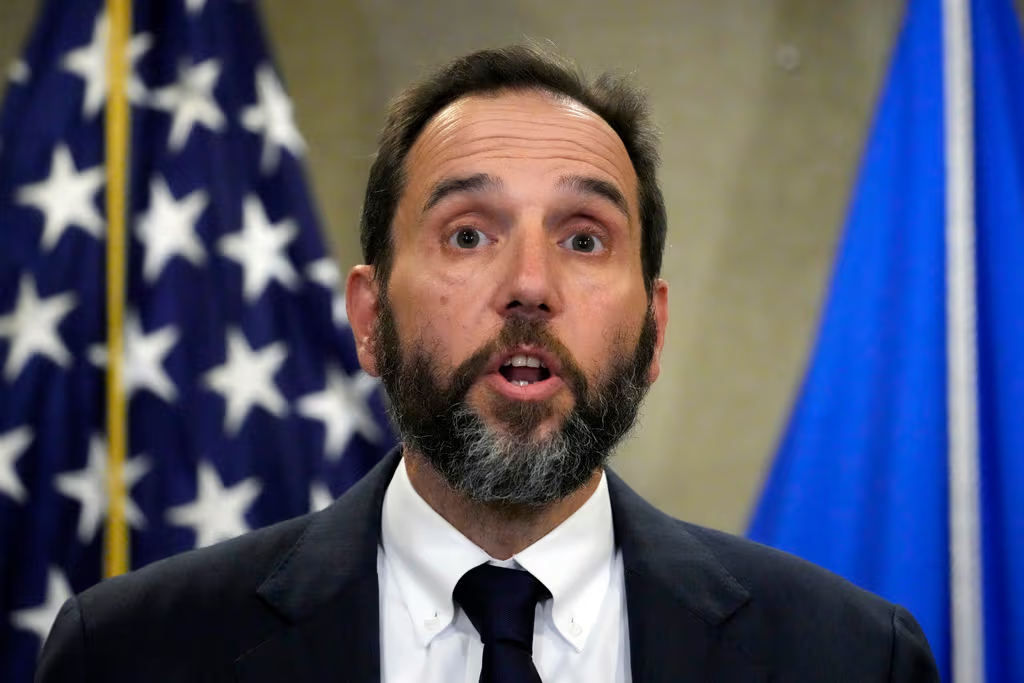
Special Counsel Jack Smith on June 9, 2023, at Washington. AP/Alex Brandon

The launching of a federal investigation into Special Counsel Jack Smith marks a new chapter in the tormented relationship between President Trump and the hard-charging prosecutor.

The request to probe Mr. Smith was made by Senator Cotton to the Office of Special Counsel, an independent government agency whose remit is to investigate government corruption and protect whistleblowers. The lawmaker wants to know if the two prosecutions of Mr. Trump — for January 6 and the storage of classified documents at Mar-a-Lago — by the special counsel (no relation to the Office of Special Counsel) violated the Hatch Act. That law aims to stop the federal government from affecting elections.

The OSC, which said on Friday it has opened the investigation, can issue fines and other civil judgments but lacks criminal prosecutorial authority. Violations of the Hatch Act are not crimes, but the penalties can include fines of up to $1,000 and a bar on future federal service. According to a 2021 report issued by the same office that is investigating Mr. Smith, 13 senior officials who served in Mr. Trump’s first term violated the Hatch Act. President Biden’s press secretary, Karine-Jeann Pierre, was warned in 2023 after she used the phrase “mega-MAGA” from the podium. 

Mr. Cotton argued on X last week that “Jack Smith’s legal actions were nothing more than a tool for the Biden and Harris campaigns. This isn’t just unethical, it is very likely illegal campaign activity from a public office. Let’s take a look at just how egregiously Smith used his DOJ role to influence the election.” Mr. Cotton alleges that the timing of Mr.  Smith’s prosecutions affected — and could have swayed — the outcome of the 2024 election. 

Attorney General Garland named Mr. Smith, who had been prosecuting war crimes at the Hague, as special counsel on November 18, 2022. That came three days after Mr. Trump formally announced his intention to retake the White House. Mr. Garland declared that it was “in the public interest to appoint a special counsel” given Mr. Trump’s announcement and Mr. Biden’s then-intention to run again. 

Mr. Garland’s decision to make his move against Mr. Trump with only two years to go before the election started the clock fairly late for Mr. Smith to win a conviction before Election Day. 

While Mr. Smith never explicitly cited the election as a factor in his handling of his prosecutions, he repeatedly urged courts to act with haste in moving the cases along. He petitioned, citing a “compelling” public interest, both the District of Columbia Circuit of the United States Court of Appeals and the Supreme Court for expedited consideration. He also pushed Judge Aileen Cannon in south Florida to move more quickly.

After the Supreme Court, in Trump v. United States, upended Mr. Smith’s election interference case by ruling that official presidential acts are presumptively immune, the prosecutor sought and secured a fresh indictment of Mr. Trump in August 2024. 

The presiding judge in the election interference case, Tanya Chutkan, disclosed filings less than 60 days before the election. That is the deadline, per “long-standing Justice Department policies and tradition,” for prosecutors to take action that could affect an election. Judge Chutkan, an appointee of President Obama, rejected arguments from Mr. Trump’s legal team that allowing Mr. Smith’s prosecution to chug forward close to the election was improper.

Mr. Trump fumed at the time that the DOJ “disobeyed their own rule in favor of complete and total election interference. I did nothing wrong, they did! The case is a scam, just like all of the others.” He also called Mr. Smith “deranged” and “a scoundrel” and threatened to fire him after the election. Mr. Smith resigned before Mr. Trump took office and has not been heard from since. Neither of his cases reached trial. 

Once Mr. Trump retook the presidency, another long-standing DOJ position holds that there is a “categorical” ban on prosecuting a sitting president. Mr. Smith wrote in his final report that “but for Mr Trump’s election and imminent return to the presidency, the office assessed that the admissible evidence was sufficient to obtain and sustain a conviction at trial.” 

Once Mr. Trump swore the oath for a second time, the 47th president quickly signaled that he would not let bygones be bygones with respect to Mr. Smith. Attorney General Bondi convened a “Weaponization Working Group” — now led by Ed Martin — to probe “Special Counsel Jack Smith and his staff, who spent more than $50 million targeting President Trump.”

Just days later Mr. Trump signed an executive order sanctioning the law firm of Covington & Burling, which according to Mr. Smith’s disclosures had provided him with some $140,000 in free legal services. The order also singled out for penalty a lawyer at Covington, Peter Koski, who is now representing Mr. Smith. The firm insists in a statement that it “serves as defense counsel to Jack Smith in his personal, individual capacity.”

Mr. Smith has been silent since his resignation, even as Ms. Bondi has purged the DOJ, in successive waves, of personnel who were seconded to his prosecutorial teams. There has never been an instance of a prosecutor being found in violation of the Hatch Act for the timing of his conduct of a case — but there has also never been an instance of a sitting president appointing a special counsel to see the conviction of his rival for the White House.

Because Mr. Smith has left government and the career justice department prosecutors who were seconded to his operation have been fired by Ms. Bondi, this OSC probe is unusual, unless it’s seen in the context of the larger “weaponization” probe. The OSC does not report to Main Justice, and an independent investigation into Mr. Smith’s conduct could help underline the findings and actions of Ms. Bondi and her team.

Mr. Trump fired the head of the OSC, Hampton Dellinger, the son of President Clinton’s solicitor general. Mr. Dellinger sued, unsuccessfully, to keep his job. Last week, the congressional hearing for Mr. Trump’s nominee for the office, Paul Ingrassia, 28, was postponed amid concerns about Mr. Ingrassia’s qualifications. The current acting head of the OSC is the United States trade representative, Jamieson Greer.


The New York Sun

© 2025 The New York Sun Company, LLC. All rights reserved.

Use of this site constitutes acceptance of our Terms of Use and Privacy Policy. The material on this site is protected by copyright law and may not be reproduced, distributed, transmitted, cached or otherwise used.

The New York Sun

Sign in or  create a free account

or
By continuing you agree to our Privacy Policy and Terms of Use