


Jane Austen Celebrates Her 250th Birthday at the Morgan Library
The author of ‘Pride and Prejudice’ and ‘Sense and Sensibility,’ among other classics, comes alive at a new show.
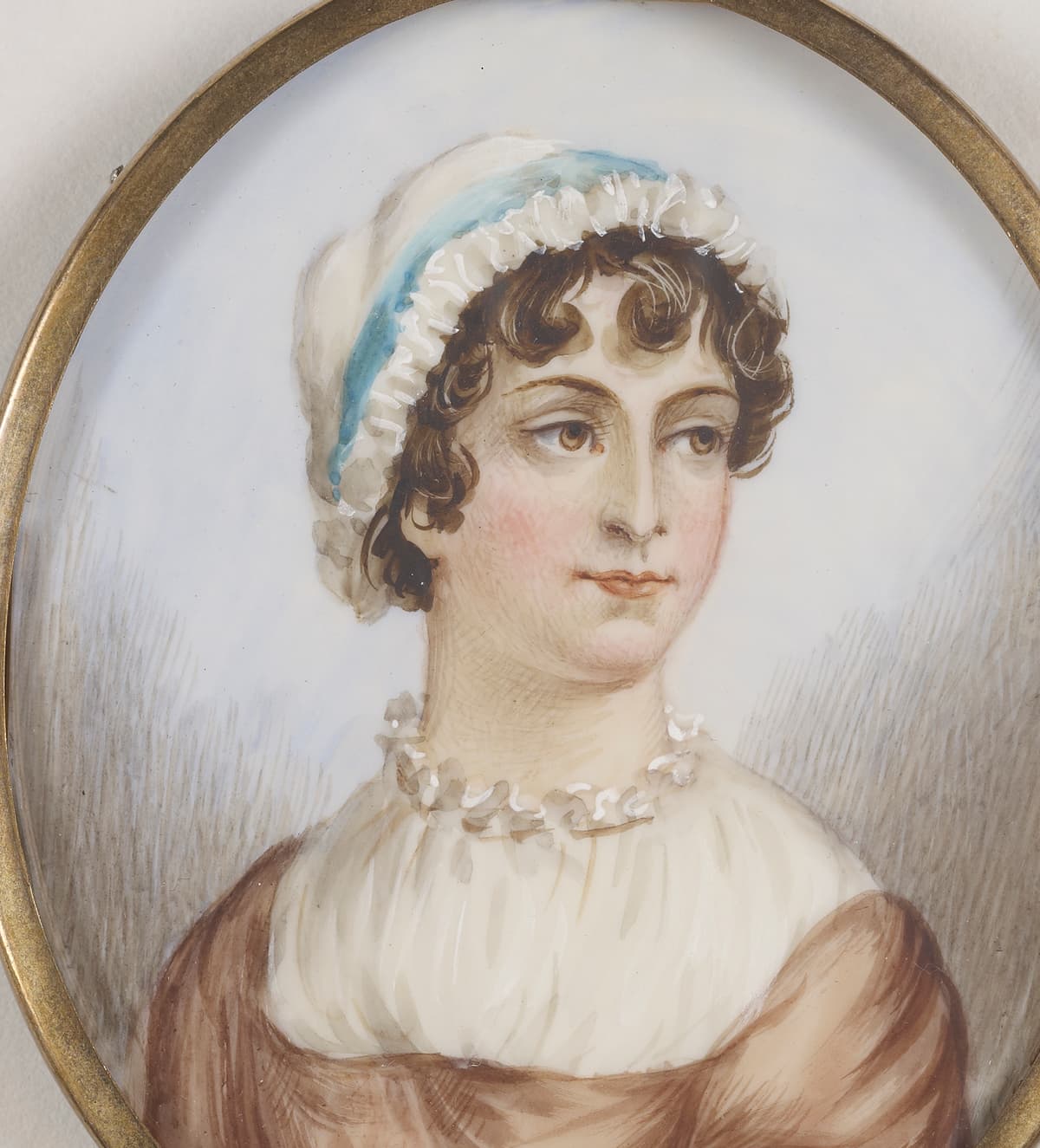
‘A Lively Mind: Jane Austen at 250’
The Morgan Library & Museum, 225 Madison Avenue, Manhattan
Through September 14
“A Lively Mind: Jane Austen at 250” confirms that we are all Janeites now. The Morgan Library is celebrating the quarter-millennium of Austen’s birth with what it calls “a major exhibition devoted to the life and legacy of the beloved literary icon.” No fiction there. The Morgan, home to more letters in Austen’s hand than any other institution, succeeds in conveying the pulse behind Austen’s prose.
Little of Austen’s life appeared to augur a writer whose work would be ensconced on the Olympus of literature. That immortality is secured by six novels set among England’s landed gentry at the end of the 18th century. Austen was born in 1775 and died in 1817. The greatest chronicler of courtship in the English language never married. She accepted one proposal, from a wealthy younger suitor, only to reject it the next morning.
Austen benefited from her family’s well-stocked library and abundant love. She was close to her sister Cassandra and her brother Edward, who after his adoption by a wealthy relative, provided her with comfortable circumstances. Her father was a rector of the Anglican Church who, unusually, encouraged his daughters to write. Austen’s name never, in her lifetime, appeared in the books she published — “A Lady” was how she was described.

Austen may have written anonymously, but she was not exactly obscure. Her books were prized by the upper classes, and the Prince Regent — later George IV — was reputed to be particularly ardent about Austen. Her letters on display at the Morgan point to her pride in earning a living by her pen. Austen was no recluse. The letters disclose a warm and engaging personality, and she was happy to have her books out and about in the world. Now they and their adaptations are legion the world over.
Austen’s novels are sometimes described as “comedies of manners,” but her style, suffused with wit and irony, remains distinctive after hundreds of years. The opening line of “Pride and Prejudice” — “It is a truth universally acknowledged, that a single man in possession of a good fortune, must be in want of a wife” — is among the best known in all of literature. Her books largely end in harmonious marriages, but they are sweet without being saccharine.
The Morgan is attentive to Austen’s enduring footprint in America. “Emma,” whose title character is described as uniting “some of the best blessings of existence,” was a success in America while Austen was still alive, though she did not hear of its reception. On display are four surviving copies of an edition printed at Philadelphia in 1816. Her novels were enjoyed by the Quincys of Massachusetts and lauded by the editor William Dean Howells.
The show celebrates not only the 250th anniversary of Austen’s birth but also the 50th of the Morgan’s landing of a bequest of Austen materials from an American collector, Alberta Hirshheimer Burke. The daughter of German Jews, and an amateur collector, Burke amassed an enormous trove of materials relating to Austen. On display here, among other treasures, is a version of “Pride and Prejudice” — in Yiddish.
Austen was precocious. By the end of her twenties, she had already produced drafts of “Sense and Sensibility,” “Pride and Prejudice,” and “Northanger Abbey.” One letter here describes her family as being “great Novel-readers & not ashamed of being so.” By 1811 Austen writes to her sister that “I am never too busy to think of ‘Sense and Sensibility.’ I can no more forget it, than a mother can forget her suckling child.”
Austen died in the arms of her sister Cassandra. Visitors to this delightful show are likely to marvel at the bounty we have been left and to agree with the sense of loss Cassandra wrote of in a letter soon after Jane’s death: “I have lost a treasure, such a Sister, such a friend as never can be surpassed — She was the Sun of my life, the gilder of every pleasure, the soother of every sorrow. I had not a thought concealed from her, & it is as if I lost a part of myself.”