


Japan Calls in the Army To Cope With a String of Deadly Attacks by Bears

The troops ‘will not actually shoot any bears since they are not trained to fire hunting rifles for the purpose of culling wild animals,’ according to local press reports.
JSDF Akita Camp via AP
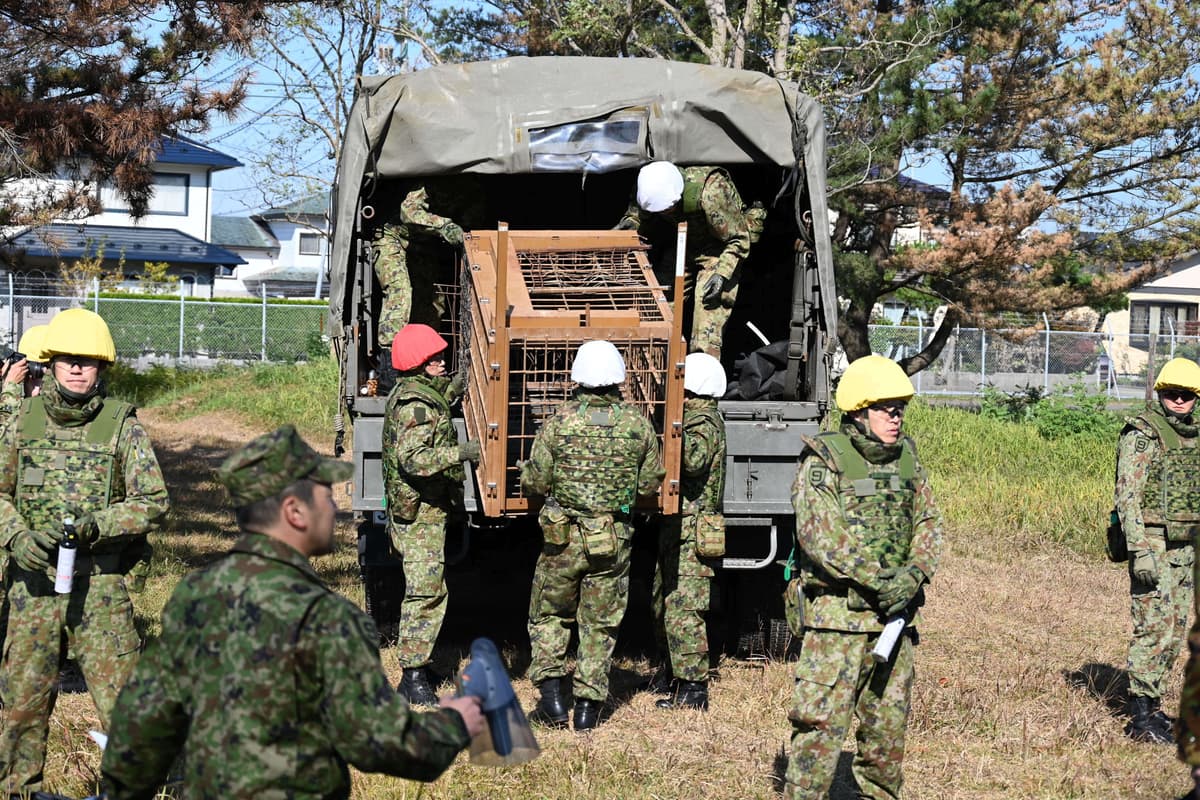
Japan Self-Defense forces personnel unload a bear cage from a military truck in JSDF Akita Camp, Akita, northern Japan. JSDF Akita Camp via AP

Japanese soldiers are on the offensive in northern Japan — not against the North Koreans or other foreign enemy, but against a beast in his native habitat: the Asian black bear.

Japan’s Ground Self-Defense Forces — a euphemism for the Japanese army — are setting box traps to capture black bears that have killed at least 13 people since April as the bears stray into farms or villages and humans invade the forests that are home to the bears.

As befitting a pacifist nation that forbids engagement in foreign wars, the GSDF on the hunt for bears are not carrying lethal weapons. They “will not actually shoot any bears since they are not trained to fire hunting rifles for the purpose of culling wild animals,” the Japan Times reports.

Moreover, the paper disclosed that the 5.56-mm. caliber rifles used by the GSDF “would also most likely be ineffective against a bear.”

Most of the human casualties, including both dead and injured, have been in the Akita prefecture in the mountainous northwest of the main Japanese island. Joggers, walkers and sight-seers have been the victims. In one case, a bear entered a supermarket, injuring two people.  

From April through September, said Japan’s Kyodo News, there were 20,000 “sightings” of black bears among a black bear population estimated to be around 44,000. Another 12,000 brown bears are on the large northern island of Hokkaido.

In the battle of man-versus-bear, Kyodo said GSDF soldiers wear bullet-proof vests, and carry rods that look like rifles and heft shields. A paper for foreigners, Tokyo Weekender, suggests they are taking even more precautions.

“Experts advise avoiding eye contact and sudden movements if a bear is encountered, and backing away slowly without turning one’s back,” said the Weekender. “ Running or climbing trees should be avoided, as bears are faster and more agile.” If people just can’t get out of the way, the Weekender cites an Akita University study recommending that they should lay “face down and using one’s hands to protect the head and neck.”

Bear attacks in Japan are far more numerous than in America, home to about 300,000 black bears. In America, “most attacks by black bears are defensive reactions to a person who is too close,” writes the founder of the North American Bear Center in Minnesota, Lynn Rogers. “Black bears that come into campgrounds are looking for food, not people, and can easily be chased away in most cases.” Since 1900, he says, black bears have killed 61 people in America.

Could Asian black bears — which are slightly smaller than their North American cousins, with males weighing in at between 130 pounds and 440 pounds — in Japan be a distinctly angrier strain or breed?

“A poor harvest of beech nuts and acorns, which are key food sources for bears, has driven them out of forests and into residential areas in search of food,” says the Weekender by way of explanation for the recent surge in attacks, while “warmer winters delay hibernation periods and increase bear activity.”

Also: “Rural depopulation and the abandonment of farmland have blurred the boundaries between wilderness and human settlements, creating easier pathways for bears to enter towns and villages” — all factors making it hard for man and bear to get along with one another.


The New York Sun

© 2025 The New York Sun Company, LLC. All rights reserved.

Use of this site constitutes acceptance of our Terms of Use and Privacy Policy. The material on this site is protected by copyright law and may not be reproduced, distributed, transmitted, cached or otherwise used.

The New York Sun

Sign in or  create a free account

or
By continuing you agree to our Privacy Policy and Terms of Use