Japan-Red China Row Escalates as Beijing Seethes Over Suggestion That Tokyo Could Fight To Defend Taiwan
Beijing is warning its citizens against travel to Japan, citing ‘significant risks’ to their personal safety and lives in that country.
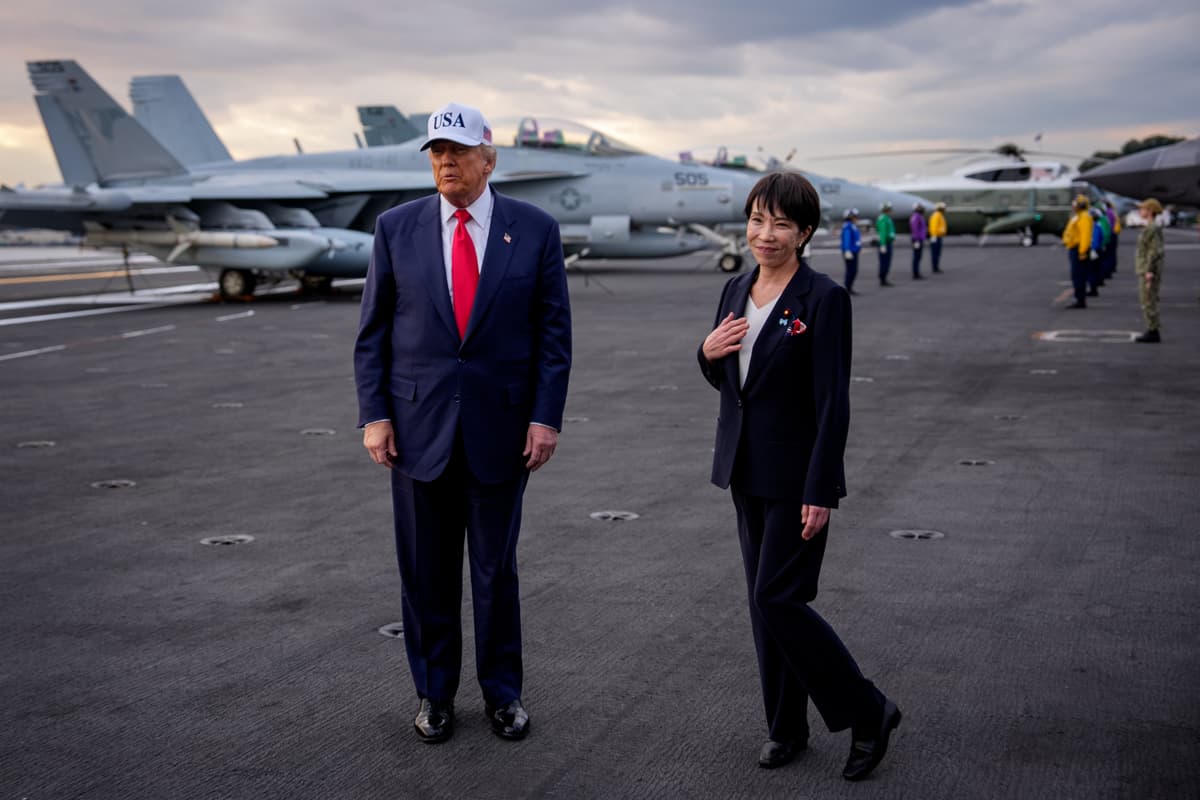

Japan’s new hard-line leader finds herself in an escalating row with Communist China following a recent suggestion that her country could be drawn into any future war over Taiwan.
Aides to Prime Minister Sanai Takaichi conveyed a conciliatory message to Beijing on Saturday after Chinese citizens were advised the previous evening to avoid travel to Japan. However, the dispute shows no sign of easing.
Ms. Takaichi, a hawkish nationalist who took office less than a month ago, infuriated Chinese leaders last week when she declared in the parliament, or Diet, that an attack on Taiwan could constitute “a survival-threatening situation” for Japan.
“Such a situation allows the country to use force to defend an ally,” she said, suggesting a loophole in the nation’s post-World War II constitution that renounces “the use of force as a means of settling international disputes.”
Beijing has long refused to rule out the use of force to restore its control over Taiwan, an island province that broke away at the time of Mao Zedong’s communist revolution in 1949.
After simmering for days, China summoned the Japanese ambassador in Beijing, Kenji Kanasugi, to receive a formal protest on Thursday. Late on Friday, the government advised its citizens to avoid travel to Japan “in the near future,” news agencies reported.
China’s embassy in Tokyo issued a statement saying Japanese leaders had made “blatantly provocative remarks regarding Taiwan” that had severely damaged “the atmosphere for people-to-people exchanges.”
The situation presents “significant risks to the personal safety and lives of Chinese citizens in Japan,” the statement said. Three Chinese airlines promptly offered full refunds to ticket holders planning visits to Japan.
Beyond tourism, the dispute carries other economic risks for Japan. China is Japan’s largest trading partner, accounting for more than 20 percent of its total trade volume this year.
Ms. Takaichi’s fledgling government sought Saturday to tamp down the furor, but without backing away from the prime minister’s original remarks.
Japan’s Kyodo news agency quoted the chief cabinet secretary, Minoru Kihara, saying the government had “conveyed the message to China and strongly asked it to take appropriate actions.”
“China’s view is not in line with Japan’s understanding. It is precisely because differences remain that multilayered communication between Japan and China is essential,” Mr. Kihara was quoted as saying.
All indications are that China will not be easily assuaged, however.
Ms. Takaichi “must retract her remarks and make formal apologies,” said a scholar quoted in the Communist Party-owned Global Times newspaper, which reliably reflects the views of Beijing’s leadership. “This is the only way for Japan to extricate itself from the current predicament.”
The scholar, Lü Chao, is president and associate professor at the Institute of American and East Asian Studies at Liaoning University.
Should Ms. Takaichi persist in her course, he said, “the situation will escalate further, severely reversing Chinese-Japanese relations and potentially plunging them to a historic low since the normalization of China-Japan diplomatic relationship. In that case, Japan will bear full responsibility.”