
Japan’s PM Offers Rationale for Fighting Red China Over Taiwan, Drawing a Furious Response From Beijing’s Envoy
Sanai Takaichi, just three weeks in office, told the parliament or Diet that a Chinese attack on Taiwan could create “a survival-threatening situation” for Japan.
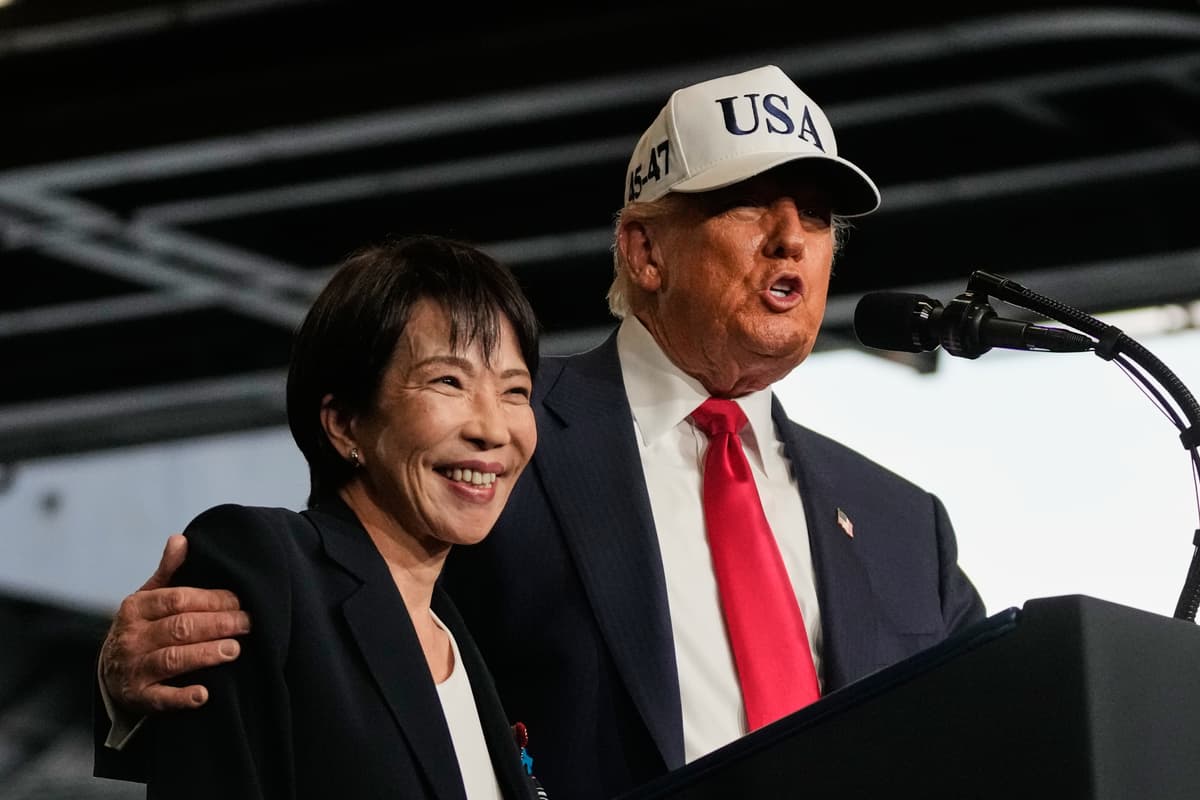
Japan and Communist China are up in arms – rhetorically – over a blunt suggestion from Japan’s fledgling prime minister, Sanai Takaichi, that Japan could go to war to defend the independent island province of Taiwan against Chinese attack.
The hawkish Ms. Takaichi, asked in the Japanese parliament, or Diet, if Japan would fight for Taiwan, was unequivocal: “If warships are used and other armed actions are involved, this could constitute a survival-threatening situation.” Under Japanese law, she said, “such a situation allows the country to use force to defend an ally.”
China’s consul-general in Osaka, Xue Jian, took the bait, posting on X that China would “cut off a dirty neck without a moment of hesitation” if Japan and China came to blows. He concluded by asking, “Are you ready for that?”
Underlying the war of words is the rationale offered by Ms. Takaichi for evading the stricture of the oft-cited Article 9 of Japan’s post-war “peace constitution,” which renounces “the use of force as a means of settling international disputes.”
Elected as prime minister barely three weeks ago by the Diet, Ms. Takaichi refused to back down from the implication – never so strongly expressed by her conservative predecessors – that Japan is ready to fight for Taiwan if China’s president, Xi Jinping, tries to make good on his oft-stated threats to take over the territory.
She was referring to a “worst-case scenario,” she said, defending her comment as “in line with conventional government views.”
Although leaders of Japan’s long-ruling Liberal Democratic Party have often voiced their “commitment” to the defense of Taiwan, they have never previously stated their view quite so frankly. Japan’s late prime minister, Shinzo Abe, after nearly eight years in power, stated more ambiguously that “a Taiwan contingency is a contingency for Japan” and “also a contingency for the Japan-U.S. alliance” that Mr. Xi “should not misjudge.”
China’s foreign ministry protested in diplomatic verbiage against Ms. Takaichi’s latest remarks but did not take back Mr. Xue’s harsh words.
A major Japanese newspaper Asahi Shimbun quoted the American ambassador to Japan, George Glass, who observed that Mr. Xue recently “compared Israel with Nazi Germany” and now “threatens Prime Minister [Takaichi] and the Japanese people.” It is time, he said, “for Beijing to behave like the ‘good neighbor’ it talks repeatedly about – but fails repeatedly to become.”
Japan’s chief cabinet secretary, Minoru Kihara, said Japan had “strongly urged” appropriate action and demanded “a clear explanation” for Mr. Xue’s remark.
Ms. Takaichi, a strong ally of Mr. Abe before he stepped down in 2022, has won a reputation as a right-wing figure eager to build up Japan militarily to defend itself against regional enemies. China, as a growing power in the Indo-Pacific, poses the greatest menace while North Korea has upset Japan by threatening the country with a nuclear attack and by test-firing missiles that flew over Japanese territory.
North Korea’s alliance with Russia, which has ships and warplanes based in its Far East, adds to Japan’s sense of encirclement. Japan still demands that Russia return several small former Japanese islands, overrun by the Russians in the last week of World War II.
Ms. Takaichi’s pledge to defend Taiwan also reflects the unusual affection formed in the half century that Japan ruled over Taiwan, from its victory against China in 1905 to its defeat in 1945 when the island again fell under Chinese rule. The Nationalist Chinese leader, Chiang Kai-shek, led his forces to Taiwan before Mao Zedong’s Red Army finished taking over the Chinese mainland in 1949.
“Taiwan and Japan have an unusually close cultural and social relationship that doesn’t need government promotion,” says a study by the Australia Strategic Policy Institute. “Japan has its own national-security reasons for backing Taiwan’s preservation from Chinese conquest, but the mutual fondness between the two countries can only reinforce Tokyo’s resolve.”
Many Taiwanese, “even feel reverence for their former Japanese colonial masters, who modernized the island,” says the study, citing a survey in which 77 percent of Japanese said “they felt close to Taiwan.”