
‘Japanese First’: Right-Leaning Party That Few Had Heard of Echoes Themes Being Sounded in America by Trump
The era of predictable elections is over, though Prime Minister Ishiba vows to remain in office.
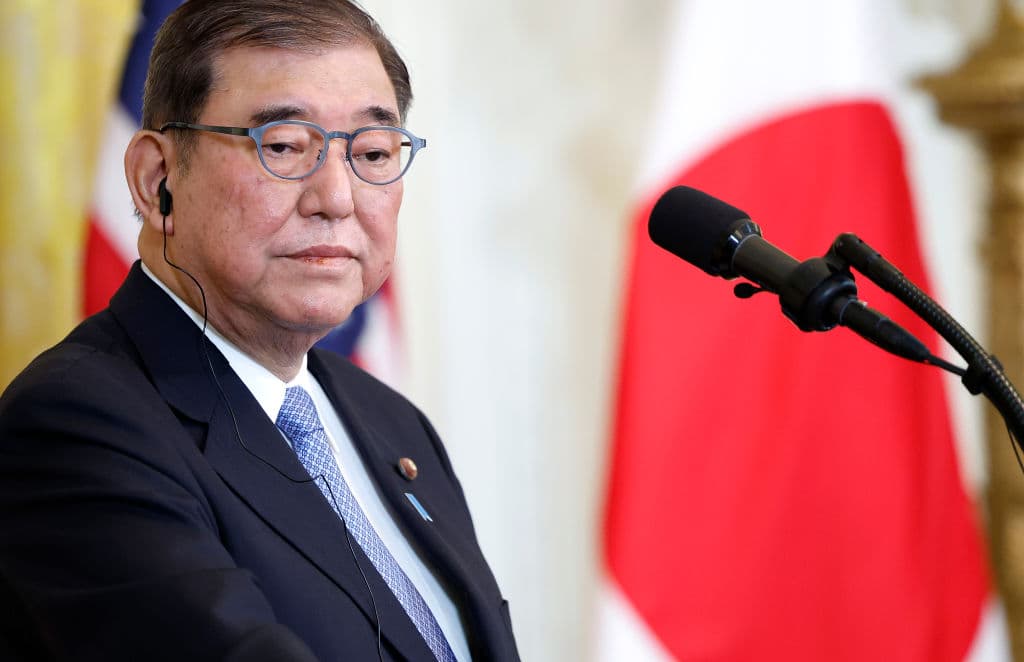
Japan’s conservative Liberal Democratic Party may not go on ruling as it has for most of the past 70 years if the results of elections for the upper house of the parliament, or Diet, are any indication of impending change.
This time Japan’s conservative structure is not challenged by leftists and socialists but rather by a far-right party whose rise parallels that of conservatism in America and Europe. At the forefront is a party that few had heard of, even in Japan, until recently, the Sanseito, or Political Participation Party, led by a former supermarket manager, Sohei Kamiya, with a basic message that is rapidly gaining traction in a disillusioned electorate.
“Japanese First” forms the dominant appeal of the Sanseito, which criticizes the influx of foreigners, hates rising taxes, and calls for greater reverence, if not authority, for the emperor. The Sanseito won 14 of 126 seats up for grabs in the Diet while the conservative DPP, or Democratic Party for the People, won 17 seats — enough to make sure the old-time LDP failed to win a majority in the upper house even with the help of its long-time ally, the Buddhist-backed Komeito.
The rise of the Sanseito was all the more impressive considering that it was founded less than five years ago, and its appeal is spreading among a populace wearying of LDP rule. “People are really disillusioned,” a Japanese housewife told the Sun. “They’re so fed up. People need something new. The LDP is corrupt to the core.”
The Sanseito, with DPP help, has far to go before knocking out the LDP, whose leader, Prime Minister Ishiba, has vowed to remain in office, but it’s badly divided and may have to pick a new face in order to hold members together and stage another election for the lower house of the Diet, which elects the prime minister.
Like the British, increasingly infatuated by the conservative leader of the Reform Party, Nigel Farage, the Japanese appear eager to cast out the old in favor of old-fashioned patriotism. A former senior American diplomat at Tokyo and Seoul, Evans Revere, put it this way to the Sun:
“Japan has now joined the rest of the G-7” — the group of seven leading capitalist powers — “in catching the disease all have been suffering from: the erosion of trust in government and institutions, the waning of commitment to long-standing democratic norms, fear of change, especially that induced by immigration, rising nationalism.”
The influx of foreigners into Japan is not comparable to that of the millions who have poured illegally across America’s southern borders, but the Japanese still worry about the rising numbers of workers from elsewhere in Asia, notably China, Vietnam, South Korea, and the Philippines. They’re taking on jobs as Japan’s population ages, challenging values and norms at variance with those of a population historically suspicious of foreigners.
“I have never witnessed an election in which fear of foreigners was so openly inflamed, nor one where discriminatory rhetoric was voiced with such blatant ease,” a contributor to the vox populi — voice of the people — column in the influential national paper, Asahi Shimbun, writes. “I fear that its rhetoric — used to legitimize prejudice — will gain broader acceptance in society, bolstered by its growing political influence.”
Mr. Revere perceives “the erosion of trust and confidence in institutions” as fueling the rightward shift. “Japan’s democracy, like that of the U.S., is powerful and long-standing,” he says, but “it is not all-powerful and impregnable, and it has lost its confidence.” He sees “good reason” for Japanese citizens with “an abiding commitment to democracy and to classical liberal thinking to be nervous.” The “rules and norms,” he observes, “are all changing.”
In Japan, change is seen as almost inevitable. “With the dust still settling after Sunday’s historic election, what is already clear is that Japan’s political equilibrium has shifted, and the parties that adapt fastest to the new rules of the game will shape the country’s future,” a special adviser on government relations at the Yokosuka Council on Asia-Pacific Studies, Michael Bosack, writes. “For the LDP and its rivals alike, the era of predictable elections is over.”