Japan’s ‘Iron Lady’ Meets Face-to-Face With Trump Next Week After Just Seven Days as Prime Minister
Sanai Takaichi has already demonstrated her deal-making prowess by engineering a last-minute coalition to secure a legislative majority — and her job.
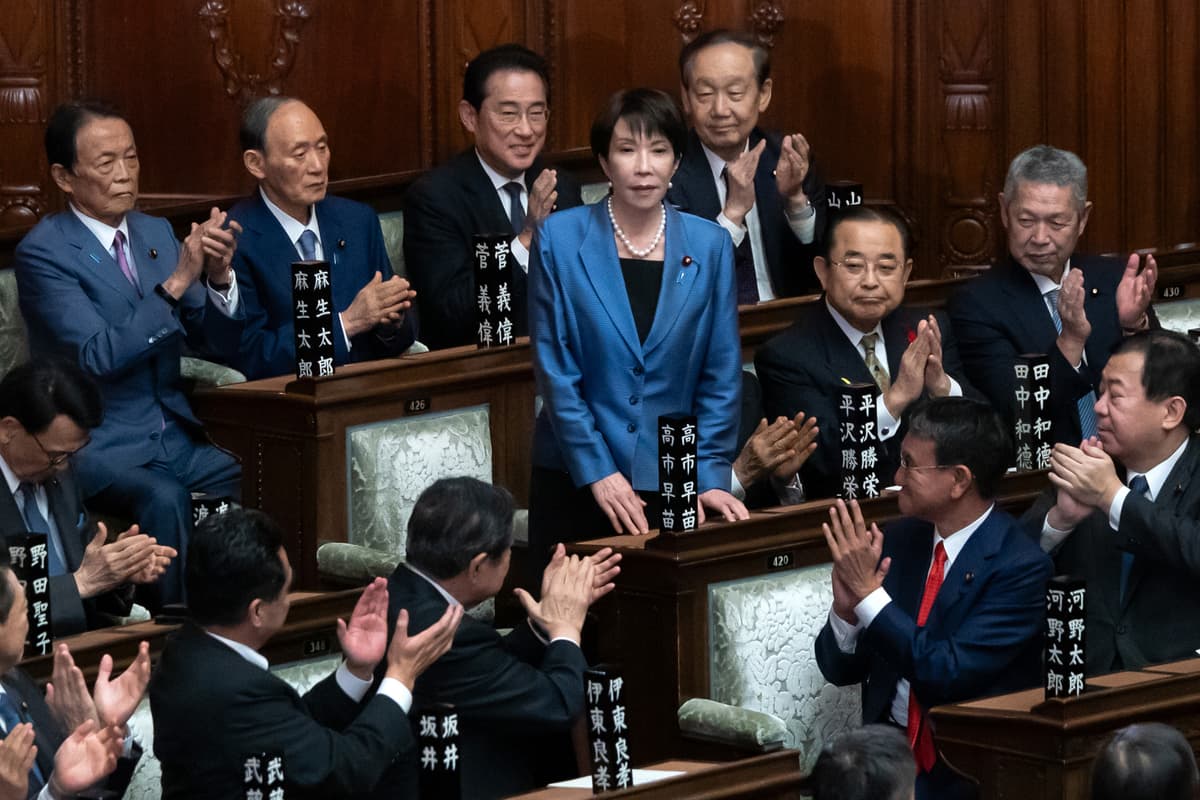

Japan’s first female prime minister, 64-year-old Sanai Takaichi, will be just one week in office when she meets President Trump at Tokyo on Tuesday for talks that could reshape the two nations’ security and trade relationships.
Dubbed Japan’s “Iron Lady” because of comparisons to Britain’s Margaret Thatcher, Ms. Takaichi survived the last-minute defection of a longtime coalition partner and, in a frenzy of backroom deal-making, secured the votes to be elected Tuesday by the Diet, the nation’s parliament.
Her next test will be to deal with thorny questions concerning tariffs and the financing of 50,000 U.S. troops on Japanese soil when she sits down Tuesday with the unpredictable American president. Tokyo will be the second stop after Malaysia on Mr. Trump’s way to South Korea for a two-day summit of Asia-Pacific Economic Cooperation group leaders.
Mr. Trump may well find a kindred spirit in Ms. Takaichi, a hawkish nationalist whose last-minute machinations to secure the prime ministership brought her Liberal Democratic Party into an alliance with the rightist Nippon Ishin, or Japan Innovation Party.
An agreement between the LDP and Nippon Ishin “spells out plans” to increase defense spending to 2 percent of the nation’s GDP, according to Asahi Shimbun, one of Japan’s huge national newspapers. That should be “music to the ears” of Mr. Trump, it said, considering his complaints that “America’s allies are not paying their way.”
Much will depend on the extent to which Mr. Trump values Japan as a strategic bulwark against China, whose leader, Xi Jinping, he is scheduled to meet later in the week. Some Japanese worry that their interests could become a bargaining chip in those talks.
Ms. Takaichi, who may have her own chance to speak with Mr. Xi at APEC, would hope to arrive with insights about Mr. Trump’s thinking on China-Japan disputes ranging from the South China Sea to Taiwan to the Senkaku islands, an unpopulated cluster north of Taiwan that Japan holds and China claims.
The prime minister is expected to approach those issues as a staunch nationalist anxious to discourage Chinese aggression against Free China — the independent government that has ruled on Taiwan since Mao Zedong’s Red Army captured the Chinese mainland in 1949.
While prioritizing economic issues and dealing with endemic corruption inside her own party, Ms. Takaichi has leaned far to the right in her coalition with the Nippon Ishin after the defection of the LDP’s longtime coalition partner, the center-right Komeito.
It’s not likely that Ms. Takaichi will call for abolition of Article 9 of Japan’s post-war constitution that bans sending troops overseas, but there may be ways to work around that prohibition by joining in more war games with American forces and possibly increasing the size of Japan’s euphemistically named “Self-Defense Forces.”
Combining commercial with military interests, Ms. Takaichi has agreed with the Nippon Ishin to revoke a restriction on military exports, limited by law to non-lethal materiel like vehicles and electronic gear.
Japan could then emerge as a top arms exporter, a challenge that could lead to Japan’s renaissance as a military power.