Jimmy Lai, Now Convicted by a Court in Hong Kong, Emerges as a Global Hero in the Struggle for Freedom
Crowds pack courthouse as verdict is delivered in case likely to go down in history as an indictment of dictatorial rule.
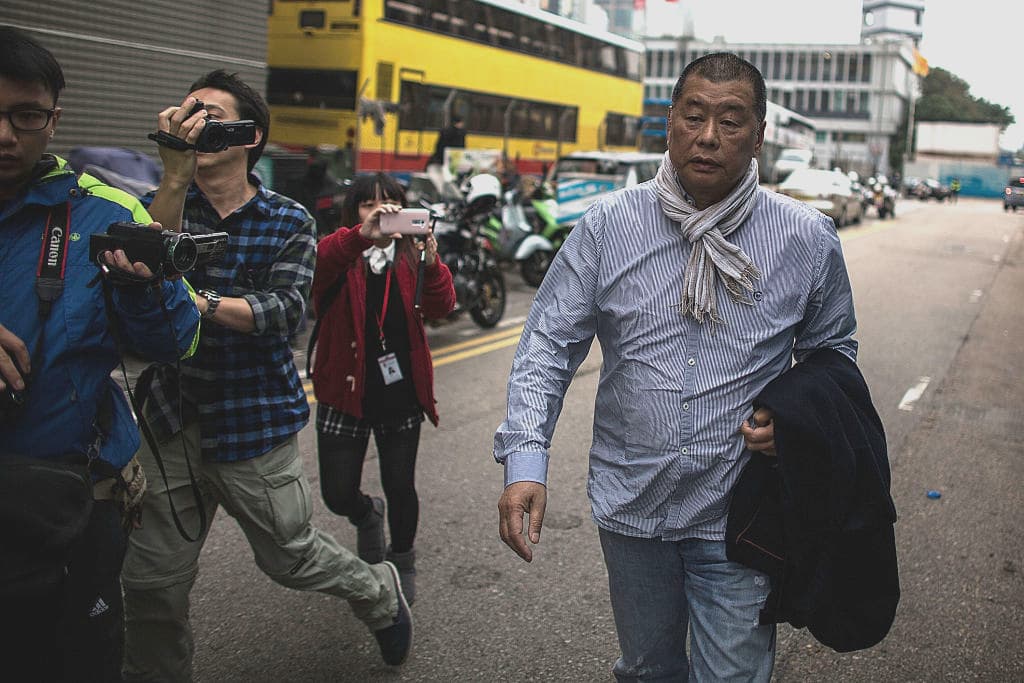

LONDON — A one-time Hong Kong self-made press tycoon, Jimmy Lai, has emerged as a global hero with his conviction by a pro-Beijing three-judge court in Hong Kong.
The 78-year-old founder of a Hong Kong tabloid, Apple Daily, once known as much for its biting criticism of Beijing rule as its colorful gossip, will have to accept international acclaim from prison assuming the court imposes a life or lengthy sentence after finding him guilty of sedition for conspiring with foreign forces in Hong Kong’s pro-democracy movement.
Mr. Lai, imprisoned five years ago while awaiting trial, heard the verdict in a Hong Kong courtroom packed with viewers who had stood in line all night to get one of some 50 available seats or to witness the proceeding on large screens inside the building.
The judges supported their decision in an astounding 857-pages, but the global verdict, outside of Communist China, is that the case is likely to go down as an indictment of dictatorial rule while assuring Mr. Lai of his place in a pantheon of heroes in the struggle for freedom.
The fact that Mr. Lai, like many Hong Kong residents in the era of British rule, holds a British passport confronts Britain’s prime minister, Keir Starmer, who has protested his imprisonment, with the question of how much of an issue to make of it. In London, Mr. Lai’s son, Sebastien, called for Mr. Starmer, considering a visit to Beijing, to place the issue at the heart of talks that have focused of late on Chinese espionage in Britain.
“It’s time,” said Sebastien, “to put action behind words and make my father’s release a precondition to closer relationships with China.” The verdict, he told BBC, “shows how the law has been weaponized against my father and shows how basically all these freedoms that we take for granted here have been made illegal in Hong Kong.”
While Jimmy Lai’s Apple Daily was sometimes criticized for its flamboyant, hyperbolic tabloid style, few outside China would doubt the significance of the verdict as a show of force against the pro-democracy movement that once roiled the streets of Hong Kong.
At the center of the case against Mr. Lai was the allegation that he had violated China’s “national security law,” hastily adopted in 2020 several months before his arrest for “conspiracy to collude with a foreign country or external elements” That was a reference to the broad international coverage of the movement to stop Beijing from imposing its own authoritarian rule over the former British colony. For good measure, the court also found him guilty of “printing and distributing seditious articles.”
Mr. Lai’s timing for his role as a voice for democracy was perfect.
He founded Apple Daily in 1995, two years before Hong Kong switched in 1977 to Chinese from British rule. A condition of reversion was that the former colony would enjoy its own form of democracy for 50 years free of Beijing’s heavy hand. Apple Daily became a leading voice on behalf of thousands of demonstrators who viewed Mr. Lai as an heroic figure, a symbol of their struggle.
Amnesty International’s China director, Sarah Brooks, calling Mr. Lai’s conviction “the death knell for press freedom in Hong Kong,” said “the activities for which he has been convicted would never have been considered crimes before the 2020 National Security Law was enacted.” The verdict, she said, is “the latest step in a systematic crackdown on freedom of expression in Hong Kong: targeting not only protests and political parties, but the very idea that people can – indeed, should – hold power to account.’
The Chinese foreign ministry’s office in Hong Kong issued “a stern warning to certain U.S. politicians, calling for them to immediately cease meddling in Hong Kong Affairs,” according to China’s English-language party paper Global Times.
That was in response to a letter “to US president,” not named by Global Times , by the chairman of the Senate foreign relations committee, Jim Risch, “and other lawmakers” in which they allegedly “made false statements and openly voiced support for anti-China and destabilizing figure Jimmy Lai.”
Several days before the court issued its verdict, Hong Kong’s last surviving opposition party was disbanded. Clearly pressured by Beijing, almost all party members agreed to dissolve the party as “the times have changed.”