Federal Judge Temporarily Blocks ‘Obviously Unconstitutional’ Arkansas Law Requiring Public Schools To Display Ten Commandments
The judge says the law appears to be part of a ‘coordinated strategy among several states to inject Christian religious doctrine into public-school classrooms.’
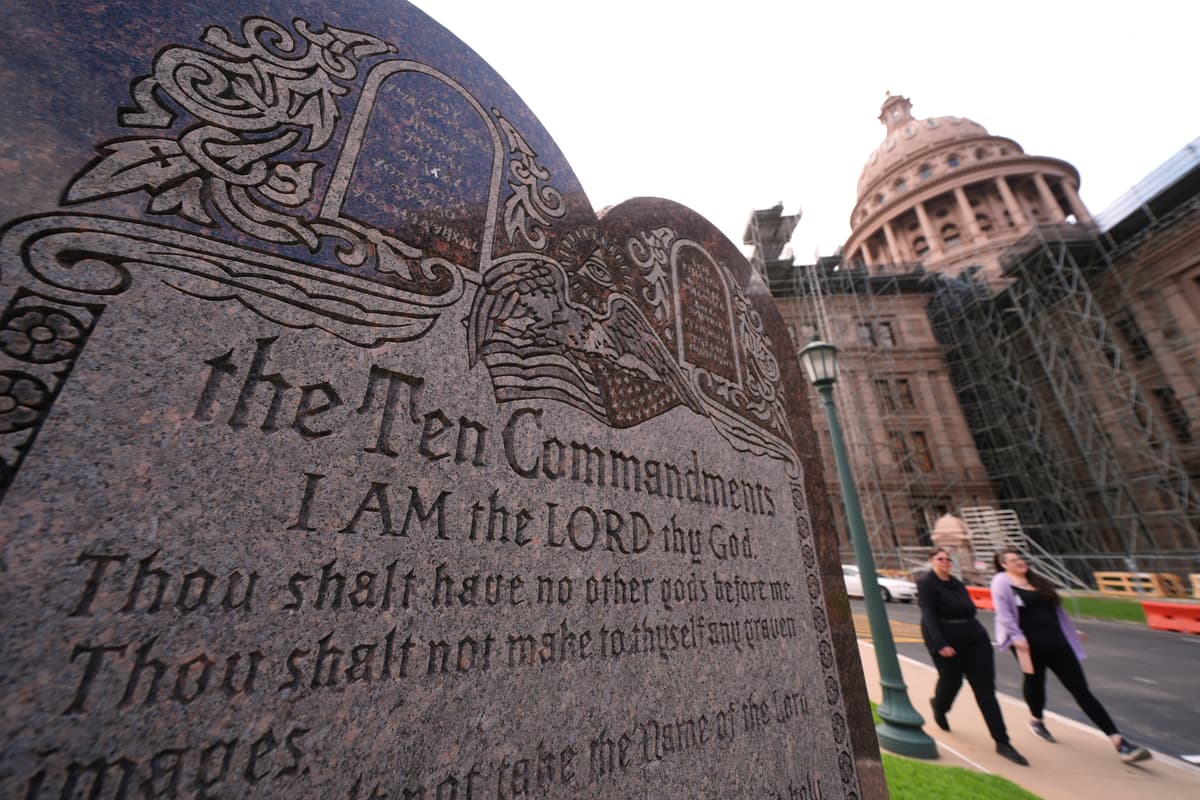

A law in Arkansas requiring that the Ten Commandments be displayed in public schools and libraries is temporarily on hold after a federal judge ruled that it is ‘obviously unconstitutional.’
A district court judge, Timothy Brooks, temporarily blocked Act 573, which requires that a “durable poster or framed copy of a historical representation of the Ten Commandments” be “prominently” displayed in public school classrooms and libraries across that state.
The law also requires the Ten Commandments be displayed in public buildings and at institutions of higher education. It states that the posters should be donated or purchased with donations.
A multi-faith coalition of parents with children in the Fayetteville, Springdale, Bentonville, and Siloam Springs school districts filed a federal lawsuit in June to block the law.
Judge Brooks granted a preliminary injunction, blocking the law from taking effect in the four school districts. In a 35-page ruling, he said there is “insufficient evidence of a broader tradition of using the Ten Commandments in public education, and there is no tradition of permanently displaying the Ten Commandments in public-school classrooms.”
In a statement, the legal director for the ACLU of Arkansas, John Williams, said the ruling is a “victory for Arkansas families and for the First Amendment.”
“The court saw through this attempt to impose religious doctrine in public schools and upheld every student’s right to learn free from government-imposed faith,” Mr. Williams said.
Arkansas’s attorney general, Tim Griffin, said the state is reviewing the decision and its options after the ruling.
Judge Brooks noted the Supreme Court’s 1980 decision in Stone v. Graham, which found that a Kentucky law requiring the Ten Commandments to be displayed in public schools violated the Establishment Clause of the Constitution because the commandments have “no secular legislative purpose.” He disagreed with Arkansas’s assertion that the purpose of Act 573 was “merely to display” the Ten Commandments.
He said, “Nor is it likely that the state’s purpose is to teach history to children, since no contextualizing historical statement is mandated, and the state emphasizes that ‘Act 573 does not require any teaching … about the Ten Commandments.” (Doc. 53, p. 47). Rather, as in Stone, the Arkansas General Assembly’s purpose is ‘to induce … schoolchildren to read, meditate upon, perhaps to venerate and obey, the Commandments.’ 449 U.S. at 42. That is illegal.”
In a somewhat ironic twist for conservatives, the judge cited the Supreme Court’s recent Mahmoud v. Taylor decision, which gave a group of religious parents a win in their bid to have the ability to opt their elementary school-aged children out of LGBTQ story books. The defendants in that case argued that the books simply presented students with stories that represented the diverse society they would grow up in. The plaintiffs pointed to guidance for teachers on how to respond to students’ questions about the books to argue that the curriculum goes further than simply introducing children to the idea that members of the LGBTQ community exist.
Judge Brooks noted that in Mahmoud, the court recognized the “potentially coercive nature of classroom instruction of this kind.” He also cited Lee v. Weisman, which noted that because children are compelled to attend public school, unless they are sent to an alternative such as a private school, for example, there are “heightened concerns with protecting freedom of conscience from subtle coercive pressure.”
He noted that the defendants in Mahmoud, as lawyers for Arkansas did, argued that the plaintiffs did not have evidence to show their rights had been violated because the curriculum had not taken effect when their lawsuit was filed. However, he said that in Mahmoud, the high court said parents did not need to go through a “wait and see” period to see how the LGBTQ storybooks were used in the classrooms.
“The Mahmoud Court noted — as relevant here — that it is ‘not realistic to expect parents to rely on after-the-fact reports by their young children to determine whether the parents’ free exercise rights have been burdened,” Judge Brooks said.
Judge Brooks said that the Ten Commandments are not “passive” because “students in public schools are forced to engage with them and cannot look away.”
He also said Stone makes Arkansas’s law “plainly unconstitutional,” and asked why legislators would “pass an obviously unconstitutional law.”
“Most likely because the state is part of a coordinated strategy among several states to inject Christian religious doctrine into public-school classrooms,” Judge Brooks said. “These states view the past decade of rulings by the Supreme Court on religious displays in public spaces as a signal that the Court would be open to revisiting its precedent on religious displays in the public-school context.”
Republicans in several states have passed laws requiring that public schools display the Ten Commandments, despite the Stone ruling, which has not been overturned. A federal appellate court upheld a ruling that found a similar law in Louisiana to be “facially unconstitutional.” Texas also passed a similar law, which has several lawsuits pending against it.
Conservatives appear to believe that the Supreme Court, with its 6-3 conservative majority, will overturn Stone, as it has done with other landmark decisions such as Roe v. Wade.