Judge To Hear Arguments in Lawsuit Over ‘Racist Reparations’ Program in Evanston, Illinois

The suit says the $25,000 payments are unconstitutional because race is used to determine eligibility.

AP/Shafkat Anowar
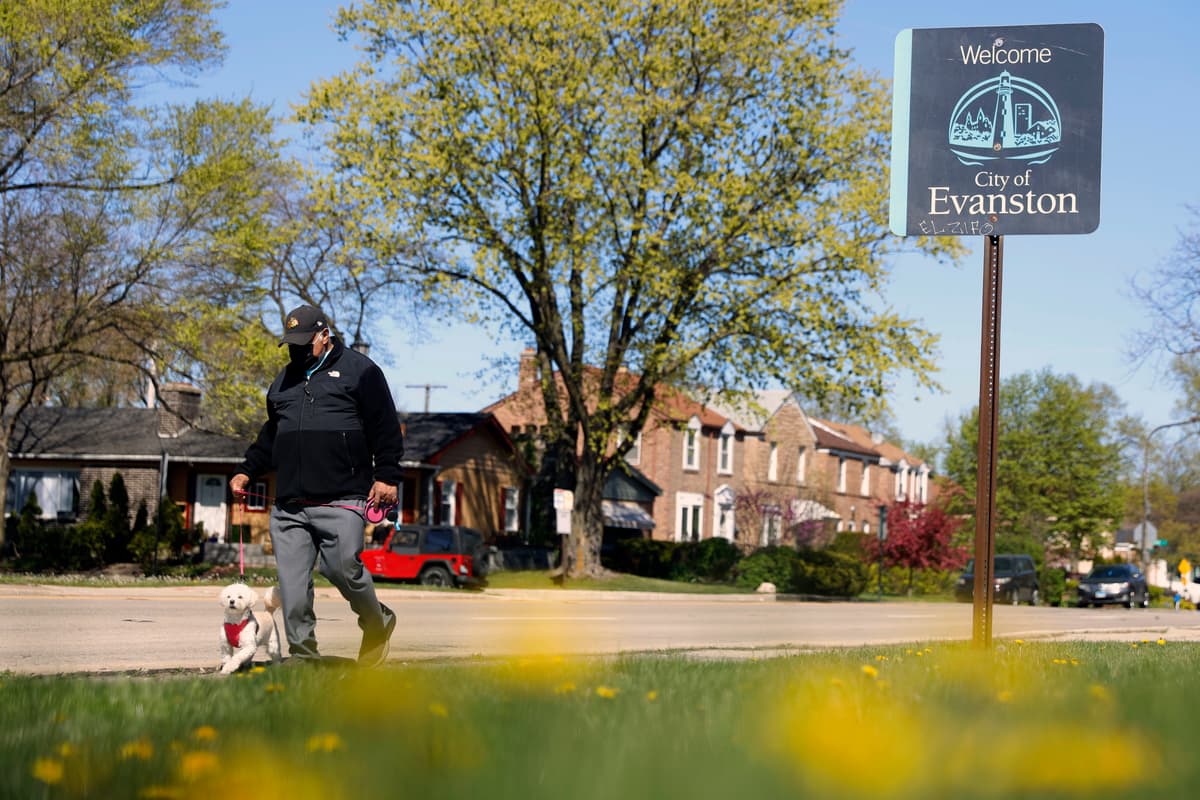
A street sign in the predominantly Black 5th Ward at Evanston, Illinois. AP/Shafkat Anowar

A reparations program in Evanston, Illinois — designed to hand out $25,000 payments to black residents — is being sued because only black residents were allowed to apply.

The Supreme Court’s decision to overturn affirmative action in college admissions might aid the case against the city.

A court hearing is scheduled Friday in the class action claiming the taxpayer-funded $20 million program is unconstitutional because of its use of race to determine who gets payments.

Evanston launched the first-in-the-nation reparations program six years ago and has paid out more than $6 million to hundreds of black residents and descendants of black residents who lived in Evanston between 1919 and 1969.

The conservative advocacy group Judicial Watch filed the suit on behalf of six residents claiming the program violates the Equal Protection Clause of the Fourteenth Amendment because of the city’s use of race as an eligibility requirement to seek payments.

Judge John F. Kness will hear oral arguments Friday on Evanston’s pending motion to dismiss the lawsuit filed in the United States District Court for the Northern District of Illinois, Eastern Division.

Through a series of resolutions, the Evanston city council created a program to provide the cash payments to residents who lived in Evanston between 1919 and 1969 and their children, grandchildren, and great-grandchildren.

The lawsuit claims that remedying societal discrimination is not a compelling governmental interest and Evanston cannot demonstrate that its use of a race as an eligibility requirement is narrowly tailored.

The suit notes that the eligibility requirements don’t even limit payments to people who actually experienced discrimination.

Evanston is accused of failing to consider race-neutral alternatives, such as requiring prospective recipients show that they or their parents, grandparents, or great grandparents actually experienced discrimination.

Judicial Watch states in the lawsuit that the six plaintiffs satisfy all eligibility requirements for participating in the program as “direct descendants” other than the race requirement.

“The Evanston, Illinois ‘reparations’ program is nothing more than a ploy to redistribute tax dollars to individuals based on race,” the president of Judicial Watch, Tom Fitton, says in a statement. “This scheme unconstitutionally discriminates against anyone who does not identify as Black or African American. This class action, civil rights lawsuit will be a historic defense of our colorblind Constitution.”

Evanston, in a legal filing, doubled down on its earlier claims that the plaintiffs don’t have legal standing. The city wants the judge to dismiss the lawsuit because the court “is not a proper forum for Plaintiffs to address their untimely policy disagreement” with the reparations program.

“This Court may only resolve timely-filed cases where the plaintiff has a concrete and particularized injury,” Evanston argues, adding that the plaintiffs lack standing because they were not “able and ready” to apply for the program in 2021, when the city last accepted applications.  

Evanston stopped making payouts in March after struggling to come up with enough funds. The key funding source for the program — a 3 percent sales tax on recreational marijuana sales in the Chicago suburb of 75,000 residents — has been lower than anticipated.

Boston, Detroit, and St. Paul are in various stages of studying or implementing their own reparations programs. California and New York are considering reparations at the state level.

At the federal level, despite potentially costing trillions of dollars and having little or no chance of passing in the current Republican-led Congress, far-left Democrats looking to establish loyalty tests for their progressive colleagues on Capitol Hill are rolling out their own efforts to pass legislation requiring American taxpayers to pay reparations for the country’s legacy of slavery.


The New York Sun

© 2025 The New York Sun Company, LLC. All rights reserved.

Use of this site constitutes acceptance of our Terms of Use and Privacy Policy. The material on this site is protected by copyright law and may not be reproduced, distributed, transmitted, cached or otherwise used.

The New York Sun

Sign in or  create a free account

or
By continuing you agree to our Privacy Policy and Terms of Use