Judge Webster and ‘Keystone Kash’: A Departed FBI Director Is Memorialized, While the Current One Faces Questions About His Abilities
In a chaotic week, Kash Patel faces questions about Epstein and Kirk from House and Senate Judiciary Committees.

In 1978, when he arrived at the J. Edgar Hoover Building to become the FBI’s third director, Judge William H. Webster laid out, in no uncertain terms, his new rules for the 7,800 agents now under his command.
For starters, he did not want to hear the word “feel.” The FBI investigates facts, not feelings.
Second, he did not want the bureau to become a “mausoleum” to J. Edgar Hoover, whose influence was still seen and felt six years after his death in the brutalist headquarters on Pennsylvania Avenue that bore his name. To make his point, he had a marble bust of Hoover moved from his office to the headquarter’s first floor, where it could be enjoyed by everyday tourists.
Finally, he was to be referred to as “Judge.” He had served on the bench as both a federal judge and an appellate judge before President Carter tapped Webster, a registered Republican, to run the FBI. He had little use for the title “Director.”
Webster’s rules were his way of “setting up his own platform,” a former FBI deputy assistant director, Scott Nelson, tells the New York Sun.
“I think he needed to sever himself from Hoover,” Nelson adds.
These rules didn’t land well with Webster’s new workforce. The FBI director of congressional and public affairs, William M. Baker, got it in the ear from his colleagues.
“They said, ‘Hey, Bill, what’s this ‘Judge’ crap? He’s director,” Mr. Baker, who would later work with Webster at the CIA, tells the Sun.
Mr. Baker asked Webster the same question, albeit with gentler language. Webster glared back at him with a pair of steel-blue eyes that, according to those who worked for him, could bore through your being.
He explained to Baker that in his new role, when he was to face the Senate or House Intelligence Committees — with politicians like Orrin Hatch, William Cohen, and Charles Grassley staring down from the dais — Webster would sit on on his briefcase to raise himself by 6 inches.
“‘But you know what raises me another 10 feet, Bill? It’s when I can look them in the eye after they refer to me as ‘Judge,’” Mr. Baker recalls.
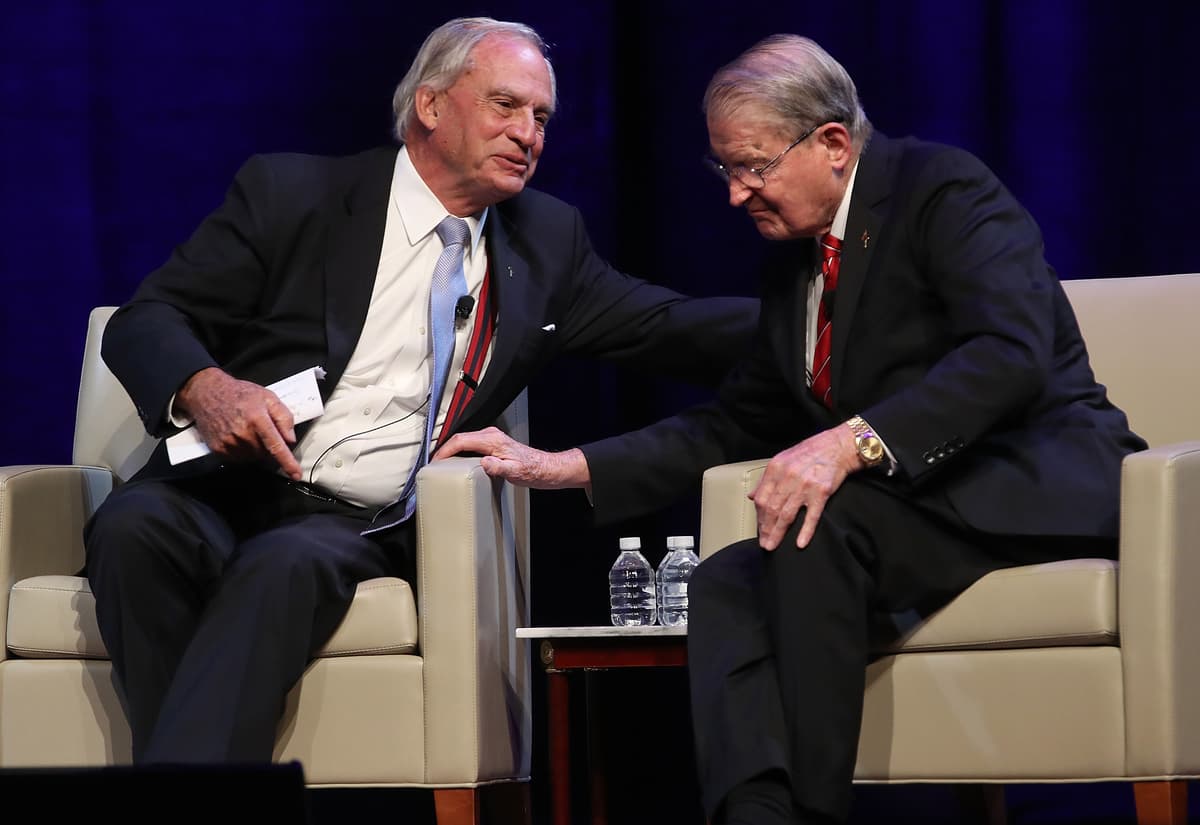
Webster, who would serve as CIA director under President Reagan from 1987 to 1991, died on August 8 at the age of 101. A memorial service for Webster was held Thursday at the National Presbyterian Church in Washington.
Those who knew and worked with Webster say he was a man of cool resolve and unwavering integrity. He was, as his professional and preferred honorific suggested, judicious. He steered the agency with a steady, unapologetic command.
“I never saw him flustered. I mean, he could sense when things weren’t going right, but he didn’t lose it,” Mr. Baker tells the Sun.
He came to the bureau wanting modernity and largely achieved it. He pushed the bureau to be a proactive agency; shootouts with Depression-era bank robberies and recovering stolen vehicles were, as the saying goes, as dead as Dillinger.
His bureau pursued sophisticated investigations like white collar crime, the mafia, political corruption, and terrorism. He forced out the “Hoover Hard Hats” – agents who feared Hoover would return from the grave and exile them to Butte, Montana for following Webster’s orders.
Webster took control of the FBI after his predecessors had failed to keep Hoover out of the picture. The acting director who immediately succeeded Hoover, L. Patrick Gray III, was forced to resign in 1973 over the FBI’s mishandling of the Watergate. After him came Clarence Kelley, whose tenure was dogged by reports of the bureau’s illegal wiretapping of Weather Underground members.
“Kelly once told me that he never got to be director for his five years because it seemed like Congress or the press were always on him about Hoover,” a former FBI assistant director in charge, Lee Laster, tells the Sun.
In 1979, Webster forced one such Hoover hard hat, John McDermott, into early retirement after McDermott wrote an internal letter criticizing the Carter administration’s proposed civil service reform plan. Webster wasn’t angry over McDermott’s position – he agreed with him, in fact. But McDermott had acted without authorization.
In 1987, President Reagan nominated Webster to run the Central Intelligence Agency, which had been hounded over the Iran-Contra scandal. His greatest legacy, according to the acting FBI director, John Otto, was “morale.’
“He was there for FBI agents and the support employees at the FBI. There’s no question he had their best interests in mind,” a former FBI agent and the former president of the FBI Agents Association, Thomas O’Connor, tells the Sun.
Webster had been nominated by a Democratic president, and eventually promoted to a bigger role at a more enigmatic agency by that president’s Republican successor – an accomplishment yet to be repeated.
As of last week, such bureaucratic longevity seemed out of reach for the current FBI director, Kash Patel.
The 45-year-old former federal public defender and national security officer has been dogged by accusations of bungling both the initial investigation into the murder of conservative Charlie Kirk and the limited release of the Jeffrey Epstein files.
This week, Mr. Patel testified before separate Senate and House Judiciary Committee hearings, where he fielded questions about both controversies that, for now, have defined his young FBI career.
He defended his decision to release images of the Kirk gunman, saying quick transparency led to the suspect’s father recognizing him and turning him. He touted record fentanyl seizures, drops in the national murder rate, and thousands of violent criminals taken off the street.
He was churlish, if not antagonistic, with Democrats from both branches. Pressed on the Trump administration’s transfer of convicted sex trafficker and Epstein associate Ghislaine Maxwell, Mr. Patel called Senator Adam Schiff, a Democrat of California, “the biggest fraud to ever sit in the United States Senate.”
On Wednesday, Representative Jared Moskowitz, a Democrat of Florida, asked if the FBI would investigate claims that Mr. Trump’s signature on a birthday card to Epstein was forged.
“Sure, I’ll do it,” Mr. Patel said.
Mr. Patel maintained that there was “no credible information” that Epstein trafficked young women to anyone else other than himself.
On Tuesday, Senator John Neely Kennedy, a Republican from Louisiana, urged Mr. Patel to release all Epstein files, warning the FBI director that it was an issue that “was not going to go away.”
“I think the essential question for the American people is this: They know that Epstein trafficked young women for sex to himself. They want to know who, if anyone else, he trafficked these young women to. And that’s a very fair question,” Mr. Kennedy said.
Last Friday, Christopher F. Rufo said on X it may be time for Republicans to “assess whether Kash Patel is the right man to run the FBI.”
Also last week, Mr. Patel and his deputy, Daniel Bongino, were sued by three former high-ranking FBI officials for allegedly carrying out “unlawful” retaliatory firings. One official accused Mr. Patel of saying his ability to keep his job as FBI director “depended on the removal of the agents who worked on cases involving the President.”
President Trump continued to show his support for Mr. Patel, saying on Sunday that he was “very proud of the FBI.”
But Mr. Patel, nicknamed “Keystone Kash” by the Daily Beast, has reportedly lost the backing of the Attorney General, Pam Bondi, and her deputy, Todd Blanche. The new FBI co-deputy director, Andrew Bailey, rumored to be Mr. Patel’s inevitable replacement, has just started his new role at the bureau.
There are also questions surrounding the FBI’s investigation into Kirk’s alleged shooter; conservative firebrand Steve Bannon, who has been openly critical of Mr. Patel’s handling of the case, said he was “not buying” the evidence presented, especially text messages between the suspect and his roommate.
Despite criticism over Mr. Patel’s actions of late, Mr. Nelson believes Mr. Patel is the director that today’s FBI needs.
“The machine today is responding to transparency and results. These guys don’t have the time to sit back in their rocking chairs and judiciously weigh out the action. To the contrary, Patel is a street agent’s guy,” Mr. Nelson tells the Sun.
“Webster was a brilliant guy, a neat guy, and a thoughtful guy. But he wouldn’t survive today because he was too damn judicious.”