Judges Appointed by Republicans Could Be Refusing To Retire — To Frustrate Trump’s Ambition for a MAGA Judiciary

The nomination of a former personal lawyer, Emil Bove, for the 47th president to an appellate seat could be a bellwether.
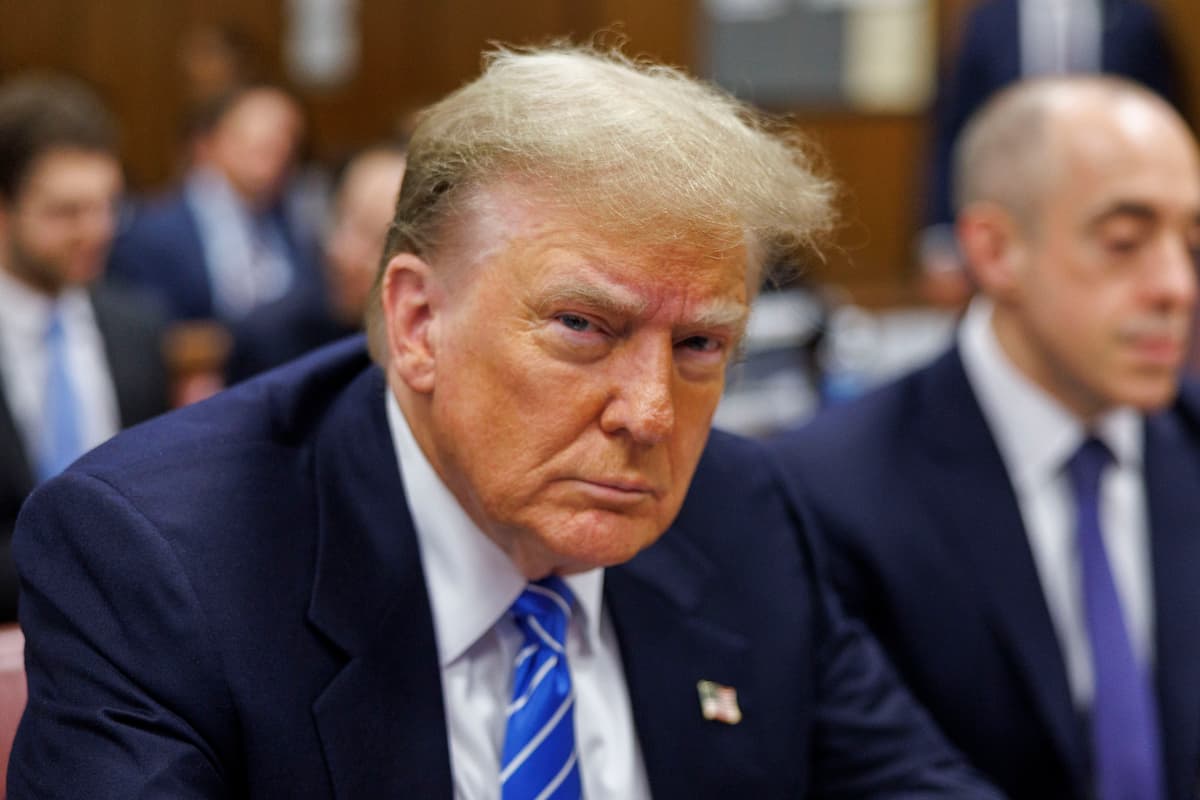
Sarah Yenesel-Pool/Getty Images
President Trump sits in court with attorney Emil Bove during his trial for allegedly covering up hush money payments at Manhattan Criminal Court on May 13, 2024 at New York City. Sarah Yenesel-Pool/Getty Images

An emerging trend of federal judges appointed by Republican presidents pushing off their retirement could amount to an obstacle in President Trump’s ability to stock the judiciary with jurists he sees as aligned with his worldview.

Bloomberg reports that “federal judges are retiring at a historically slow pace …  most strikingly among those appointed by his Republican predecessors.” Mr. Trump has dozens fewer seats to fill on the bench than he did during his first term — and many of those who are resisting retirement are not Democratic appointees, but jurists named by Republicans.

That slowdown stands in contrast to Mr. Trump’s first term success in stocking the judiciary, when he placed 234 judges on the federal bench, including three justices of the Supreme Court. President Biden did him one better, with 235 appointments — though he  nominated only one Supreme Court justice, Ketanji Brown Jackson. Her selection followed his vow to appoint a black woman.

According to Bloomberg’s count at least 22 appellate judges appointed by Republican presidents eligible for retirement have failed to sail into the sunset. There are at least 42 district court judges who are in the same category. That amounts to approximately 70 federal judges who owe their jobs to Republican presidents who are eligible to step aside but have not done so. 

Emil Bove attends Manhattan criminal court during President Trump's sentencing in the hush money case at New York, January 10, 2025.
Emil Bove attends Manhattan criminal court during President Trump’s sentencing in the hush money case at New York, January 10, 2025. Jeenah Moon/Bloomberg via AP

By June 1 in Mr. Trump’s first term, he had 153 seats to fill on the federal bench. By the same date of his second term, that number stood at 61. To qualify for retirement or senior status, a judge must reach the age of 65 and his age added to his years of service must equal 80. At least 10 years of service on the bench are required.  That is called the “Rule of Eighty.”

The Constitution ordains that federal judges — including the justices of the Supreme Court — “shall hold their Offices during good Behaviour,” meaning that their tenure is a lifetime unless they retire or are impeached. Federal judges are nominated by the president and must be confirmed by the Senate. 

Alexander Hamilton writes in 78 Federalist that lifetime tenure is “the best expedient which can be devised in any government, to secure a steady, upright, and impartial administration of the laws.” 

A legal scholar, Joshua Blackman, tells the Sun that he is not sure whether the hesitancy among Republican-appointed judges to step back is a movement or more of a “narrative” among watchers of the judiciary. He reflects that tying the choice to take senior status — a reduced case load — to the political climate is “galling” and reflects the attitude that the positions are “sinecures” to be passed on to the preferred candidates of incumbents.

The timing of judicial retirements has often been entwined with political considerations. Justice Ruth Bader Ginsberg, a liberal, famously persisted through President Obama’s two terms in the White House. She died toward the end of Mr. Trump’s first term, creating a vacancy that was filled by a conservative, Justice Amy Coney Barrett. Justice Stephen Breyer, though, retired in 2022, and was replaced by another liberal, Justice Jackson. 

Mr. Trump has not shied away from conflict with the federal bench. He called one district court judge, James Boasberg, a “radical left lunatic” and called for his impeachment. That prompted a rebuke from Chief Justice Roberts. He declared in a statement that “For more than two centuries, it has been established that impeachment is not an appropriate response to disagreement concerning a judicial decision.” 

The Trump administration has also bristled at the spate of nationwide injunctions handed down by district court judges, orders that have come at a far more voluminous clip than they did under President Biden or during Mr. Trump’s first term. Both Vice President Vance and a senior adviser to the president, Stephen Miller, have chafed at the ability of trial judges to impede executive action, especially in respect of immigration.

Last month a majority of the Supreme Court agreed, sharply limiting the use of nationwide injunctions. That ruling came in a case concerning Mr. Trump’s executive order banning birthright citizenship. While the court did not reach the merits of that issue, Justice Barrett’s decision reckons that “When a court concludes that the Executive Branch has acted unlawfully, the answer is not for the court to exceed its power, too.”

One flashpoint between Mr. Trump and the federal bench could be the nomination of an official at the Department of Justice, Emil Bove, to a seat on the Third United States Appeals Circuit. Before joining the DOJ, Mr. Bove served as Mr. Trump’s personal lawyer on three of the criminal cases faced by the 47th president. Mr. Blackman allows that Mr. Bove’s nomination could rub the judiciary the wrong way, but reckons that would be a “one-off” rather than a widespread warning against retirement. 

Mr. Bove was responsible for dropping the criminal bribery charges against Mayor Adams.That decision spurred resignations at the DOJ and the Southern District of New York, where the acting United States Attorney, Danielle Sassoon, accused Mr. Bove of engineering a “quid pro quo” with Mr. Adams where the charges were dropped in exchange for cooperation on immigration. Mr. Trump this week shared that he “helped” Hizzoner. 

The federal judge overseeing that case, Dale Ho, granted the motion to dismiss — “with prejudice” — but concluded that “Everything here smacks of a bargain: dismissal of the indictment in exchange for immigration policy concessions.” During an initial confirmation hearing last month Mr. Bove testified that ““I am not anyone’s henchman. I am not an enforcer.”

On Monday, though, a group of federal prosecutors wrote in a letter sent to the Senate that Mr. Bove is “the worst conceivable nominee” for the Philadelphia-based court and that he “has demonstrated a willingness to ignore his oath to the Constitution and to disregard the Rule of Law in an effort to conform to every possible whim of the President.”

Mr. Trump, though, defended his nominee on Truth Social, writing that “Emil Bove will never let you down.”      


The New York Sun

© 2025 The New York Sun Company, LLC. All rights reserved.

Use of this site constitutes acceptance of our Terms of Use and Privacy Policy. The material on this site is protected by copyright law and may not be reproduced, distributed, transmitted, cached or otherwise used.

The New York Sun

Sign in or  create a free account

or
By continuing you agree to our Privacy Policy and Terms of Use