
Justice Department’s Probe of Letitia James for Violating Trump’s Civil Rights Increasingly Mirrors Jack Smith’s Prosecution of the President
The Department of Justice appears to be mulling a case against New York’s attorney general similar to the one brought by the special counsel.
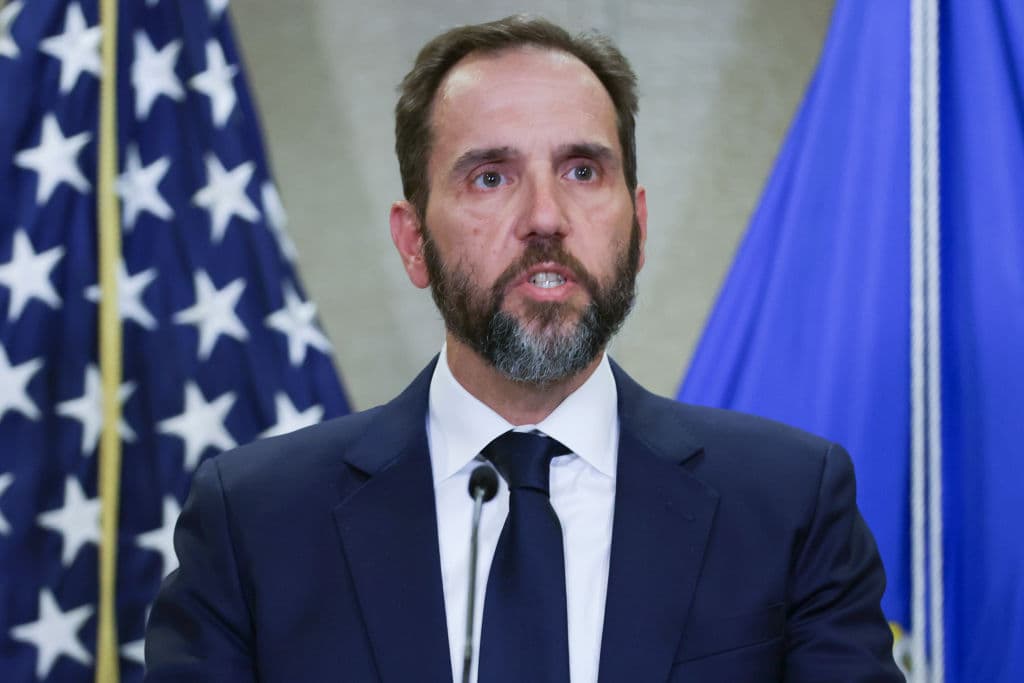
The Department of Justice’s investigation — possibly criminal — into New York’s attorney general, Letitia James, for violating President Trump’s civil rights appears, in an ironic twist, to be drawing inspiration from Special Counsel Jack Smith’s criminal prosecution of the president.
The investigation, while preliminary, has already secured a subpoena in connection to Ms. James’s civil fraud lawsuit against Mr. Trump, his two adult sons, and his business. That case resulted in a judgment of some $500 million and a set of other harsh penalties. Mr. Trump has appealed, and awaits a verdict more than 300 days after oral arguments were aired.
While Ms. James is also facing scrutiny from another quarter of the DOJ over allegations that she lied on mortgage applications and for her relentless pursuit of the National Rifle Association in the Empire State, this investigation appears to center on her signature courtroom victory — the fraud case against Mr. Trump for practices of “persistent fraud” that Judge Arthur Engoron reckoned “shocked the conscience.”
Ms. James crowed when she launched her lawsuit that while Mr. Trump “may have authored the ‘Art of the Deal,’ our case revealed that his business was based on the art of the steal.” Now, though, the case could expose her to criminal or civil jeopardy as Mr. Trump’s DOJ turns the tables on the Democratic legal and political establishment who hounded Mr. Trump with what he calls “lawfare” during the interregnum between his presidencies.
The verdict in Ms. James’s civil fraud case was greeted with dismay by some in New York’s business establishment and could face long odds of surviving the president’s appeal. The appellate court in the case appeared skeptical of a verdict one judge called “troubling.” Another jurist likened it to a “commercial dispute.” The judgment, though, did not impede Mr. Trump’s re-election victory over Vice President Kamala Harris.

Mr. Trump’s electoral prospects were also not wounded by the two, far more serious criminal cases brought by Mr.Smith. The hard-charging prosecutor sought to convict Mr. Trump for the storage of classified documents at Mar-a-Lago and for election interference relating to the events of January 6. Both of those cases foundered before trial, and were eventually ended by the immunity Mr. Trump grasped when he swore the oath for a second time.
While most of the charges in Mr. Smith’s classified documents case were drawn from the 1917 Espionage Act —with some obstruction charges thrown in for good measure — the January 6 prosecution required more creativity. The special counsel charged Mr. Trump with violations of the Sarbanes-Oxley Act, which was originally passed to target financial fraud and prohibits “corrupt” interference with an “official proceeding.”
The Supreme Court eventually curtailed the use of that charge, which carries a 20-year prison sentence, against more than 300 other January 6 defendants. Mr. Smith, though, to the end maintained that it was lawful as applied to Mr. Trump. The prosecutor also charged Mr. Trump under another unusual statute — deprivation of rights. That is the same allegation that the DOJ is now probing with respect to Ms. James’s case against Mr. Trump.
The DOJ’s website explains that Section 241 of Title 18 “makes it unlawful for two or more persons to agree to injure, threaten, or intimidate a person in the United States in the free exercise or enjoyment of any right or privilege secured by the Constitution or laws of the United States or because of his or her having exercised such a right. … The offense is always a felony, even if the underlying conduct would not, on its own, establish a felony violation.”
Mr. Trump has repeatedly denounced Ms. James — a black liberal Democrat — for being “racist.”
Unlike other kinds of conspiracy, deprivation of rights does not require the existence of what the law calls an “overt act.” The mere existence of a plan is sufficient. The DOJ explains: “Those prosecuted under the statute typically include police officers, sheriff’s deputies, and prison guards.” Defendants are required to be acting “under the color of law,” meaning that they “wield power vested by a government entity.”
Mr. Smith alleged that Mr. Trump, through his actions after the 2020 election, engineered and helmed “a conspiracy against the right to vote and to have one’s vote counted.” This crime, Mr. Smith contended, unfolded “from on or about November 14, 2020, through on or about January 20, 2021, in the District of Columbia and elsewhere.” While Mr. Smith charged Mr. Trump criminally, the law also has a civil dimension.
The ancestor of the law under which Mr. Trump was charged was first passed as a component of the Enforcement Act of 1870, and was intended to thwart the efforts of groups like the Ku Klux Klan, who sought to block black southerners from exercising their rights under the Reconstruction Amendments. In a 1966 case the Supreme Court determined that the law was to be applied broadly, beyond “a narrow and relatively unimportant category of rights.”
More recently, the Obama and Biden justice departments have used the statute to prosecute racially charged local cases of alleged police brutality where federal officials didn’t have confidence in state courts to mete out harsh punishments.
While a grand jury approved the subpoena the DOJ requested with respect to Ms. James’s fraud case, the secret nature of those proceedings mean that the DOJ’s theory of the case against her are still obscure — meaning that it is not yet clear which of Mr. Trump’s rights his justice department is mulling as a basis for a criminal or civil case.