Justice Gorsuch Denounces the ‘Anarchy’ of Lower Court Judges Trying To Block Trump’s Policies
The justice lashes out at alleged insubordination on the part of district court judges.
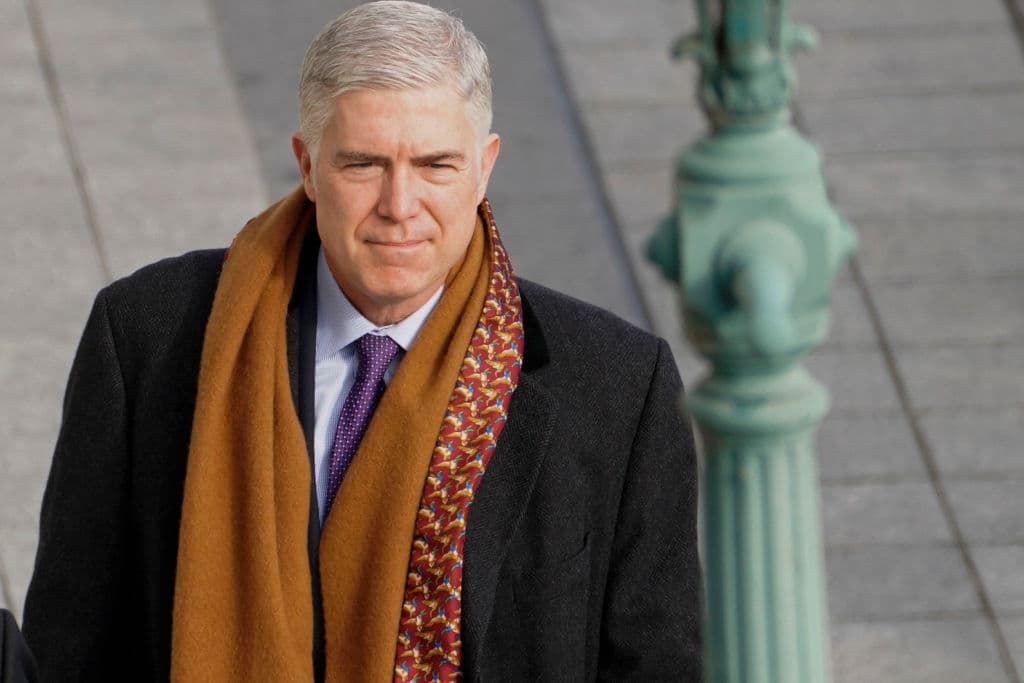
Justice Neil Gorsuch’s admonishment of lower courts, articulated in an opinion last week, could amount to a powerful endorsement of President Trump’s contention that he is being thwarted by recalcitrant lower court judges.
The rebuke, which was joined by Justice Brett Kavanaugh, came in a ruling in the case of National Institutes of Health v. American Public Health Association, in which the NIH, adhering to new guidelines from the Trump administration, canceled some $800 million in research grants related to “health equity” and “gender identity.” Those cancellations had been blocked by Judge William Young, an octogenarian appointee of President Reagan.
Judge Young wrote in his order that he has “never seen government racial discrimination like this” and also decried “pervasive racial discrimination and extensive discrimination” against LGBT people.
The court’s narrow majority ruled that challenges to grant terminations must be heard not in federal district court but in the Court of Federal Claims. Justice Ketanji Brown Jackson issued a solitary and scathing dissent in which she compared the court’s jurisprudence to “Calvinball,” a reference to the “Calvin and Hobbes” cartoon. She explains that the invented sport has “only one rule: There are no fixed rules. We seem to have two: that one, and this administration always wins.”
Addressing the substance of the NIH cuts, Justice Jackson added that her colleagues on the court were making “preventing manifestly injurious Government action as difficult as possible.”
In the NIH ruling Justice Gorsuch, who was named to the Supreme Court in 2017 by Mr. Trump, wrote separately with Justice Kavanaugh — also an appointee of Mr. Trump — to declare, “Lower court judges may sometimes disagree with this court’s decisions, but they are never free to defy them. This is now the third time in a matter of weeks this court has had to intercede in a case ‘squarely controlled’ by one of its precedents.”
Justice Gorsuch writes that in an earlier and similar case “this Court granted a stay because it found the government likely to prevail in showing that the district court lacked jurisdiction to order the government to pay grant obligations.” The Coloradoan cites an earlier ruling of the Nine that reasoned, “Unless we wish anarchy to prevail within the federal judicial system, a precedent of this Court must be followed by the lower federal courts no matter how misguided the judges of those courts may think it to be.”
Justices Gorsuch and Kavanaugh add: “When this court issues a decision, it constitutes a precedent that commands respect in lower courts.” That is Federal Courts 101, canon to generations of law students. It could be, though, that the surge in the high court’s reliance on the emergency or “shadow” docket — where rulings are handed down without oral arguments and sometimes without fully explicated reasoning — has empowered lower court judges to ignore or evade pronouncements from the high court.
Decisions rendered off the emergency dockets, though, do not have the status of fully formed precedent. During President Biden’s term Justice Samuel Alito acknowledged that only full opinions carry precedential weight but also declared that the “catchy and sinister term ‘shadow docket’ has been used to portray the court as having been captured by a dangerous cabal that resorts to sneaky and improper methods to get its ways.”
The question of district court judges impeding Mr. Trump’s agenda was addressed last term in the case of Trump v. Casa, which bubbled up to the Supreme Court in the context of the 47th president’s effort to outlaw birthright citizenship. The Nine deferred ruling on the merits of that push, but seized the opportunity to sharply curtail the use of nationwide or “universal” injunctions by district court judges.
On Tuesday a federal district judge in Virginia, Thomas Cullen, an appointee of Mr. Trump, criticized the administration’s rhetoric toward the lowest rung on the federal bench. Judge Cullen dismissed a lawsuit that the Trump Department of Justice — angered by district judges stymying its rapid deportation efforts — had filed against all 15 federal district judges in Maryland. The invective from senior officials has included, the judge enumerates, language like “‘left-wing,’ ‘liberal,’ ‘activists,’ ‘radical,’ ‘politically minded,’ ‘rogue,’ ‘unhinged,’ ‘outrageous,’ ‘overzealous,’ ‘unconstitutional,’ ‘crooked,’ and worse.”
Judge Cullen, who called the case a “constitutional free-for-all” — writes that “although some tension between the coordinate branches of government is a hallmark of our constitutional system, this concerted effort by the Executive to smear and impugn individual judges who rule against it is both unprecedented and unfortunate.”