Justice Kagan Lashes Out at Trump’s Thriving ‘Shadow Docket’ Strategy Designed To Thwart Liberal Judges From Blocking His Policies
The former dean of Harvard Law School contests how the court’s conservative wing is handing the 47th president victories.
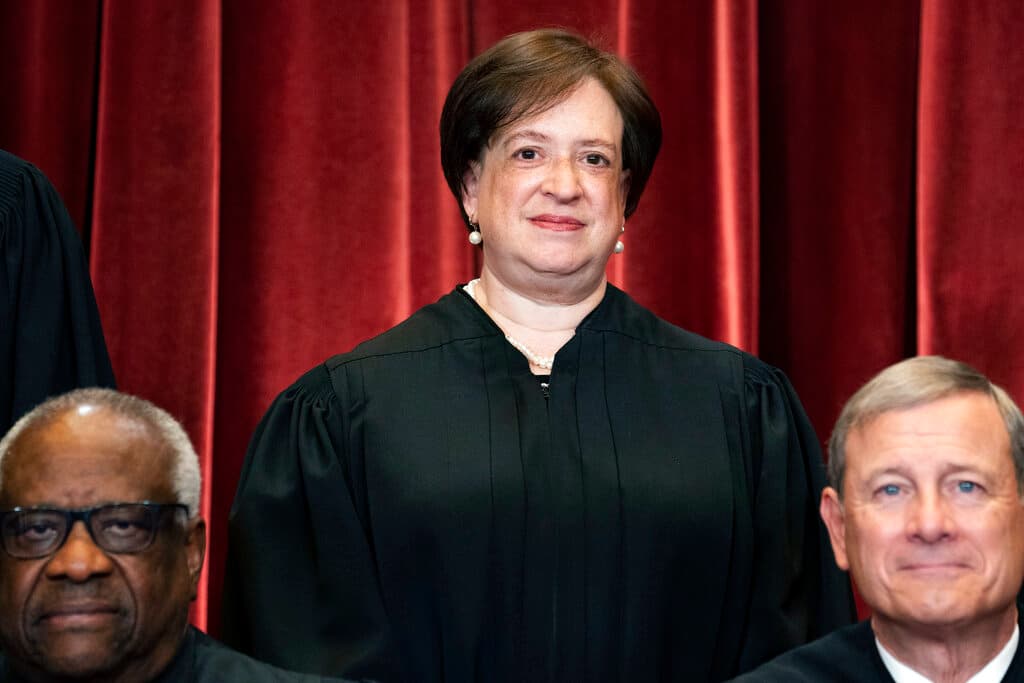
Justice Elena Kagan’s broadside against the Supreme Court’s “shadow docket” — sometimes called its “emergency” one — puts in sharp relief the liberal critique of how the conservative justices are increasingly conducting their business in President Trump’s second term.
Justice Kagan told a gathering of the Ninth Circuit Judicial Conference in California last week that “the orders themselves don’t tell anybody anything about why we’ve done what we’ve done.” She was referring to decisions handed down without oral arguments — and without written opinions. The justice cites a “real responsibility” for the court to explain itself.
The Trump administration has petitioned the high court some 12 times for relief in the expedited form. That is largely, though, a function of the unprecedented deluge of orders from lower court judges blocking elements of Mr. Trump’s agenda. The Supreme Court ruled last month to curtail nationwide or “universal” injunctions, the issuance of which had skyrocketed. Mr. Trump has amassed critical, albeit provisional, victories off of the court’s emergency docket.
Justice Kagan adds, “What we started doing when we started doing these things is just issuing orders. But I think that that’s not the right way to approach it, because the orders themselves don’t tell anybody anything about why we’ve done what we’ve done. A court is supposed to explain things. That’s what courts do. They’re supposed to explain things to litigants. They’re supposed to explain things to the public generally.”
Justice Kagan, who was appointed by President Obama after serving as America’s solicitor general, clarified, “I don’t mean like we should write 50-page magnum opuses. I think, you know, one or two or three pages would do.” Frequently the only prose found in decisions rendered off the shadow docket are the dissents, increasingly written by Justices Sonia Sotomayor and Ketanji Brown Jackson.
While still a stalwart of the high court’s liberal wing, Justice Kagan has increasingly found herself voting with the court’s majority. That has brought into focus the heightened isolation of Justice Sotomayor and especially of Justice Jackson, who is writing solitary dissents — often with combative rhetoric that is drawing rebukes from her colleagues — at a record clip.
The phrase “shadow docket” was coined in 2015 by a conservative legal scholar, William Baude, to refer to “a range of orders and summary decisions that defy its normal procedural regularity.” A decade ago Mr. Baude reckoned that these orders “lack the transparency that we have come to appreciate in its merits cases.” He likened them to “lightning bolts.”
In a 2021 speech at Notre Dame titled “The Shadow Docket,” Justice Samuel Alito defended the court’s reliance on rapid rulings, declaring that the “catchy and sinister term ‘shadow docket’ has been used to portray the court as having been captured by a dangerous cabal that resorts to sneaky and improper methods to get its ways. This portrayal feeds unprecedented efforts to intimidate the court or damage it as an independent institution.”
Justice Kagan, though, in a case last week, Trump v. Boyle, accused the Trump administration of deploying “its emergency docket to destroy the independence of an independent agency, as established by Congress.” In that emergency docket case the justices stayed a district court’s judgment reinstating three members of the Consumer Product Safety Commission who had been fired by Mr. Trump. The three liberals dissented.
Justice Kagan in her comments last week pointed to a case decided earlier this month off of the court’s emergency docket, McMahon v. New York. The Nine temporarily froze a district court order — the case has not been fully heard on the merits down below — requiring the government to reinstate Department of Education employees that Mr. Trump had fired. Once again, Justice Kagan joined Justices Jackson and Sotomayor in dissent.
The Sun spoke to a Supreme Court watcher, Joshua Blackman, who notes that Justice Kagan uses public remarks before the Ninth Circuit — a liberal tribunal — “strategically, to try to influence her colleagues, especially Justice Amy Coney Barrett.” Mr. Blackman, though, reckons that she “doesn’t speak for her colleagues.”
Justice Kagan told the judges at Monterey with respect to McMahon that “a casual observer might think, ‘Oh, the president does have legal authority to dismantle the Education Department’” — even though the merits had not been reached by the high court. The ultimate lawfulness of Mr. Trump’s actions, Justice Kagan notes, wasn’t “even before us.” She worried that the court’s true stance is “just impossible to know.”