Key Moment in Gerrymandering War Comes in View as Indiana Republicans To Vote on Redrawing Congressional Maps
If Indiana does adopt the new maps, Democrats in other states are threatening to retaliate.
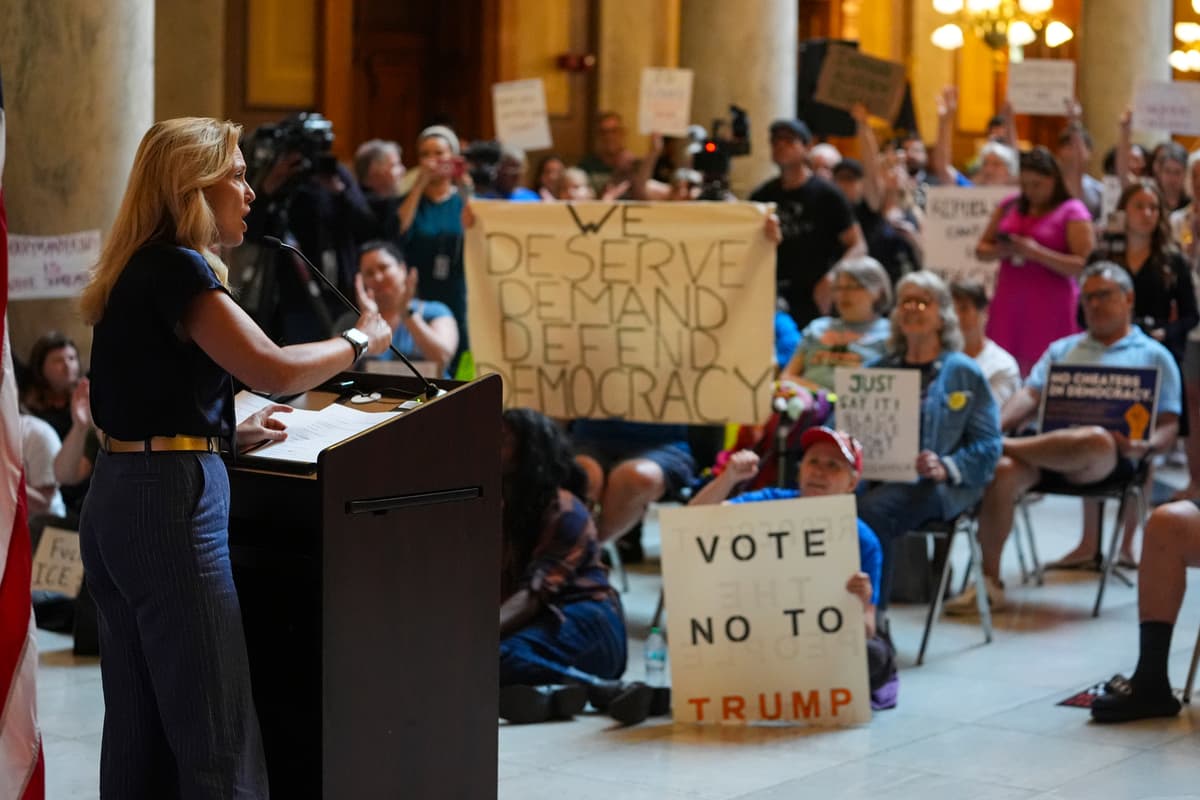
In what could be a pivotal moment for President Trump’s redistricting effort, Indiana state senators will vote Thursday to either adopt or reject a new congressional map eliminating two Democratic seats. Other blue states have threatened to retaliate if Indiana lawmakers approve the map.
Mr. Trump has been pressuring Indiana Republicans for months to gerrymander the state. That followed his push to redraw Texas’s map in order to likely flip five Democratic seats, and other Republicans’ attempts to pick off one or two Democrats in several other states.
“It was Trump’s Honor to win Indiana six times, including Primaries, in 2016, 2020, and 2024, and this new Map would give the incredible people of Indiana the opportunity to elect TWO additional Republicans in the 2026 Midterm Elections,” the president wrote in a Truth Social post on Saturday, pushing Republicans to redistrict.
“The Indiana Senate must now pass this Map, AS IS,” he continued, sharing the map passed by the state house of representatives. Mr. Trump specifically called out nine Republican senators who “need encouragement to make the right decision.”
In order to pass the new map, Republicans would need 25 of the senate’s 50 members. So far, only 16 GOP lawmakers have publicly stated that they will vote in favor of the gerrymander. All ten Democrats and 14 Republicans in the state senate are opposed to redistricting, meaning they are two votes away from defeating the maps.
Republican state senator Mike Crider, who is opposed to redistricting, says his concern is that eliminating two Democratic seats could actually dilute the power of rural Hoosiers to represent their communities. Of the two Democratic seats being eliminated, one is currently anchored at Indianapolis, though the new map would break the city into four different red districts.
“I think the maps are pretty alarming, actually,” Mr. Crider recently told Indiana Capital Chronicle. “I mean, I just think that if those maps pass, there’s a good possibility that three or four millionaires from Indianapolis will represent a third of the state, so I don’t know that that serves us well.”
Several members of the senate have been threatened during the course of the redistricting debate. Two Republican lawmakers, state senators Ron Alting and Jean Leising have received bomb threats at their homes. Several others have been victims of “swatting” attempts, which is where someone calls the police and directs them to a certain person’s home in order to intimidate them.
The final vote is expected to take place early Thursday afternoon.
If the new map does pass and become law, Democratic states say they are prepared to retaliate. To date, Republicans have only been able to pick up a handful of seats through redistricting across the country.
Texas Republicans hope that their five new GOP-friendly seats will hold, though with Hispanic voters swinging wildly back toward Democrats in special elections over the course of this year, Democrats may be able to hold on.
Two Democrats, Congressmen Henry Cuellar and Vicente Gonzalez, both represent south Texas, and have had their districts redrawn in order to have larger Latino populations. If Hispanics swing back in 2026, both men might be able to pull out wins, meaning Republicans will have only picked up three seats in Texas.
California Democrats, meanwhile, have secured five new seats for their party. None of those new five seats are expected to fall into Republican hands next year, based on voting trends and the historic overperformances that out-of-power parties have in midterms.
The only other places where Republicans have potentially picked up seats are in Missouri, where they have secured one additional seat; Ohio, where only one Democratic seat has moved to the right, but not by much; and North Carolina, where Republicans hope they can defeat Democratic Congressman Don Davis, though he has vowed to run for reelection what is now a seat that only slightly favors the GOP.
If Indiana moves forward, Illinois and Maryland have threatened to wash away any GOP gains. Governor Wes Moore of Maryland has already set up a redistricting commission to eliminate his state’s lone Republican seats in case the Indiana gerrymander goes through. Governor JB Pritzker in Illinois told reporters last month that he was watching what happens in Indiana before he makes a decision about whether or not to redraw his state’s maps.
Democrats in the Virginia legislature may be the boldest of all, promising to eliminate as many as four Republican seats in the state. That effort will have to be approved by voters in a statewide ballot initiative next spring, however.