Key Provision of Voting Rights Act Is at Stake in Impending Supreme Court Challenge
Some liberals worry that if the challenge is successful, Republicans will be able to flip more than two dozen House seats.
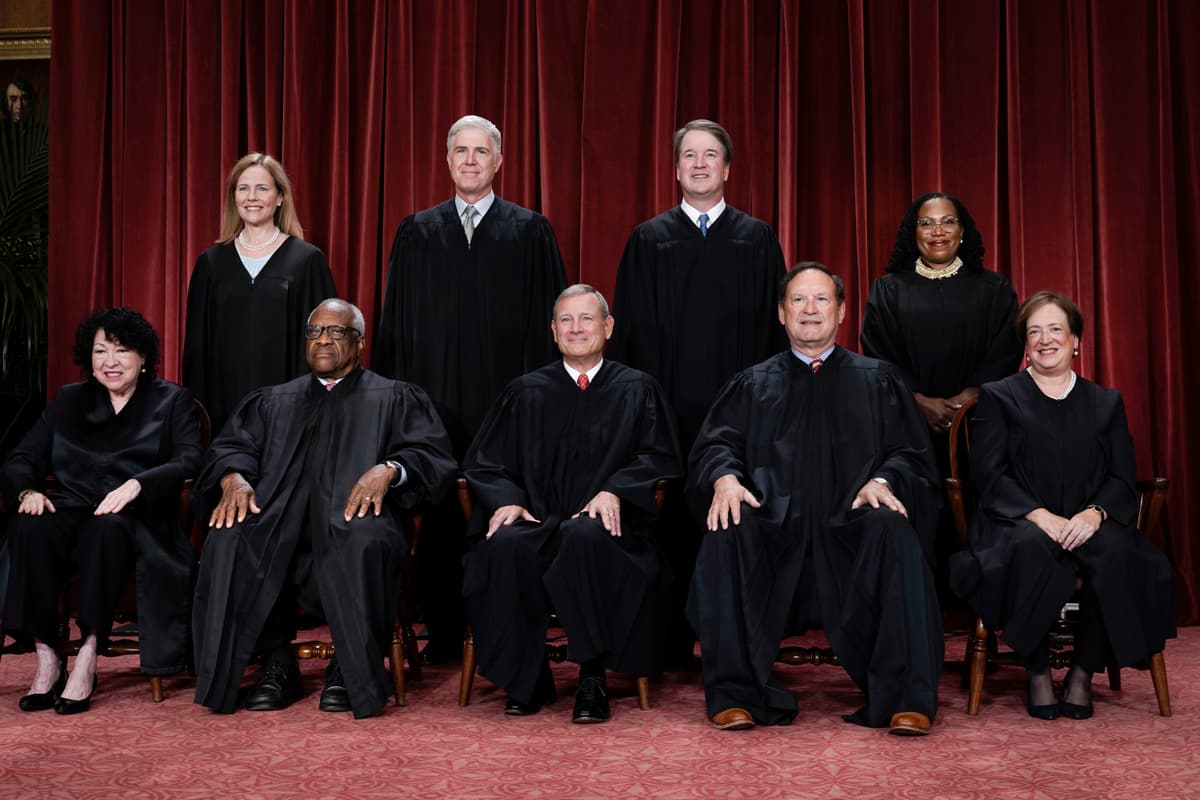

A constitutional challenge coming before the Supreme Court next week has Democrats and some voting rights groups on edge, saying that if successful, the challenge could hand Republicans control of the House of Representatives for a generation.
The Supreme Court will hear arguments Wednesday in Louisiana v. Callais, which calls into question Section 2 of the Voting Rights Act of 1965, which prohibits election practices that lead to a denial or abridgement of the right to vote based on race. The section has become the primary tool for addressing complaints of racial gerrymandering.
The high court first heard oral arguments in the case in March, but did not issue a ruling at the end of its 2024-2025 term.
The case, which has been full of twists and turns, began in 2022 when a group of black voters sued over a congressional map drawn by Louisiana the year before. They argued that the map violated Section 2 because only one of the state’s six congressional districts had a black majority, even though about a third of the state’s population is black.
A federal court agreed with the plaintiffs and ordered Louisiana to draw a new map that included a second majority-black district. That decision was upheld by the U.S. Court of Appeals for the 5th Circuit
Louisiana released its new map in 2024 with a second majority-black district. However, that prompted a new lawsuit from a group of “non-African American” voters who said the deliberate creation of a majority-black district amounted to unconstitutional racial gerrymandering in violation of the equal protection clause of the 14th Amendment.
A three-judge panel agreed that the map was an unconstitutional racial gerrymander.
In the oral arguments in March, Louisiana defended the map. Its lawyers acknowledged that the district court had ordered it to draw another majority-black district but maintained that the drafters had focused primarily not on race but on politics, deciding which Republicans in Congress to protect.
The U.S. Supreme Court has held that racial gerrymandering is unconstitutional, but that partisan gerrymandering based on politics is legal.
In another case last year, Alexander v. South Carolina State Conference of the NAACP, the justices said that to prove a case of racial gerrymandering, plaintiffs must show that race was the “predominant factor motivating the legislature’s decision to place a significant number of voters within or without a particular district.”
The “non-African American” plaintiffs in the current Louisiana case disputed the state’s argument that politics was the primary factor in drawing the new map, arguing that the state’s compliance with Section 2 and the court order showed that race was the main factor.
While the arguments were heard in March, the high court did not issue a ruling and instead scheduled a new round of arguments for next week. In August, the court directed both sides to file briefs in response to the question of whether “the State’s intentional creation of a second majority-minority district violates” the 14th Amendment or the 15th Amendment.
Louisiana has switched its position ahead of the arguments and is no longer defending the 2024 map. Lawyers for the state now say that race-based redistricting is unconstitutional, even if it is done to remedy discrimination in compliance with Section 2.
“The Equal Protection Clause commands that the government ‘may never use race as a stereotype or negative,’” the state said in a brief filed in August.
“Yet race-based redistricting rests on an invidious stereotype: that all minorities, by virtue of their membership in their racial class, think alike and share the same interests and voting preferences. And it uses race as a negative in this zero-sum context by advantaging some racial groups at the expense of others.”
The “non-African American” plaintiffs said in a brief that Section 2 is “inconsistent with the letter and spirit of the Constitution.”
The black voters who are defending the 2024 map say that Section 2 does not violate the Constitution and is the “crown jewel of civil rights legislation.” They say the Voting Rights Act “authorizes some consideration of race” when it comes to redistricting, provided that “doing so is required to remedy identified racial discrimination.”
The case has sparked strong warnings from left-wing groups who say that striking down the 2024 map could give Republicans a chance to pick up more than two dozen House seats for years to come.
Fair Fight Action and Black Voters Matter said in a report this week, “Combined with Republicans’ mid-decade gerrymandering, a ruling gutting Section 2 could help secure an additional 27 safe Republican U.S. House seats, at least 19 directly tied to the loss of Section 2.”
“It’s enough to cement one-party control of the U.S. House for at least a generation,” the report said.
Specifically, it said that Republican lawmakers could redraw the maps so that roughly 30 percent of the Congressional Black Caucus and 11 percent of the Congressional Hispanic Caucus lose their seats.
While left-wing groups are warning of rampant racial gerrymandering, conservatives argue that race-based redistricting violates the Constitution. They have also asked whether the law is necessary, as access to the ballot box for minority voters has greatly increased since the Voting Rights Act was signed into law.
It is not clear why the Supreme Court chose to hear new arguments rather than issue a ruling last term. However, Louisiana’s secretary of state, Nancy Landry, has asked the Supreme Court to issue a ruling in “December or early January,” ahead of the state’s April 2026 primary elections.