
Kishida Due To Address Congress Thursday as America, Japan on Biggest Expansion of Mutual Defense Relationship in 70 Years
Prime minister is meeting President Biden on the first state visit since Shinzo Abe, now gone, alas, came to Washington nine years ago.
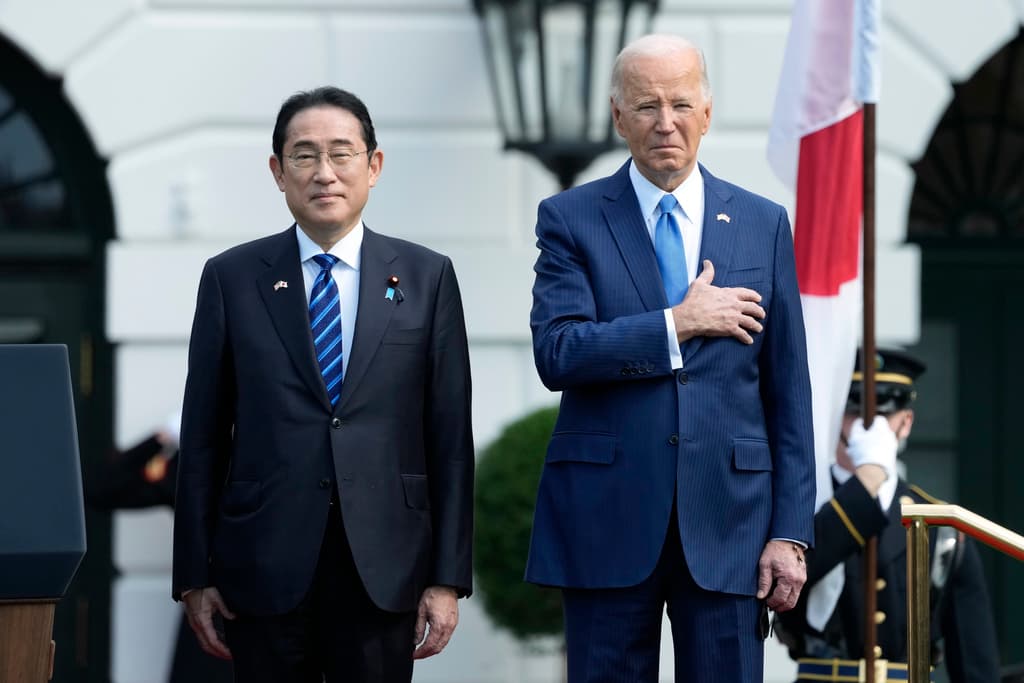
Prime Minister Kishida will address Congress Thursday as Japan and America are buttressing security against China in perhaps the sharpest escalation of their mutual defense relationship in more than 70 years.
Mr. Kishida, meeting President Biden on the first state visit by a Japanese leader since that of the late Shinzo Abe nine years ago, is counting on an agreement whereby Japanese companies can repair American warships, notably those of the Seventh Fleet headquartered at the sprawling American navy base at Yokosuka on the entrance to Tokyo Bay.
That agreement, on top of pledges of still closer cooperation between the two allies, bound by a security treaty dating to 1960, caps off a year in which Mr. Kishida has doubled the percentage of Japanâs gross domestic product for defense spending to 2 percent.
He also is committed to increasing missions by sea and air for Japanâs âself-defenseâ â the rationale for getting around Japanâs constitutional ban against sending troops overseas.
Mr. Kishida has âupended policies that have been around for 70 years,â Washingtonâs envoy to Tokyo, Rahm Emanuel, tells Nikkei Asia, an offshoot of Japanâs financial daily, Nihon Keizai Shimbun. Indeed, he said, the âpast two years have been, for Japan, probably the most momentous two years since World War II.â
Mr. Kishida calls America and Japan âglobal partners in maintaining and strengthening the rules-based, free and open international order.â Not least among the shifts to which he is agreeing is production of arms for export, also forbidden until recently.
Under the watchful eye of a newly formed joint Council on Industrial Defense Policy, Japan could soon be co-producing Patriot-3 missiles and other weapons, too. Japan has already agreed to import 400 American-made Tomahawk missiles. Thatâs in addition to a new joint command center opening next year.
Mr. Kishida will promote the American-Japanese defense relationship Thursday on Capitol Hill, where he will explain why the allies need one another more than ever in the face of Chinaâs aggressive pursuit of regional domination and amid persistent threats from North Korea, now providing arms for Russia.
On the same day, heâs to see the Philippine president, Ferdinand âBongbongâ Marcos Jr., in a display of trilateral unity hosted by Mr. Biden.
American officials are casting Mr. Kishidaâs meeting with Mr. Marcos as evidence of a de facto alliance against Chinese claims to the entire South China Sea, including small islands and shoals that belong to the Philippines.
Mr. Kishida isnât pledging to go to war against China, but heâs enthusiastic about joint naval operations with the Americans while the Chinese bully Philippine fishing boats with blasts from water cannon and deliberate collisions.
Japanese, American, and Australian warships plied the South China Sea on Sunday along with Philippine vessels in a show of force and solidarity. The message to the Chinese was clear: The Philippines may be weak militarily but has strong friends.
One sticking point in the warming ties between Tokyo and Washington, though, could be Mr. Bidenâs opposition to a deal for Nippon Steel to take over U.S. Steel, a goliath that many Americans donât want to see fall into foreign hands.
Mr. Kishida maintained that the steel deal would not be on the agenda, though, and Mr. Emanuel downplayed the mergerâs significance.
In a parley with Japanâs ambassador at the Center for Strategic and International Studies, he pronounced relations with Japan âa lot deeper and stronger and more significant than a single commercial deal.â